
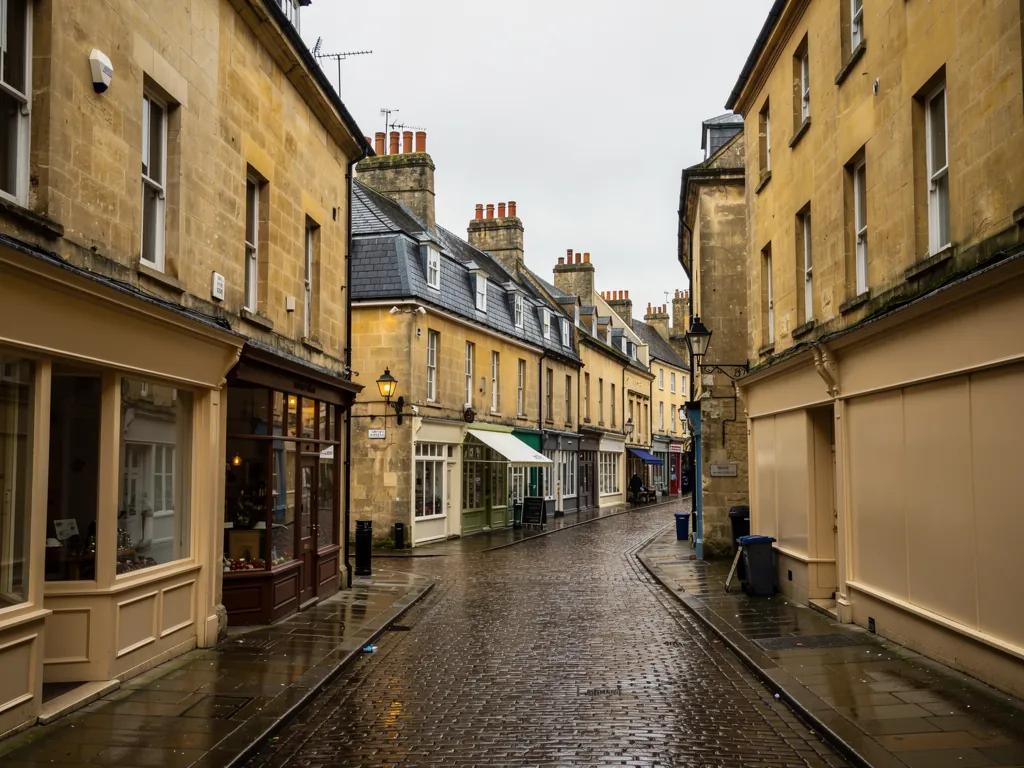
Bath has a great many independent restaurants, cafes and pubs, and they open, close and change hands all the time. Rather than list them, this guide sticks to places and foods with a documented history that a visitor can still find today. It does not rate or rank any business, and it leaves out menus, prices and opening details, which change often. Check those directly before you go, and book ahead for weekend afternoons, when the centre is at its busiest. Each section names the source we checked.
The Pump Room
The Grand Pump Room stands beside the Roman Baths and Bath Abbey. Thomas Baldwin began it, John Palmer continued it after Baldwin was dismissed, and it was built between 1789 and 1799. It is listed at Grade I (source: Wikipedia, 'Pump Room, Bath').
The room now houses a restaurant where afternoon tea can be taken, with live music from the Pump Room Trio and visiting pianists. Next to the main street entrance to the Roman Baths, visitors can drink water from the warm spring that feeds the baths. Jane Austen knew the room well and used it as a setting in both Northanger Abbey and Persuasion, and Charles Dickens mentions it in The Pickwick Papers. For a Georgian visitor, taking the waters here was the point of coming to Bath at all.
Sally Lunn's and the Sally Lunn bun
A Sally Lunn is a large, light bun made from a yeast dough enriched with cream and eggs, rather like a French brioche. It was first recorded in Bath in 1780, when Philip Thicknesse's guidebook described visitors eating Sally Lunns after drinking the Bath water (source: Wikipedia, 'Sally Lunn bun').
The bun is served at Sally Lunn's Eating House, 4 North Parade Passage, a lane once called Lilliput Alley. The house itself is old: the carpenter George Parker built it after leasing the site in 1622, and the lowest floor goes back to the rebuilding of the abbey after a fire in 1137, with a masonry oven in the basement from that period. The building is listed at Grade II*. The house tells the story of a Huguenot refugee called Solange Luyon who brought the recipe to Bath in the 1680s. Wikipedia notes there is no evidence for that legend, and one suggested origin for the name is the French soleil et lune, sun and moon, for the golden crust and pale crumb.
The Bath bun and the Bath Oliver
The Bath bun is a different thing: a sweet roll from a milk-based yeast dough, finished with crushed sugar after baking, sometimes with currants or candied peel. References date from 1763. Jane Austen wrote in an 1801 letter about "disordering my stomach with Bath Bunns". The original eighteenth-century recipe used a rich egg and butter dough topped with sugar-coated caraway seeds (source: Wikipedia, 'Bath bun').
The bun's invention is credited to Dr William Oliver, a Bath physician, and so is its plainer cousin. Oliver is said to have created the Bath Oliver, a hard, dry biscuit of flour, butter, yeast and milk, around 1750, because the buns were too rich for his patients. When he died in 1764 he left the recipe to his coachman, Mr Atkins, together with £100 and ten sacks of wheat flour, and Atkins set up in business baking it (source: Wikipedia, 'Bath Oliver'). It is often eaten with cheese.
The Guildhall Market
The Guildhall on the High Street is Thomas Baldwin's Bath stone building of 1775 to 1778, extended by John McKean Brydon in 1893 and listed at Grade I. Behind it, the Guildhall Market has traded on the same site for around 800 years, and today has about 20 stallholders under one roof. A market house stood on the High Street marketplace as early as 1552 (source: Wikipedia, 'Guildhall, Bath').
It is a covered, everyday market rather than a showpiece, which is part of its appeal. Inside you will find food stalls alongside books, household goods and repairs. It is a sensible place to stop for a cup of tea on a wet afternoon, and the passage through it links the High Street with Grand Parade by the river.
Green Park Station
On the western side of the centre, Green Park Station is a former railway terminus that now houses a market, small shops and places to eat. It opened on 7 May 1870 as the end of the Midland Railway's branch from Mangotsfield, and the Somerset and Dorset line also used it from 1874. Passenger trains stopped on 7 March 1966. The station buildings were designed by John Holloway Sanders and are Grade II listed. Today the site is a covered market and events space, with a farmers' market under the old train shed, and a restaurant in the former booking hall (source: Wikipedia, 'Bath Green Park railway station').
The iron and glass roof over the old platforms is the thing to look at. It is a reminder of how much daylight a Victorian railway shed could bring into a covered space.
Pulteney Bridge and the riverside
Pulteney Bridge carries small shops across its full span on both sides, one of only four bridges in the world built that way; the others are the Ponte Vecchio in Florence, the Rialto in Venice and the Krämerbrücke in Erfurt. Robert Adam designed it and it was finished by 1774. It is Grade I listed (source: Wikipedia, 'Pulteney Bridge').
The bridge's shops are tiny, and some of them serve food and drink. Below it, the curved weir was built between 1968 and 1972 as part of a flood prevention scheme. The riverside paths and Parade Gardens nearby give a good place to sit with a takeaway coffee and watch the water.
Practical points for eating out
- Book ahead in busy months. Bath draws large numbers of visitors at weekends, in the summer holidays and around the Christmas market, and the smaller historic rooms fill quickly.
- Ask about access. Many cafes occupy old buildings with steps at the door, narrow stairs and toilets on another floor. If you need step-free access, ask before you arrive.
- Look beyond the centre. Walcot Street, Widcombe across the river, and the high streets in Larkhall and Oldfield Park have their own cafes and pubs, away from the main visitor streets.
- Check the details yourself. Menus, prices and opening times change, so use each business's own website for current information.
Under the roof
Almost every place in this guide sits under a historic roof: Welsh slate pitches, lead parapet gutters behind stone balustrades, and Victorian glazing at Green Park. Keeping them watertight is careful, specialist work. Empire Roofing Bath repairs and replaces roofs for homes and businesses across the city and the towns around it, matching the original materials where we can. To find out how we work, see our roofers in Bath page.