
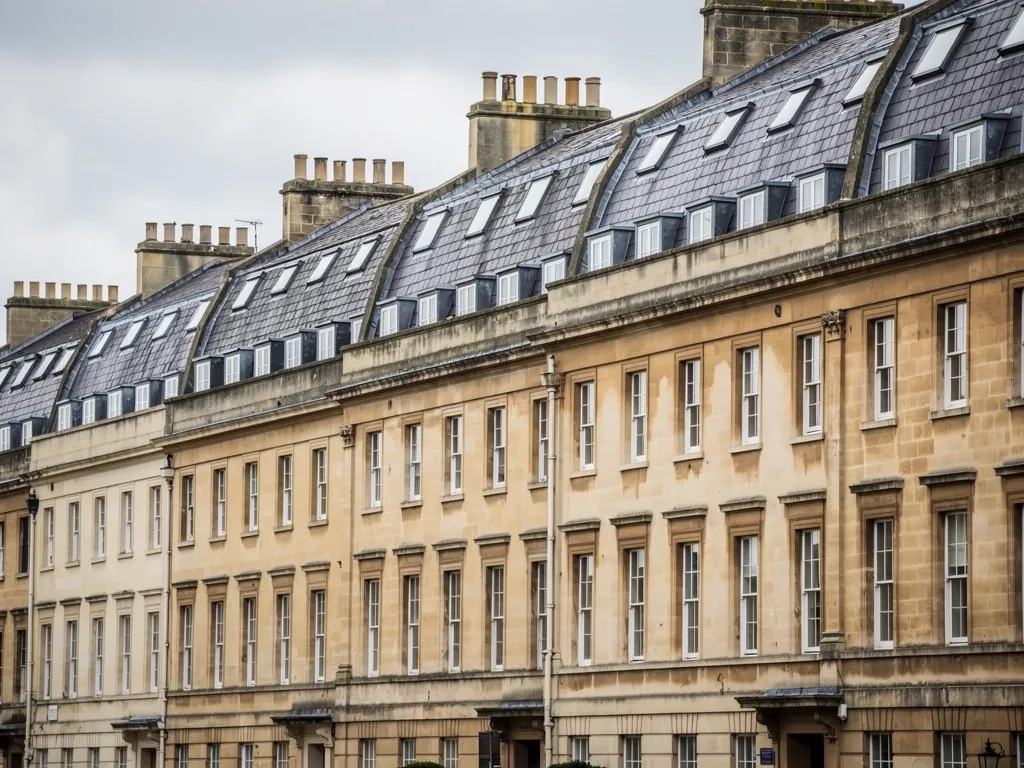
Georgian Bath was a magnet for people with money, talent or ambition, and the city still carries their traces in plaques, museums and street names. The list below is a selection, not a ranking. It separates people who were born in Bath from those who lived and worked here, because the two are often confused. Every fact has been checked against the Wikipedia article named in brackets, and the dates come from those articles.
Born in Bath
Arnold Ridley
The actor and playwright Arnold Ridley was born in Walcot, Bath, on 7 January 1896 and went to school in the city. He wrote the play The Ghost Train, but most people know him as Private Godfrey in the BBC sitcom Dad's Army. He was president of Bath Rugby from 1950 to 1952, and his ashes were buried in his parents' grave at Bath Abbey Cemetery (source: Wikipedia, 'Arnold Ridley').
Mary Berry
The cookery writer and broadcaster Mary Berry was born in Bath on 24 March 1935. She went to Bath High School and studied catering at Bath College of Domestic Science. Her father, Alleyne Berry, was Mayor of Bath in 1952 and was closely involved in founding the University of Bath. She was a judge on The Great British Bake Off from 2010 to 2016 and received the Freedom of the City of Bath on 7 June 2014 (source: Wikipedia, 'Mary Berry').
Jacqueline Wilson
The children's author Jacqueline Wilson was born in Bath on 17 December 1945. The Story of Tracy Beaker (1991) made her name, and she was Children's Laureate from 2005 to 2007 (source: Wikipedia, 'Jacqueline Wilson').
The people who made Georgian Bath
Beau Nash
Richard "Beau" Nash was born in Swansea in 1674 and became Bath's Master of Ceremonies in 1704, holding the role until he died in 1761. He set the tone of the city's social life: he regulated gambling, ran the balls and their musicians, and decided who was fit to join the fashionable company. He lived in a house on Saw Close, at what is now the main entrance to the Theatre Royal, and he is buried in the nave of Bath Abbey (source: Wikipedia, 'Beau Nash').
Ralph Allen
Ralph Allen was born around 1693 at St Columb Major in Cornwall and came to Bath in 1710, becoming its postmaster at 19. He reformed the cross and bye posts across the South West, bought the stone mines on Combe Down and Bathampton Down, and promoted the honey-coloured Bath stone the Georgian city is built from. He was elected Mayor of Bath in 1742 and built Prior Park on the hill above the city. Henry Fielding based Squire Allworthy in Tom Jones on him. His town house, in what is now North Parade Passage, is known as Ralph Allen's Town House (source: Wikipedia, 'Ralph Allen').
John Palmer
John Palmer (1742 to 1818), son of a Bath brewer and theatre owner, ran the Theatre Royal in Orchard Street, the first theatre outside London to hold that title, granted by royal patent in 1768. His coach service between his Bath and Bristol theatres led him to the mail coach: on 2 August 1784 a coach he funded ran from Bristol to London in about 16 hours, against up to 38 by the old post. He later sat as MP for Bath and is buried in Bath Abbey (source: Wikipedia, 'John Palmer (postal innovator)').
Writers
Jane Austen
In December 1800 Jane Austen's father announced that he would retire and move the family to 4 Sydney Place in Bath, close to Sydney Gardens. She was not happy to leave Hampshire, and her writing slowed during the Bath years, though she revised the novel that became Northanger Abbey. Her father died in January 1805 and the family moved to Southampton in 1806 (source: Wikipedia, 'Jane Austen'). Bath still runs through her fiction: the Pump Room is a setting in both Northanger Abbey and Persuasion (source: Wikipedia, 'Pump Room, Bath').
Charles Dickens and Mary Shelley
Charles Dickens set much of The Pickwick Papers in Bath, and Mary Shelley, the author of Frankenstein, also appears on the city's list of notable people (source: Wikipedia, 'List of people from Bath').
Science and invention
William and Caroline Herschel
William Herschel was born in Hanover in 1738 and came to Bath as a musician. He became organist of the Octagon Chapel in 1766 and later directed the Bath orchestra. His sister Caroline joined him in Bath in 1772 and became his assistant. Herschel built telescopes in the house at 19 New King Street, and it was there, on 13 March 1781, that he first observed the planet Uranus. Brother and sister left for Datchet in 1782. The house is now the Herschel Museum of Astronomy (source: Wikipedia, 'William Herschel'). Caroline went on to discover several comets.
Isaac Pitman
Isaac Pitman, born in Trowbridge in 1813, published his shorthand system in 1837 and moved to Bath in 1839, where he opened a small school. He lived in the city for the rest of his life and died in Bath on 22 January 1897 (source: Wikipedia, 'Isaac Pitman').
Artists
The portrait and landscape painter Thomas Gainsborough was born in Sudbury, Suffolk, in 1727 and moved to Bath with his family in 1759. He lived at 17 The Circus, painting the visitors who came to take the waters, and moved to London in 1774 (source: Wikipedia, 'Thomas Gainsborough'). The actress Sarah Siddons appears on the city's list of notable people, as do the novelists Henry Fielding and Tobias Smollett (source: Wikipedia, 'List of people from Bath').
Exiles and visitors
Bath has sheltered more than one exiled ruler. Haile Selassie, Emperor of Ethiopia, lived at Fairfield House, a Victorian house he bought in the city, from 1936 to 1941 while Italy occupied his country. He began writing his autobiography during his exile in England. After returning to Ethiopia he gave the house to the city of Bath as a home for elderly people, and in 2019 his grandson unveiled a blue plaque on it (source: Wikipedia, 'Haile Selassie'). Before he became King of France, Louis XVIII also spent part of his exile in Bath (source: Wikipedia, 'List of people from Bath').
Most of the houses named in this guide are private, so look from the street unless a museum is open.
The roofs they lived under
From the Circus to New King Street, the houses these people lived in are listed Georgian buildings, and their roofs need the same care today as when they were built. Empire Roofing Bath repairs and replaces roofs across the city and the towns around it, matching slate, stone and lead to what is already there. To see how we work, visit our roofers in Bath page.