The short answer
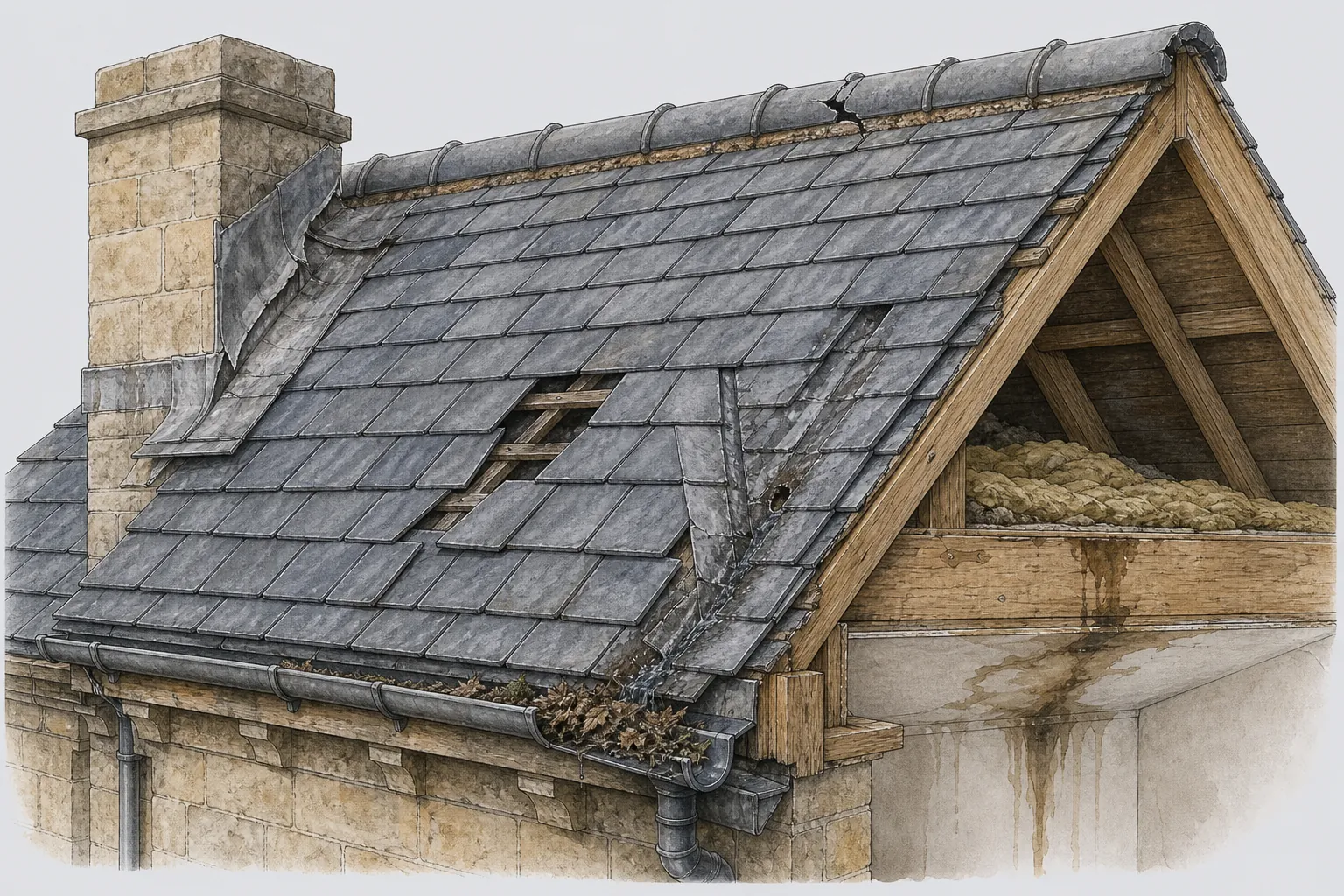
Look first for paperwork: building control records, a past guarantee, a survey from when you bought, or planning history held by B&NES. Then read the roof. The covering type, the underlay in the loft, the nails, the way the ridge is fixed and the state of the lead each hint at an age band. None is exact, but several clues agreeing give a fair estimate.
Paperwork that can date the roof
The quickest answer is often in a drawer. If the roof was replaced in recent years, there may be an invoice, a written guarantee or a completion certificate. A re-roof that needed Building Regulations approval leaves a record with building control, whether B&NES or a registered building control approver. Ask whoever did the job for copies.
When you bought the house, your solicitor's file and any survey report may have mentioned the roof. Surveyors often note covering and condition even when they cannot give a date. Estate agent particulars from the sale, especially older ones, sometimes say that the roof was renewed and when.
For listed buildings and houses in a conservation area, the planning history can be searched on the council's website. Applications for dormers, extensions or roof alterations carry dates, drawings and sometimes descriptions of the existing roof. Neighbours are another source. In a terrace, roofs were often renewed around the same time, so a neighbour's records may apply to yours.
If nothing turns up, move on to the roof itself. The evidence there is physical, and it is surprisingly consistent.
What the covering tells you
Material is the broadest clue. Natural slate on a Georgian or Victorian house can be well over a century old, because good slate outlives the parts holding it, and MyBuilder reports a typical life of more than a hundred years for Welsh slate. A slate roof is therefore often a roof of two ages: old slate on newer battens and nails.
Fibre-cement slate and concrete interlocking tiles belong to later building. MyBuilder gives both a typical life of around 30 to 50 years, so a sound-looking roof in either with faded colour and surface wear is likely to be middle-aged at least. Clay plain tiles have a wide range, with 40 to 60 years often quoted though peg-tiled roofs can last far longer.
Look at the surface. Hand-made clay tiles and stone slates vary in shape and thickness, while machine-made ones are uniform. Colour fade in concrete tiles, a chalky surface on fibre cement and lichen on old stone all show weathering. Mix is informative too: patches of newer slate among old ones are repairs, not a re-roof, and show how often the roof has been dealt with.
Clues in the loft
Go up with a torch, because the loft shows a roof's real age. Start with the underlay, the layer beneath the battens that catches wind-blown rain. Old bitumen felt is dark, stiff and often cracked, with brown stains. Modern breathable membrane is lighter, plastic-like and usually printed with a manufacturer's name. No underlay at all, with daylight and pointing on the back of the slates, suggests a roof laid before felt was common.
Next, the timbers. Hand-sawn, irregular rafters with pit-saw marks or wooden pegs belong to an older frame. Machine-cut softwood of uniform section points to later work. Battens that are dark, soft or flaking at the nail points show age and damp. Check for fresh timber among old, which shows where repairs happened.
Finally, look for dated clues: names, pencilled dates or chalk marks on rafters, old newspapers used as stuffing, and the age of any wiring or water tanks. These are casual, but a dated scrap of paper can fix a repair to within a few years.
Nails, ridge and lead
Small parts date a roof well. On a slate roof, iron or poorly galvanised nails have a much shorter life than the slate, and rust streaks, slipped slates and the problem roofers call nail sickness mean the fixings are near the end. Copper or stainless nails show a later refix.
The ridge is another marker. BS 5534:2014 expects mechanical fixings on ridge, hip and verge tiles, with bedding mortar no longer trusted alone. A ridge bedded only in mortar, often cracked and crumbling, is probably older than a ridge with clips, screws or a dry-fix system. Dry-fix is a ridge fixed with mechanical clips, with no wet mortar.
Lead tells its own story. Flashing and valley lead that is thick, silvery-grey and patinated is older and in good order. Lead that is cracked at folds, lifted at the edges or patched with sealant is tired. Newer lead is brighter and often marked with its code. Sealant smeared along a junction, instead of lead properly dressed, is a sign of repeated quick fixes.
From age to remaining life
Age matters less than condition. A century-old slate roof with new fixings can outlast a thirty-year-old concrete roof with failing underlay. Treat any figure for a lifespan as a typical range that depends on exposure, workmanship and maintenance, never as a promise.
What you want to know is whether the roof should be repaired or replaced, and for that the age of the covering, the fixings and the underlay each count separately. One tired part does not condemn the rest. Where repair works, repair is what we recommend. The free survey comes with photographs taken on your roof, so the evidence is in front of you.
Cold callers sometimes use age as a lever, telling you that a roof is past it. Our answer on doorstep roofers explains how to respond. Roof types differ across the city, and roof types in Bath helps you recognise yours. VAT can affect any repair or replacement budget, covered in VAT on roof repairs. To arrange a survey, go to the home page or call 01225 285181.