

A Wiltshire market town street with stone and brick houses and clay tile roofs

Roofers in Trowbridge

Trowbridge is the county town of Wiltshire, 10.3 road miles south-east of Bath, and one survey day here can take in a Victorian terrace in Newtown, a Grade I frontage on Fore Street, a converted brewery and an estate laid over old meadow. Each wants a different eye, and each gets a roof repaired in the way it was first built.

Local roofs

A cloth town with roofs from every era

In 1820 Trowbridge had more than twenty woollen cloth factories and was nicknamed the Manchester of the West. The Handle House, which straddles the River Biss and was once used to dry and store teazles, is one of the few buildings of its kind still known in the United Kingdom, and a reminder that the town's trade left physical marks.

The housing tells a second story. Between 1951 and 2011 the population grew by 133%, as arable fields and some riverside meadows were turned over to residential estates. A roofer walking the streets therefore meets a very wide age range in a short distance: Victorian terraces inside the Newtown conservation area, post-war semis on the estates, and new flats such as the town centre scheme Newland Homes built on the former Usher's brewery site, where the old frontage of the brewery was kept.

These roofs do not fail in the same way. The old terrace gives trouble where its lead meets masonry, the estate house shows its age along the ridge, verge and eaves, and the flats come down to flat roofs, upstands and shared access. Before we put a figure on anything, we work out which of these you are dealing with and write it down with photographs of your own roof.

Council
Wiltshire Council
From central Bath
10.3 road miles, south-east
Conservation area
Newtown, mostly Victorian houses
Grade I listed
Six, including St James's Church and Lovemead House
Population growth
133% between 1951 and 2011

What we find

Party wall lead, estate ridges and conversion upstands

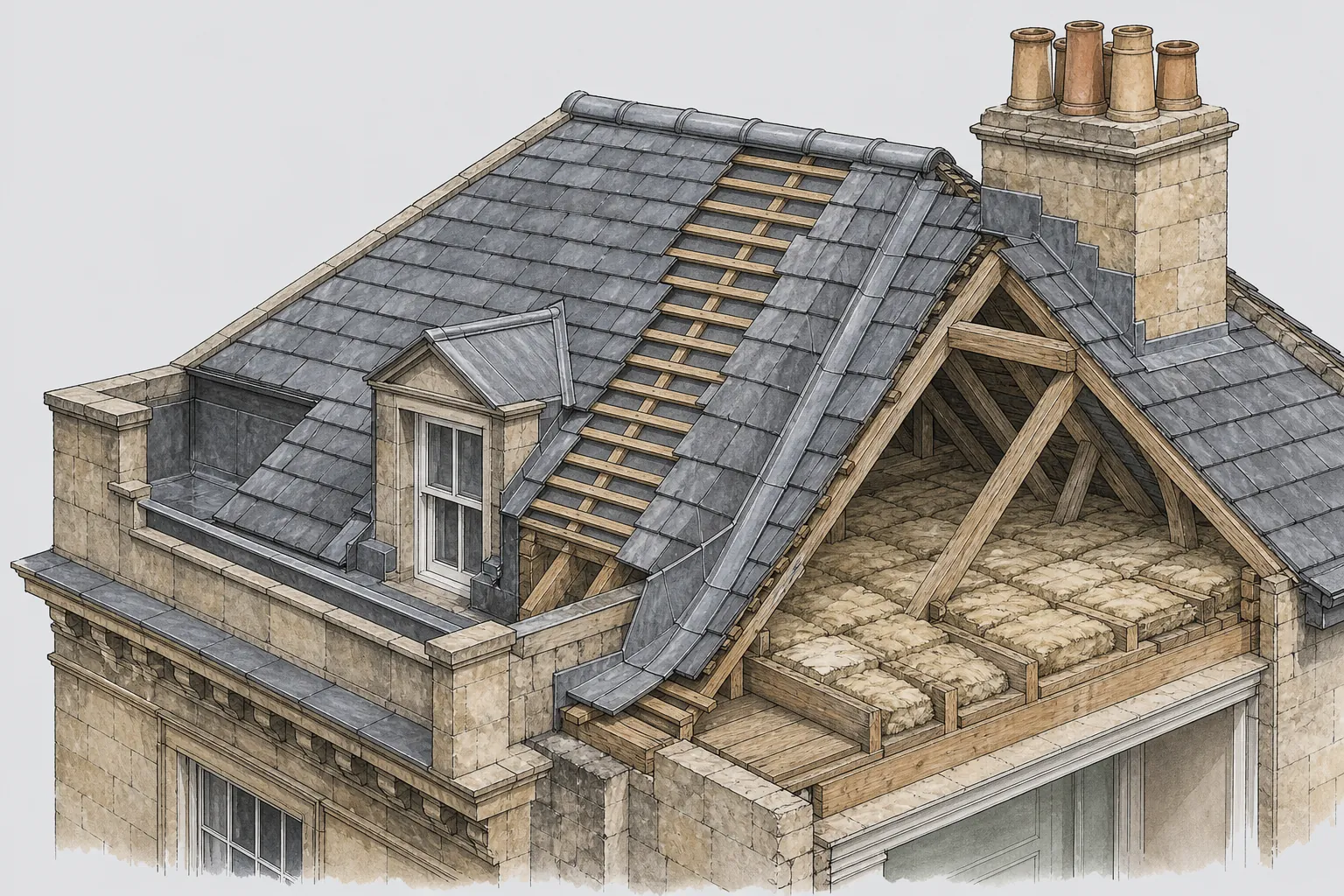
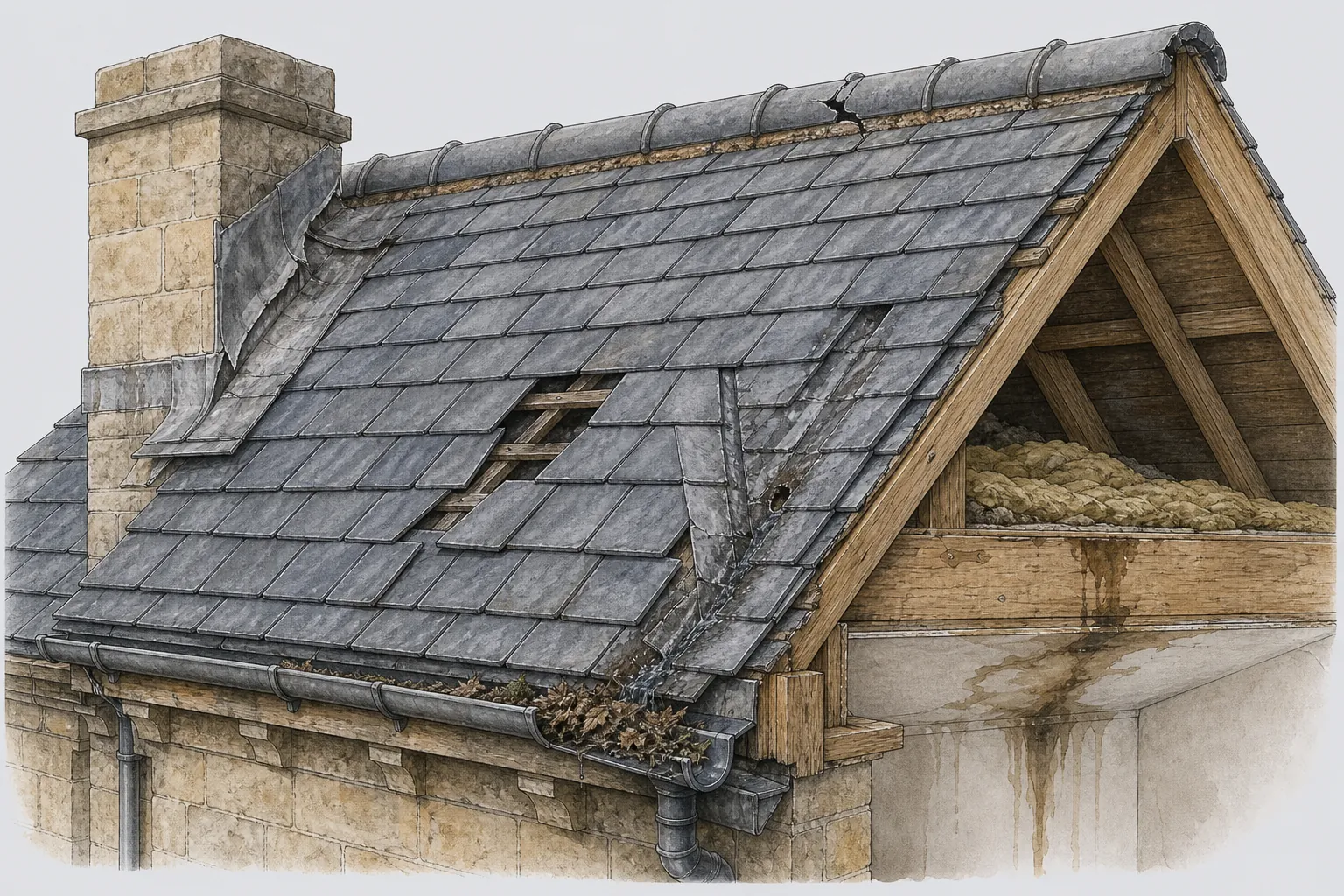
Tired lead beside party wallsOn a terrace the dividing wall stands proud of the slope, and the line where wall meets covering is where water gets in. We study the lead flashing, the mortar fillet under it and the small lead strips woven between the courses beside the wall before we look at anything else.
Cracked ridges and open verges on estate housesRoofs laid over the old fields tend to fail at their outer lines first. Bedded ridge tiles split, verge mortar crumbles, and the wind finds the gap. We check how each is held, and whether anything beyond mortar was ever used.
Ponding and weak upstands on converted buildingsFlats and converted industrial buildings nearly always have a flat or shallow section somewhere. A puddle still sitting there a day after rain tells us more than the surface does, so we look at the membrane, the outlets and the turn-up where it meets a wall.

Newtown and the Victorian terraces

A protected zone of Victorian houses wants a repair that reads as the original.

Trowbridge has a conservation area called Newtown, a protected zone of mostly Victorian houses. Living inside one does not stop a roof being repaired. The rule exists because the council keeps an eye on how a street looks, and a roof seen from the pavement is part of that appearance. A patch that shifts the colour, the size or the texture of the covering will be noticed by the neighbours long before the council hears of it.

A Victorian roof is a covering on sawn softwood timbers, with lead wherever it meets chimneys and walls. The slate or tile can outlive the timber and the nails beneath it. When a slate drops, the cause is generally the fixing rather than the slate itself, so a sound repair deals with the fixing. We lift the courses around the gap, inspect the battens (the thin timber rails each slate is nailed to) and the nail holes, then tell you whether the trouble is three or four slates or a roof whose fixings have all run their course.

Matching is the whole point. A slate roof is mended with slate of a similar size and shade, reclaimed where new would look too sharp beside weathered neighbours. A clay-tiled roof gets clay tiles from the same family. Man-made substitutes weather differently, and in a run of original roofs they show up like a patch of new paint on an old door.

Whether Building Regulations apply depends on the scale of the work, not on the street. Replacing a small share of a roof is treated differently from stripping the lot, and bigger jobs can bring a thermal upgrade with them. If you want to know what Newtown's designation means for your own house, Wiltshire Council's planning team can answer, and we will give you a precise description of the repair to take to them. For slate and tile in general, see pitched roofing.

Fore Street, St James's and listed roofs

Six Grade I buildings in one town means the consent question arises more often than you might expect.

Trowbridge has six Grade I listed buildings: St James's Church, Lovemead House on Roundstone Street, and numbers 46, 64, 68 and 70 Fore Street. Grade I is the highest grade, and the town has others at lower grades too, so anyone living or trading near the centre should first find out whether their own building is on the list. Historic England's online National Heritage List will answer that in a minute.

If it is, the roof is within the listing, and consent for changes comes from Wiltshire Council under a separate system from ordinary planning permission. Skipping that step risks a criminal charge, so ask the council before anything bigger than a small repair in the materials already there. We cannot rule on a particular building, but we can state exactly what a repair involves: the slate, the lead and the mortar to be used, and anything that would look different afterwards.

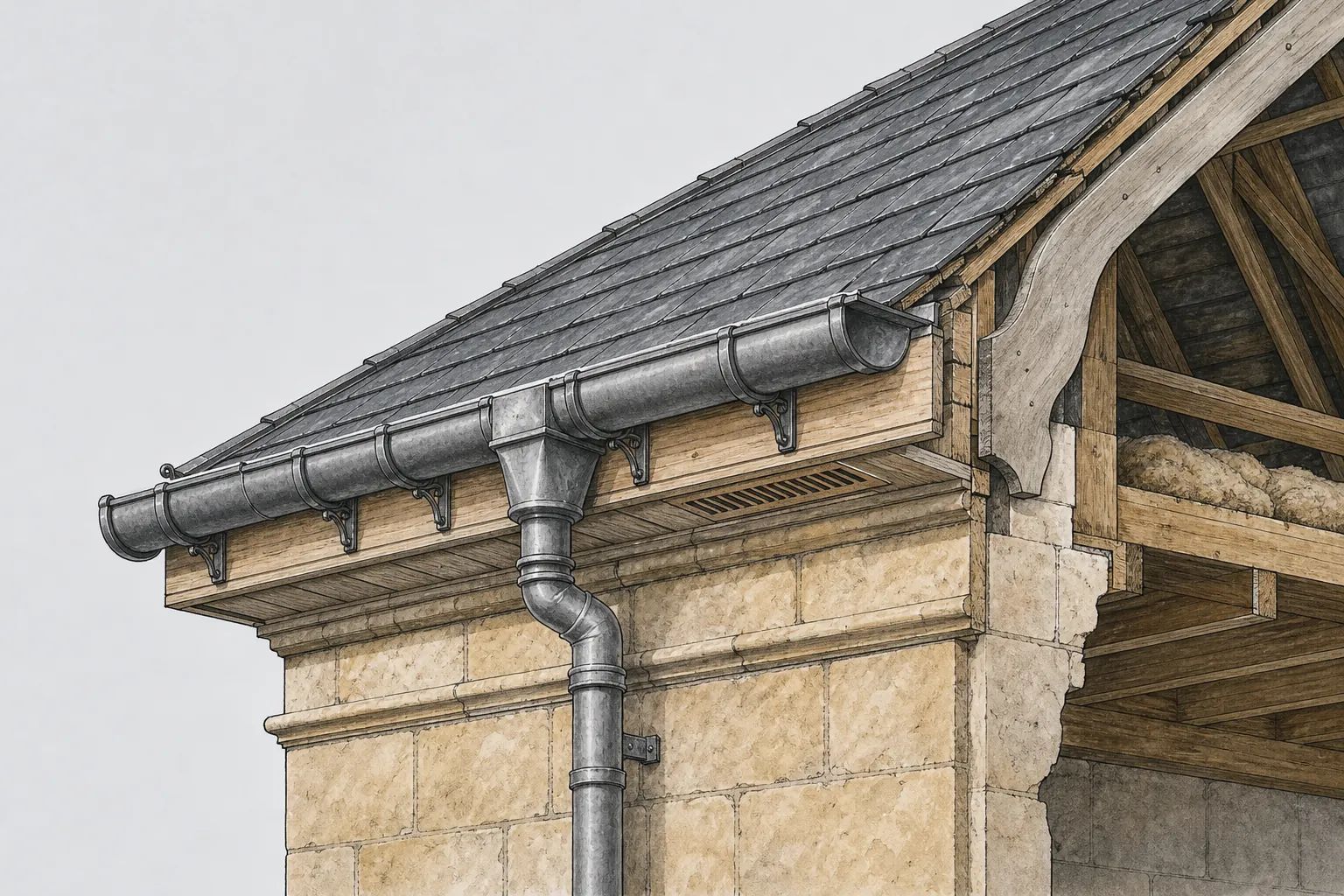
On old stone and brick buildings, the covering is rarely the real story. Where a low wall stands along the eaves there may be a parapet gutter, which is a lead channel that gathers a surprising quantity of rainwater and carries it out of sight to a downpipe. A box gutter does similar work between two slopes. When the lead in either splits at a lap or a drip, a stain low on an inside wall may be the only clue, appearing long after the leak began.

Lead is where listed work often hinges. It is shaped by hand to fit the roof, and how long it lasts depends on the detailing, the fixings and the soundness of the timber under it. Our lead roofing page explains what is involved, and where consent has to come first we say that before any fixed figure is offered.

6

Grade I listed buildings in Trowbridge

1820

Year the town had over 20 woollen cloth factories

133%

Population growth in the town from 1951 to 2011

Figures: Trowbridge entry, Wikipedia, checked October 2026

Mill and brewery conversions

Redeveloped industrial sites put flat roofs, shared access and several owners into one conversation.

The cloth and brewing trades left large buildings behind, and some have found second lives. Clark's Mill now holds offices, Salter's Home Mill houses the town museum, and the former Usher's brewery site now has town centre flats by Newland Homes, built to incorporate the frontage of the Usher's building. Roofs on converted sites differ from a house roof because they are shared, often flat or shallow, and joined to an older structure with its own history.

A flat roof has no spare margin for standing water. A fall that has settled (the slight slope that drains it), an outlet half clogged with leaves, or a membrane peeling at an upstand will show as a stain or a drip below within a season. We survey the whole roof rather than the visible leak, since the point where water enters is seldom the point where it appears. Our flat roofing page covers the main finishes: EPDM, a single synthetic rubber sheet; GRP, a skin of resin and glass fibre set down on site; and lead.

On a shared roof the difficulty is often people rather than materials. A managing agent needs a defined scope, a written fixed price and a short description of the job so that leaseholders can be told. We write our findings so they can be circulated, with photographs, and we mark every joint between new covering and old fabric, because that junction is where replacement membranes most often let go.

Commercial units and offices around the centre follow the same reasoning. A roof on such a building is priced on survey, because system, insulation, access and edge details each change what the job involves. Anything involving a listed frontage also needs the consent question closed before a fixed sum can be quoted.

Repair or replace

A flat roof that holds water and has opened at several seams is generally past patching, whereas one split at a single upstand can often be put right.

Estates on the old fields

Houses built from the 1950s onward on former farmland tend to age along their edges first.

The 133% rise in population from 1951 to 2011 was housed on land that had been farmed, including some riverside meadows. The estates that resulted carry the roofs of their era, and those roofs now share a set of faults that have little to do with how well any one house was kept.

The ridge frequently goes first. Many estate houses were finished with ridge and hip tiles laid on a mortar bed, and that bed cracks as the roof flexes in heat, cold and wind. BS 5534:2014, the British Standard covering slating and tiling, does not trust mortar to hold ridge and hip tiles by itself. A ridge we rebuild therefore has a mechanical fixing under the mortar. Dry-fix is another route on suitable tiled roofs: clips and caps secure the ridge and verge without a mortar bed, and the systems are tested to BS 8612:2018. Our ridge and verge repairs page compares both.

The verge runs up the sloping side of the roof as it ends against a gable. Once its mortar has gone, the wind lifts the end tiles and rain follows. The eaves are the opposite end of the slope: an elderly felt underlay can sag and split along the bottom course, so water meant to run into the gutter drops behind it.

Re-covering a whole estate house is a larger decision. Swapping to a covering 15% heavier or more calls for approval and a look at the structure, and a larger re-roof may also need better insulation. When approval is needed, we make the application, either to the building control department at Wiltshire Council or to a private firm registered to approve such work, and we raise it with you before the first tile comes off.

Words you will hear

Soaker
A folded lead tab placed under each course at a wall or stack.
Box gutter
A lead trough set where two slopes meet, or along a wall.
Underlay
The sheet below the battens that stops wind-driven rain reaching the loft.
Upstand
The lip where a flat roof covering turns up against a wall.

Map showing the location of Trowbridge.

Nearby

Roofers near Trowbridge

Roofing services in Trowbridge

Local questions

Newtown terrace or Fore Street listing, ask us

My house is in the Newtown conservation area. Can I still repair the roof?

Yes. A conservation area is aimed at changes that alter the look of the street, not at maintenance. A repair in the same slate or tile, in the same size and shade, is the simplest route, and a change of covering is the thing to raise with Wiltshire Council beforehand. We describe the work on paper so the planners can answer a concrete question.

Our flat is in a converted Trowbridge industrial building. Who deals with the roof?

Usually the freeholder or managing agent, since the roof belongs to the building rather than to one flat. We survey, take photographs and set out a scope and fixed price that the agent can pass round. If the building is listed, consent from Wiltshire Council has to be sorted before work is booked.

How do I find out whether a Fore Street building is listed?

Listed status shows on the National Heritage List for England (on the Historic England website), and Wiltshire Council can confirm it. The Grade I buildings on Fore Street are numbers 46, 64, 68 and 70, and neighbours may be listed at lower grades. For a listed building, agreement has to come before any change to the covering, the lead or a chimney.

Is a cracked ridge on an estate house a quick job?

Sometimes. A few loose tiles on an otherwise healthy slope can be re-seated and pinned in one visit. When the cracking runs the full length of the ridge and the verge is open as well, the fixings are worn out and the better answer is a full refix, which we price after the survey.

Get your free survey

Get your free roof survey

Tell us what's happening and we'll call you back to arrange a visit. Prefer to talk? Call 01225 285181.

  • Photos of your own roof
  • A fixed price in writing
  • 10-year workmanship guarantee
Call Free survey