



Clay, gravel and the water a roof sheds
A village built above an alluvial floodplain has to treat roof water as a ground problem as well as a roof one.
Rain does not vanish when it leaves the downpipe. It enters the ground, and what the ground does with it depends on what the ground is. Holt lies on Kellaways clay, close to river alluvium and a gravel terrace. Clay is slow to drain, so water placed carelessly stays near the surface. If a downpipe empties onto the base of a wall, or into a soakaway that cannot soak, the foundations, plinth and lower masonry take the water instead.
That makes the end of the pipe as important as the gutter. We follow each downpipe to the ground and ask what happens next. Is there a gully that connects to a drain? Is the soakaway a proper one, set away from the building, or just a hole with rubble in it? Has a path been laid in a way that slopes towards the wall? Fixing the roof alone does not help if the water it sheds is returned to the building at ground level.
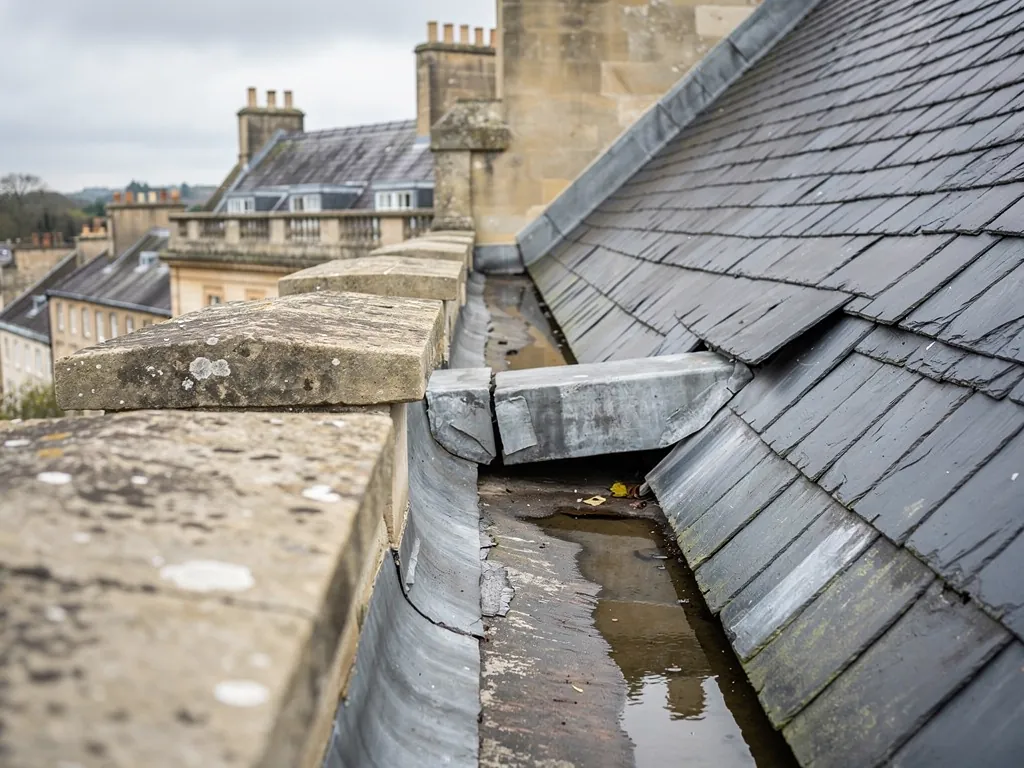
The gutters need to be right too. A run that sags between brackets holds a pool and tips over at its low point. An outlet blocked by moss and grit sends water down the face of the wall. Cast iron rusts from within, uPVC cracks, and joints weep. Where a run is beyond repair, replacement in a matching profile restores both function and appearance. Fascia boards that have been wet for years are checked with a probe before anything new is fixed to them.
Details of the range of work, from realigning a few brackets to a full new run, sit under gutters, soffits and fascias.