The short answer
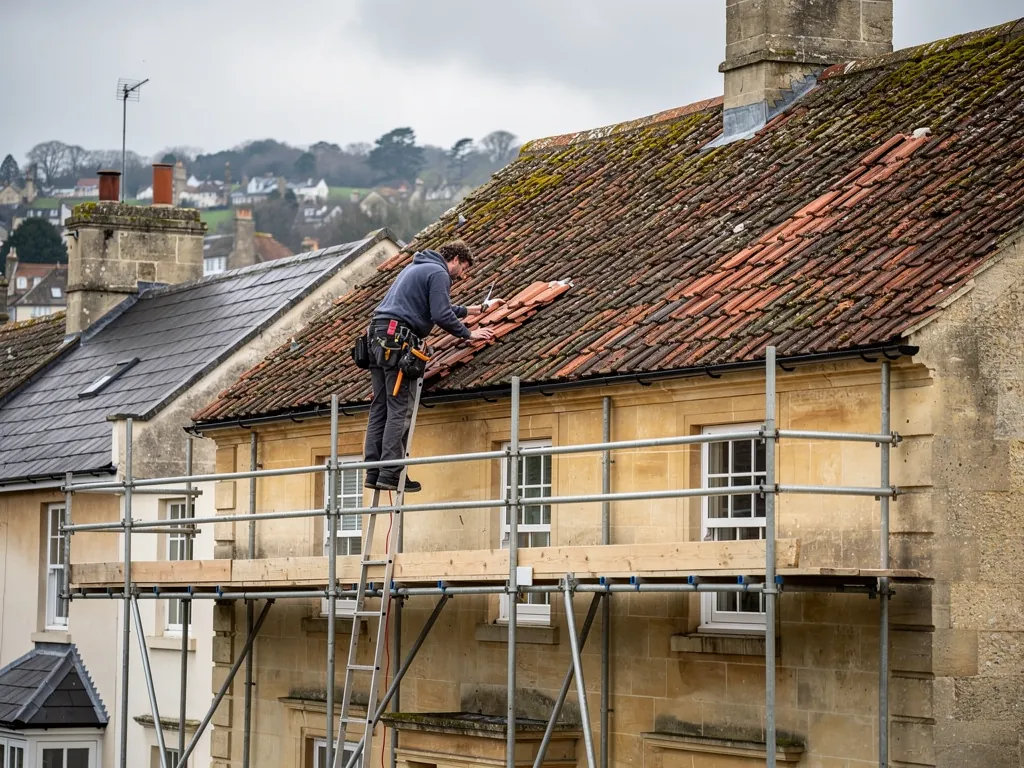
Roof tiles slip because their fixing has failed, most often through corroded nails, a broken nib on the tile, rotten battens beneath it or wind lifting it. One slipped tile after a storm is a simple repair. Several slipping across a slope, or the same area slipping again, points to a worn fixing system underneath and usually to a bigger job than replacing tiles.
How a tile is held in place
A tiled roof is hung, not glued. Each tile has a small projection on its upper edge called a nib, which hooks over a batten, the thin timber lath fixed across the rafters. The tile rests on the course below and, depending on the roof, is also nailed or clipped. On a plain tile roof, the nails are typically driven through holes near the top of the tile into the batten.
So three things keep a tile where it belongs: the nib, the batten it hooks onto and the fixing, whether nail or clip. The weight of the tile above and the overlap of the course below help, but they are not the main restraint.
When one of those three fails, the tile can slide down. It may stop partway, leaving a gap, or drop out altogether. Because the tile above has lost a little of its support too, one slip can start another.
Nail fatigue and corrosion
Nails are the usual first failure. On older roofs they were often iron or poorly galvanised steel, and these corrode. Heritage guidance observes that these fixings wear out far sooner than the covering they hold, and that British Standard guidance lists copper, aluminium or silicon bronze as the better choice for a lasting job.
Once a nail rusts, it thins and may snap at the tile hole. The tile then has only its nib to hold it, and a gust or a hard frost is enough to move it. In slate roofing this is called nail sickness. The same process happens on tile roofs, and it tends to appear everywhere at once, because every nail went in together and has faced the same weather.
That is the telling feature. A scatter of slipped tiles over several slopes, returning after each winter, suggests the whole roof's fixings are nearing the end. Replacing individual tiles treats the symptom, and the next ones fail soon after.
Broken nibs and cracked tiles
The nib is a small, brittle part of the tile. It can snap through frost, through a foot placed on the roof by someone cleaning gutters or fitting an aerial, or through a tile that was poorly made or old and porous.
A tile with a broken nib may stay put for years, held by its nail, then slip the day the nail gives way. A cracked tile can also let water in and drop pieces. If you find shards on the ground, a tile above has failed even if you cannot see the gap.
This kind of damage points to the covering's condition. Tiles that crumble, flake or split at the nib are finished as a covering, and swapping them one at a time buys only a little time. Our comparison of heavier roof tiles explains why changing the covering needs care when you do reach that point.
Rotten or loose battens
If the batten under a tile is soft, the nail has nothing to grip and the nib can pull free. Battens rot from the damp that comes with condensation in the loft, a leak or an overflowing gutter that soaks the eaves. They can also be undersized for their span on older roofs, or fixed at the wrong spacing for the tile.
The signs show on the outside as a wavy course, a tile sitting proud or a line that dips between two rafters. Inside, the battens look dark and feel soft when you press them with a screwdriver, and the nail points may be visible, rusty, through the timber.
When a batten has rotted, replacing the tile does nothing, because the new one slips as well. The timber has to be renewed first, which means lifting the surrounding tiles. If several battens are involved, that is a re-battening of the slope, and it often runs alongside the underlay. Our page on roof battens sets out what they do and how they fail.
Wind, frost and movement
Wind is the trigger more often than the cause. A gust lifts a tile whose fixing is already weak. If a storm takes a tile off a sound roof, the tile was probably unlucky or poorly fixed. If it takes several off a worn one, the storm exposed what age had done.
Frost matters because tiles absorb water, and when it freezes it expands and flakes the surface or cracks the nib. Clay and concrete differ here, and porous or old tiles suffer most.
Movement in the roof itself can loosen tiles too. A ridge that has dropped, rafters that have sagged or walls that have moved will distort the courses and put strain on the fixings. One clue shows from inside the loft, and sagging roof felt is worth reading about.
Insurers frequently set a storm threshold at gusts of 55 mph, and ordinary wear is a common exclusion. Pictures and a written roofer's report support a claim, though no claim is certain.
Repair, or a bigger job?
One slipped tile, on a roof that otherwise looks even, is a repair. We replace it, check the neighbours and the batten beneath, and fix the new tile properly.
The decision changes when there is a pattern. Tiles slipping across more than one slope, the same spot failing again, nails visibly rusted when a tile is lifted, soft battens or crumbling tiles all suggest the fixing system is spent. Patching then costs more over time than a re-lay.
A re-lay lifts the sound tiles, renews battens and underlay, and fixes everything back with nails that will not rust. It is covered in our page on re-felting cost, with typical UK price ranges.
The first step is to know which you have. Our survey is free, and it includes pictures from your own slopes, so the nails, battens and tiles are there for you to inspect. Where repair works, we repair, and we tell you when it does not. For the whole service, see pitched roofing.