
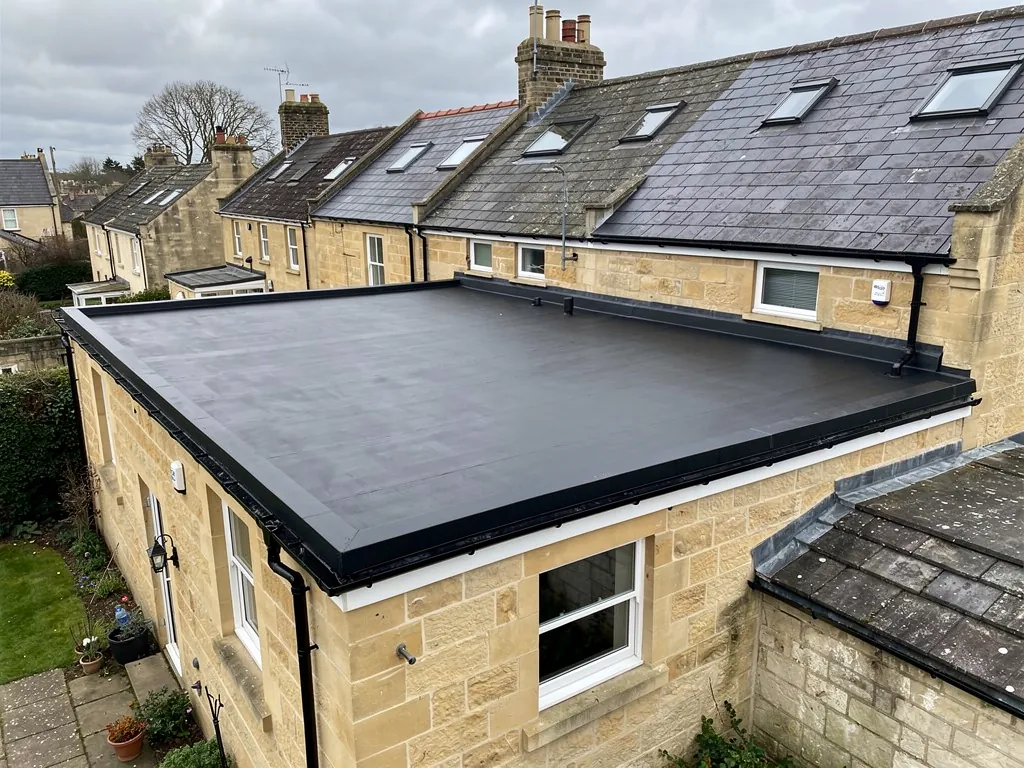
Say felt roof and many people picture a shed: a single thin sheet, tacked down and painted with bitumen every few years. A torch-on roof on a house is a different product. It is a built-up system of reinforced bitumen sheets, laid in layers and fused together: a gas torch warms the back of every roll until the bitumen turns tacky and sticks to the surface beneath. Done well, the layers become one membrane with welded laps rather than a row of overlaps waiting to lift. Done badly, it carries the faults people remember from old felt, along with a real fire risk. This guide explains how the modern system differs from the old, what each layer does, what shortens or extends its life, and the precautions that should be in place whenever a flame is used on a roof. It sits alongside our guides to the other domestic coverings, and the wider choice is set out on our flat roofing service page.
Old felt and modern torch-on: what actually changed
The felt many homes still carry was a fibre-based sheet saturated with oxidised bitumen. It was commonly built up from several plies, mopped down with hot bitumen from a boiler or simply nailed and lapped. It became brittle in cold weather and soft in heat. It tore where the deck moved, and it split along the laps because the bitumen had little elasticity. Many of the felt roofs that have a poor reputation were built this way, often on a thin deck and with little attention to falls.
Modern torch-on sheets keep the bitumen but change almost everything else.
- Modified bitumen. Polymers are blended into the bitumen so that it stays flexible at low temperatures and resists softening in sun. The common types are described as plastomeric or elastomeric, and the elastomeric ones stretch more before they tear.
- Reinforcement. A woven polyester or glass-fibre carrier runs through the sheet. It gives tensile strength and stops the membrane drifting when the deck moves.
- A cap sheet. The top layer is faced with mineral granules, usually in grey or green, which shield the bitumen from UV and from heat.
- Welded laps. The torch melts the underside of each roll as it is unrolled, so the lap fuses with the sheet beneath it. A properly welded seam is a fused joint and not an overlap.
The result is a membrane that moves with the building, accepts foot traffic better and gives a long life when it has been laid on a sound deck. It still has limits. Bitumen is attacked by sunlight, and the cap sheet is what stands between the two. Granules that have been scoured off by gutters, ladders or cleaning expose the reinforcement, and that is where a modern roof starts to age.
A modern roof is different to old felt in kind and not just in name. If you are comparing it with a rubber or fibreglass roof, the flat roof materials guide sets the three systems side by side.
The layers, from the deck up
A torch-on roof is a system, and every layer has a job. The build-up varies with the design, but a typical warm roof on a timber deck is arranged as follows.
Deck and falls
The deck is normally ply or OSB3 boards over joists, with firrings (tapered timbers) forming the fall to the outlet. Boards must be dry, flat and firmly fixed, because the sheets above are only as stable as the deck beneath them. Rockwool's summary of BS 6229:2018 is that all flat roof surfaces, gutter beds included, "should be designed with a fall of 1:40 to achieve finished drainage falls of 1:80". On our page about flat roof falls we explain why a roof that is level by eye can still hold water.
Vapour control layer
On a warm roof, a vapour control layer goes down first. It limits the amount of warm, moist air from inside the house that can reach the insulation. In a torch-on roof it is often a bitumen sheet, stuck or nailed to the deck. Without it, moisture can condense in the insulation and the roof underperforms.
Insulation
Rigid insulation boards go above the vapour layer. Their type and thickness are set by the thermal performance wanted, not by the felt. Boards are mechanically fixed or adhered, and they are laid with staggered joints so there are no continuous gaps.
Base layer and cap sheet
A base sheet is fixed over the insulation, and a cap sheet is welded on top with laps staggered so the joints do not line up. The cap carries the granules. Some systems use two layers in total, others three, and the choice depends on the manufacturer's specification for the particular roof.
Edges and details
At a wall, the sheet is carried up as an upstand, with a flashing fitted above to shed rain. At the eaves a drip edge directs water to the gutter. Around rooflights and pipes, purpose-made upstands are formed in the same felt. Detailing is slow work, and it is where a roof is won or lost.
The layers above the deck are only the waterproofing. The warmth, the strength and the fall come from what sits beneath them.
Seams, upstands and the places a felt roof leaks
Most leaks on a felt roof do not come from the middle of a sheet. They come from the places where one sheet ends and something else begins.
Laps and end joints
If the torch has not been moved evenly along the roll, a lap can be left only partly welded. The give-away is a small bead of molten bitumen along the edge of a lap, which shows the seam was heated enough to flow. A seam without it deserves a second look. Laps in the cap sheet should be staggered against those in the base layer, so a failed edge cannot run straight through to the deck.
Walls and abutments
An upstand against a stone or brick wall needs to be taller than the likely depth of water on the roof, and the top edge has to be sealed. In Bath, where a flat roof often joins a rear wall of ashlar or rubble, the junction is usually either chased into the stone with a lead or metal flashing set into the joint, or covered with a cover flashing dressed down over it. Mastic alone is a short-term fix. Chasing the joint and pointing it in a lime-based mortar suits an old wall far better than cement does.
Penetrations and outlets
Pipes, vents and rooflights are the other weak points. Each should have its own formed collar or kerb, welded into the membrane and not just smeared with sealant. Outlets need a proper flange, welded in, and a cover to keep leaves out. A clogged outlet often explains why water lingers on a flat roof.
Parapets and gutters
A parapet gutter is the channel that runs behind a parapet wall. On a flat roof that meets one, it needs a membrane that is welded with no gaps and dressed up the face of the parapet. Where it is lined in lead, the felt and the lead must be designed to meet. A gutter out of sight from the pavement still needs clearing on a routine.
If a leak has appeared and you are trying to decide how far to go, our repair or replace page sets out how to judge it.
How long a torch-on roof lasts, and what shortens it
Published lives for felt vary. The cost guide Less gives 10 to 20 years, and says workmanship makes the difference: around 20 years for good work, under 10 for poor. Stirling City Heritage Trust gives around 20 years, the Historic Churches guide up to 30, tying it to the quality of the solar finish, and the Confederation of Roofing Contractors 30 years or more if well maintained. A fair summary is typically 10 to 20 years, with good three-layer systems lasting longer, depending on exposure, workmanship and maintenance. Treat any single figure as a rough guide and not a promise. What can be said with confidence is which factors move it up and down.
- Quality of the deck. A flexing or damp deck shortens the life of any membrane.
- Number and quality of layers. A modern two- or three-layer system with a mineral-faced cap lasts longer than a single layer. A single-layer repair to an old roof does not match a new build-up.
- Workmanship at the seams. A properly welded lap holds. A half-welded one opens in time.
- Foot traffic. Granules are lost where people walk. Regular access to clear a gutter or service a chimney wears them away on the same path again and again.
- Shade and debris. Leaves and moss hold moisture against the surface, and plant roots find lap edges. A roof under a tree needs clearing more often.
- Exposure to sun. The south-facing slope or roof section ages first, because heat and UV are what harden bitumen.
- Ponding. Standing water speeds up wear and increases the load on the deck. We cover the subject on the flat roof ponding page.
Signs a felt roof is coming to the end of its useful life include granules gathering in the gutter, blistered or alligator-patterned surface cracking, exposed reinforcement and open laps. A blister is not always a failure. It can be trapped air or moisture, and a small one in a flat area may be left alone and watched. A split blister, or any sign of water entering, calls for attention.
Maintenance is modest. Keep outlets and gutters clear, look at the upstands once or twice a year, and keep access to the minimum. Do not use a pressure washer, which strips granules, and do not coat the surface with products unless the manufacturer of the system recommends them.
Fire precautions: the part of torch-on that deserves respect
Torch-on is installed with an open flame on or very near a combustible building. Most roofs have timber decks, timber fascias, timber-framed walls and a loft full of dry material under the covering, so a stray spark has a lot to catch. The fire risk is the reason many insurers, schools and landlords ask specific questions about hot work, and it is why we say clearly what the precautions are.
Before the torch is lit
- Assess the roof. Where is the timber? Are there gaps in the deck, open eaves or cavities where heat could travel? Flame is not directed at any gap that leads into the structure.
- Plan the order of work. Details near timber, soffits and old cladding are the places to avoid direct flame. They are often done with cold-applied adhesive or self-adhesive sheets, or with a heat shield between the flame and the timber.
- Set up fire equipment. An extinguisher and a water source are kept on the roof, within reach, and not at the bottom of the ladder.
- Protect surroundings. Combustible items are cleared from the roof and the area below, and nearby vents and gaps are covered.
While the work goes on
The torch is moved steadily along the roll and is never left burning unattended. Gas cylinders are stood securely and kept away from the heated area. A second person on site who knows what to do is part of a sensible plan.
After the last roll
Felt and the surfaces around it hold heat, and smouldering can start long after the flame has been put out. The usual precaution is a fire watch: someone stays or returns to check the roof, and the roof void if it can be reached, for a period after the work stops. We do not finish a torch-on job and leave the site straight away.
Some situations call for a different method altogether. On a roof where the construction cannot be seen or the deck sits tight on old timber, a cold-applied or self-adhesive system avoids the flame. Next to thatch, or to timber cladding that comes right up to the roof edge, the same applies. A careful roofer will say which method suits your roof and why. If one is offered without any mention of fire precautions, ask about them before accepting the quote.
Cost, Bath settings and when torch-on is the right choice
MyBuilder's 2026 flat roof guide reports typical UK rates for felt of £70 to £100 per square metre. Rubber and fibreglass sit higher, and the comparison is on the pages for each. For a whole roof the same guide gives replacement at £2,800 to £7,500, averaging about £75 per square metre, which is lower than most of the individual systems. For commercial work, a single contractor's answer on MyJobQuote (July 2026) puts torch-on at £80 to £120 per square metre, which we treat as low-confidence. Your fixed quote follows the survey. Area, deck condition, any new insulation and the number of upstands and outlets are what move the figure.
Torch-on suits a plain roof on a house or an extension, where the area is large enough that welded sheets are efficient. It copes well with a roof that will be walked on occasionally, and it can be finished with a mineral cap in a colour to blend with the surroundings. It is a poorer fit on a small, intricate roof with many angles, where a liquid-applied system follows the shape more easily, and on any roof where the fire risk cannot be managed. The comparison with GRP fibreglass roofs sets out the alternative.
If you are thinking of planting the roof, felt can form the waterproofing under a green roof provided the cap sheet is a root-resistant type. Our green roofs guide covers that build-up.
In Bath, a flat roof on a rear addition may sit within the setting of a listed building, or within the conservation area that covers about half of the city. A roof is read as part of the house, so the colour of the cap, the detail at the stone wall and the choice of flashing all matter. On a listed house, a change to how a roof looks calls for listed building consent, applied for to B&NES Council ahead of any work. On the Planning Portal's line, a re-roof affecting 25 per cent or more of the total building envelope, or 50 per cent or more of the roof, normally needs Building Regulations approval, which we arrange. Before work starts, check that the quote names the felt system, the number of layers and the finish of the cap sheet.