
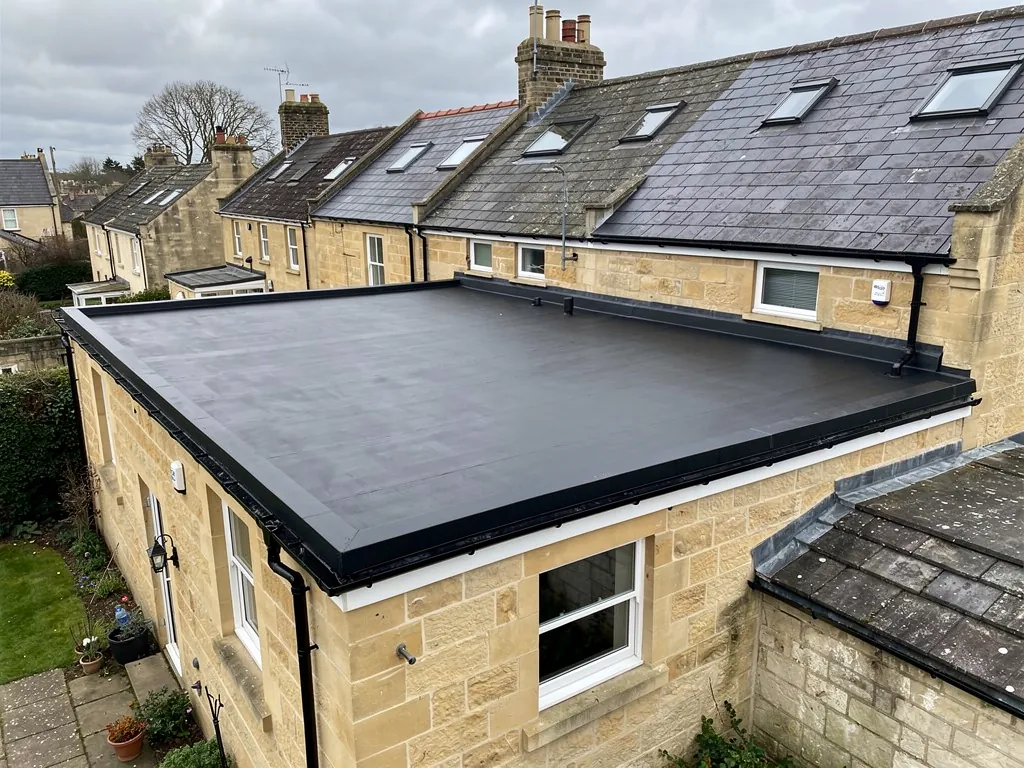
GRP stands for glass-reinforced plastic, and on a house it means a flat roof formed in place from liquid resin and glass-fibre matting. There are no overlapping sheets. The roof cures into one continuous skin that runs up the walls, around the rooflight and over the edge trim without a joint in the field of the roof. That is the appeal for a small extension, a bay or a dormer cheek, where a sheet product has to be cut and lapped around awkward shapes. It is also why the quality of a fibreglass roof depends so heavily on what happens before and during the day it is laid. The resin does not care how good the product was on the shelf if the deck underneath is damp or the sky turns. This guide follows a GRP roof from the timber upwards, sets out the conditions it needs, lists the finishes you can choose and describes where these roofs go wrong. For a wider comparison of coverings, our flat roofing service page is the place to start.
What goes into a GRP roof, layer by layer
A fibreglass roof is a laminate, and like any laminate it is only as strong as its weakest layer. Starting at the bottom, the layers are these.
- Joists and deck. Timber joists carry boards, usually exterior-grade ply or OSB3 in sheets. The boards need to be flat, fixed with screws and free of loose edges.
- Falls. A fall is the slope that drains water to the gutter. On a timber roof it is built in with tapered timbers called firrings, or by notching the joists. Flat does not mean level.
- Insulation. With a warm deck, insulation goes on top of the boards, which keeps the structure warm and dry. In a cold deck it sits between the joists with a ventilated void above. Our guide to the warm and cold deck options goes into the difference.
- Resin and matting. Glass-fibre matting is bedded into catalysed polyester resin and rolled out so the fibres are fully wetted. The matting is the reinforcement and the resin is what keeps water out.
- Topcoat. A pigmented resin layer, applied over the cured laminate, gives the colour and the UV protection.
- Trims. Edge trims at the eaves and verge form a drip which carries water off beyond the wall face. They are fixed before the laminate goes on, so the glass-fibre skin wraps over them.
Each step has to cure before the next goes on. When it works, the result is a smooth, jointless surface, but the strength comes from the fibre and the bond, not from the paint on top. A thin laminate over a good deck will outlast a thick one over a bad deck, which is why a competent installer spends more time on the boards than on the resin.
GRP is one of three coverings most often chosen for domestic flat roofs. The other two are torch-on felt and EPDM rubber, and we compare all three on the flat roof materials page.
Getting the deck right before any resin is mixed
The deck is the foundation of the roof, and most GRP problems that appear a year or two after laying began there. Before the work starts, a surveyor or roofer should check four things.
Moisture and rot
Boards that are damp when the resin goes on will release moisture later, and the laminate can blister as the trapped water warms. Damp can come from an old leak, from condensation in a cold deck or from rain that fell on the boards the day before. If the old covering has been leaking for some time, the joist ends and edges of the boards need probing. Rotten timber is replaced, not covered over. This is also where any condensation risk shows up: a cold deck without proper ventilation can feel dry in summer and be wet in winter.
Flatness and joints
Board edges that sit proud of their neighbours will telegraph through the laminate as ridges, and a ridge is a place for water to sit. Joints between boards should be tight and supported on the joists. Any movement in the deck will eventually try to crack the rigid laminate above it. That is the underlying cause of many hairline cracks along the line of the boards.
Falls and ponding
GRP is waterproof even when water stands on it, but a roof that holds puddles ages faster, collects dirt and can sag at low points. A properly designed fall moves water to the outlet. We cover the subject in more detail on the flat roof fall page.
The old covering
Resin does not bond reliably to bitumen. For that reason an old felt roof is normally stripped before GRP goes down, and the deck beneath is inspected once the felt is off. Laying fibreglass directly over felt is not a sound shortcut, and any roofer proposing it should be asked how the bond is meant to work.
Ask to see the deck once the old covering is off. A roofer sure of the work will be happy to show you the boards and the joists before they are covered.
Laying conditions: why the weather decides the day
GRP is a chemical cure. A catalyst is stirred into the resin and the mix then hardens over a short working time. That has three practical consequences for the day the roof is laid.
It must be dry, and stay dry
Rain on uncured resin ruins the surface. So does dew or fog settling on the boards before the work begins, and moisture in the air that a cold, still morning can leave on a deck. A good installer looks at the forecast for the whole working window and also at the condition of the surface in the morning. Boards are checked by touch and, on a larger roof, with a moisture meter. If the roof is damp, the work waits.
Temperature changes the cure
Resin cures more slowly in cold weather and faster in heat. In the cold, the laminate can stay soft for longer than planned and may not reach a full cure before the weather turns. In strong sun, the resin can go off before the matting has been rolled in properly. The catalyst quantity is adjusted for the conditions, and the installer should know how to do that. This is why GRP roofs are laid in settled weather, and why we would sooner postpone than rush the resin on a poor day.
One continuous operation
The laminate and topcoat are laid in a single visit where possible, so the layers bond chemically rather than mechanically. A roof that has to be left half-laid overnight needs to be protected and keyed again before the next layer goes on. For an extension roof of ordinary size this usually means the job is planned around a spell of good weather and a firm start time, with scaffold or access already in place.
None of this is a reason to avoid GRP. It is a reason to ask how the day will be planned, what happens if it rains and whether the roofer will move the date. A roof laid in the wrong weather can look fine on completion and fail within a season.
Finish options: colour, grip and edges
The visible finish is where GRP offers the most choice, and also where early decisions are hard to undo.
Topcoat colour
Topcoats are made in a range of greys, blacks and other colours. A mid-grey is a common choice because it is neutral against slate, render and stone. Darker colours show less dirt but take on more heat in sun. Lighter colours stay cooler. The topcoat is a coating over the laminate, so it can be renewed later with a compatible product if it fades. Ask which product is used and what its manufacturer says about recoating.
Anti-slip surface
A glossy topcoat is slippery when wet. Where a roof will be stepped on when reaching a window or cleaning a rooflight, grit can be broadcast into the topcoat to give grip. If the roof is meant to be used regularly as a terrace or a balcony, the build-up changes. Boards or pedestals are laid over the roof, and the structure needs checking for the extra load. We explain what that involves on the walk-on flat roof page.
Edge trims and upstands
Trims can be GRP, aluminium or PVC. A drip trim at the eaves matters more than its material, because it sets whether water clears the fascia or runs behind it. At a wall junction the laminate turns up to form an upstand, and a lead or metal flashing is dressed over the top so rain cannot enter behind the edge. That covering strip of metal is the flashing. In Bath, that wall is often stone, and the junction needs to be chased and sealed with care.
Rooflights and penetrations
Rooflights, soil pipes and vents are set into the laminate with their own upstands. A rooflight on a GRP roof needs a kerb that is high enough to stand above any water on the surface and is tied into the laminate. Skimping the kerb height is a recurring cause of leaks at the opening.
Where fibreglass roofs fail
GRP has a good record when installed carefully, but it fails in recognisable ways. Knowing them helps you read a quote and inspect an existing roof.
- Cracks at board joints. If the deck flexes, the rigid laminate cracks along the same line. The remedy is stiffening the deck, not filling the crack.
- Cracks at the edges. The laminate at a drip trim or an upstand takes movement and thermal stress. A thin laminate or a poorly formed corner will split first.
- Blisters. These come from moisture or trapped air under the laminate. Some are cosmetic. Others are a sign that water is inside the layers.
- Dry, white-looking patches. Where matting was not fully wetted with resin, the fibres show. These are weak spots and let water wick through.
- Topcoat chalking. Sunlight breaks down an old topcoat, leaving a dusty surface and fading the colour. The laminate below may still be sound, so recoating can restore a roof of this kind.
- Impact damage. A dropped tool, a heavy ladder foot or a falling branch can crack the surface. GRP is hard, not tough.
Repairs are possible. A damaged area is cut back, the surface is keyed, new matting is wetted into place and the topcoat is applied over it. The patch is sound if it is done properly, but it rarely matches the surrounding colour exactly, particularly on a roof that has faded. A repair that works well is still a good reason to ask whether the underlying cause, such as a flexing deck, has been addressed.
If you are weighing up whether to fix the roof you have, repair or replace sets out how we decide.
Cost, consent and when GRP suits a Bath house
The 2026 MyBuilder flat roof guide quotes typical UK ranges: a whole replacement lands between £2,800 and £7,500, averaging roughly £75 per square metre. The same source lists the three usual coverings separately.
| System | Typical UK rate |
|---|---|
| Torch-on felt | £70 to £100 a square metre |
| EPDM rubber | £90 to £130 per m² |
| GRP fibreglass | £95 to £150 per m² |
Your fixed quote follows the survey, with each part of the roof itemised. The spread depends on roof area, how much of the deck needs renewing, whether insulation is being upgraded and how many edges, upstands and penetrations the roof has. GRP is often priced at the upper end of the range for a small, complicated roof because the shaping and trims take time, and at the lower end for a large plain roof where the material does the work.
Where does GRP suit best? It works well on small roofs with many angles, such as bays, porches and dormer cheeks, and on roofs where a rigid, jointless surface is wanted for foot traffic. It is a weaker choice on a deck that moves a lot, on a roof that cannot be kept dry during laying, or on a building where a visible modern finish is not acceptable. Our comparison of EPDM rubber roofs covers the sheet alternative, and torch-on felt roofs covers the bituminous one.
On the consent side, replacing a flat roof covering like for like does not normally raise planning questions on an unlisted house. A new flat-roofed extension raises separate questions, and our flat roof planning page explains what to check. For a listed house, altering the roof calls for consent that B&NES Council grants, and a glossy new material on a rear addition is the sort of thing the conservation officer will want to discuss first. Re-covering that stays below a quarter of the building's envelope and below half the roof surface normally escapes Building Regulations approval. Bigger jobs bring building control into play, and an insulation upgrade can follow. The paperwork is ours to handle on notifiable jobs, and GRP needs a dry day above about five degrees to cure, so spring to early autumn is the usual window for laying it.