The short answer
You can usually walk on a flat roof for occasional maintenance, such as clearing leaves or checking an outlet, if it is sound and you stay on the boards and softer soles. Regular use, furniture or a terrace needs a surface designed for foot traffic, with a firm build-up beneath. Treat any roof as fragile until you know what it is made of.
Occasional access and regular use are different things
A flat roof built as a weatherproof cover is designed to keep water out, not to be walked on. It will usually put up with an occasional visit. A roofer clearing a gutter, someone brushing leaves off the surface, or an engineer checking a rooflight are all light, short-lived loads that a healthy membrane over a sound deck can take.
The trouble starts with repetition. Feet scuff the surface, grit grinds into it, and a pair of heavy boots can punch through a membrane softened by summer heat. Over a season or two, a regular path across the roof wears through to the layer beneath. Regular use also adds weight to a deck that was only designed for rain and maintenance.
If you walk on the roof once or twice a year, a few simple habits will protect it. If you need to cross it every week, or plan to put furniture and plants on it, you are really asking for a different roof. That is a design question, and the answer is a surface made for people, with a build-up that supports it.
How the covering changes the answer
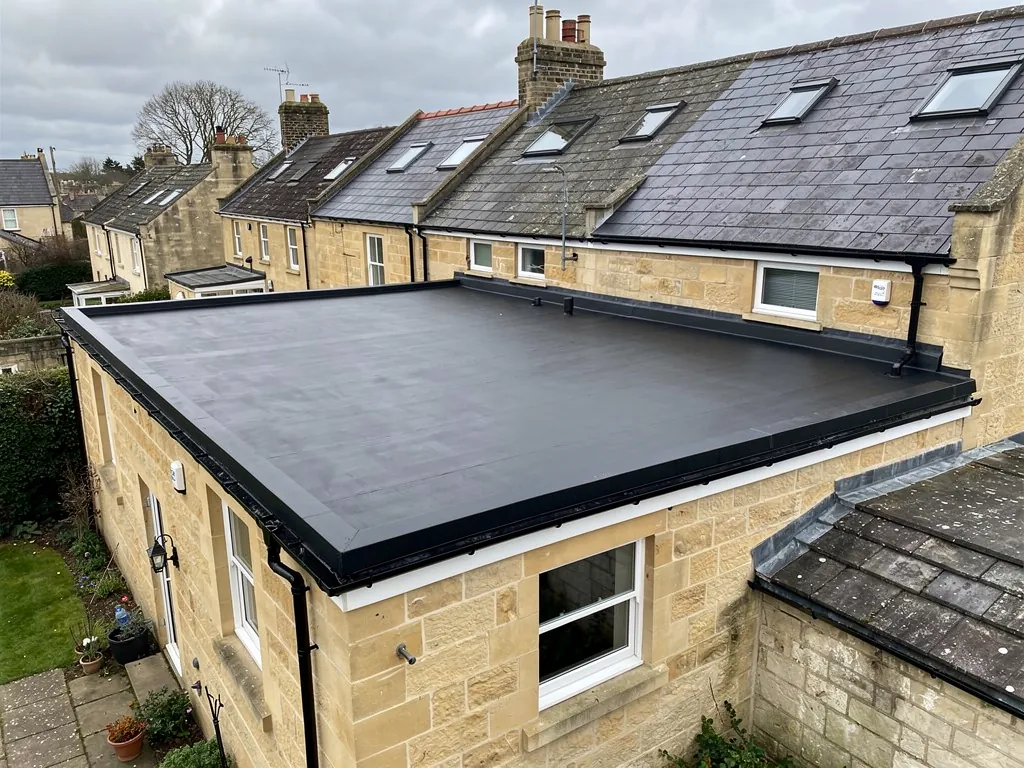
Each flat roof covering handles feet differently. Bitumen felt, laid in layers and finished with a mineral cap sheet, tends to take light foot traffic well, but the mineral surface can be dislodged and the felt can soften in heat. EPDM, a rubber membrane supplied in one large sheet, is flexible and tough, but it can be punctured by sharp objects, and grit on boot soles will scuff it. GRP, which is glass-reinforced plastic built up wet and left to set on site, forms a hard shell, and it is the covering most often chosen where walking is expected.
Lead and other metals can take a footfall, but they dent, and lead in particular marks easily. Single-ply membranes such as PVC vary by product, and some are designed with a textured finish that provides grip.
None of this means one material is walkable and another is not. The manufacturer's instructions for a particular product say what it is designed for, and the quality of the work beneath matters too. A GRP roof over a weak deck can crack when people walk on it. A felt roof over a firm deck with good insulation boards will cope with more than the name suggests. See our comparison of EPDM or GRP for how the two differ when the roof is used.
Insulation and what sits under the surface
What is under the covering decides how a roof feels underfoot. On a warm roof, the insulation sits above the deck, directly beneath the waterproof layer. Insulation boards vary in how much load they can carry. Standard boards can compress under repeated foot traffic, which cracks or stresses the membrane above. Higher-density boards are made for roofs that will see people, and they cost more.
On a cold roof, the insulation goes between the joists, so the waterproof layer rests straight on the deck. This arrangement supports a walking load more simply, since the surface is only the deck and the covering. It carries its own risk of condensation, which we describe in our answer on condensation under a flat roof.
A soft spot underfoot is a warning. It can mean a wet deck, a rotten board or a void under the surface. If the roof flexes when you step on it, stop and look from underneath, not only from above. A spongy patch near an outlet or upstand often suggests moisture has been reaching the deck for some time.
Making a roof safe to walk on
For access that goes beyond the occasional visit, the usual answer is a walkway. This is a path of paving-style tiles, timber decking on supports or a purpose-made walkway board, laid across the membrane so the load spreads over a wider area. The finish is raised slightly or laid on pedestals, so water can still run underneath.
The design must respect the fall. A walkway that dams the water behind it makes a pond at the worst point. This is why the fall and the walkway are planned together, and why our page on flat roof fall is a useful companion to this one.
If the roof is going to carry people at an edge, there is also the matter of safety. A raised edge or parapet that is fine as weather protection may be too low to guard against a fall. A roof you walk on regularly should have a guard that suits the height. That moves the conversation from maintenance towards a terrace, which we cover in our answer on turning a flat roof into a balcony or terrace.
A green roof is another option for a surface that people see but do not walk on. It holds planting and needs a separate access path, and our page on green roofs sets out how it is built.
Staying safe and protecting the roof
Before anyone steps onto a flat roof, check what it is. Skylights and rooflights are particularly dangerous, since the glazing or plastic may not take weight at all. Old fibre-cement or asbestos-containing sheets can break underfoot, and a fall through a roof is a serious risk. If you are not sure what a roof is made of, or if it is in poor condition, treat it as fragile and keep off.
Choose soft-soled shoes without grit in the treads. Lay boards, scaffold boards or a crawling board to spread your weight, and keep to the supported lines of the deck where you can. Avoid walking on a roof in frost or rain, since the surface can be slippery, and on a very hot day when the membrane has softened.
If you need someone to check the roof, we can do it safely with the right access and edge protection. We survey for nothing, photograph your roof as it stands, and explain what the roof can take and what would be needed to make it fit for use. Where a roof needs to be rebuilt to carry people, we price the work in writing after the survey. See our flat roofing service for the rest of our flat roof work around Bath and its neighbouring towns.