The short answer
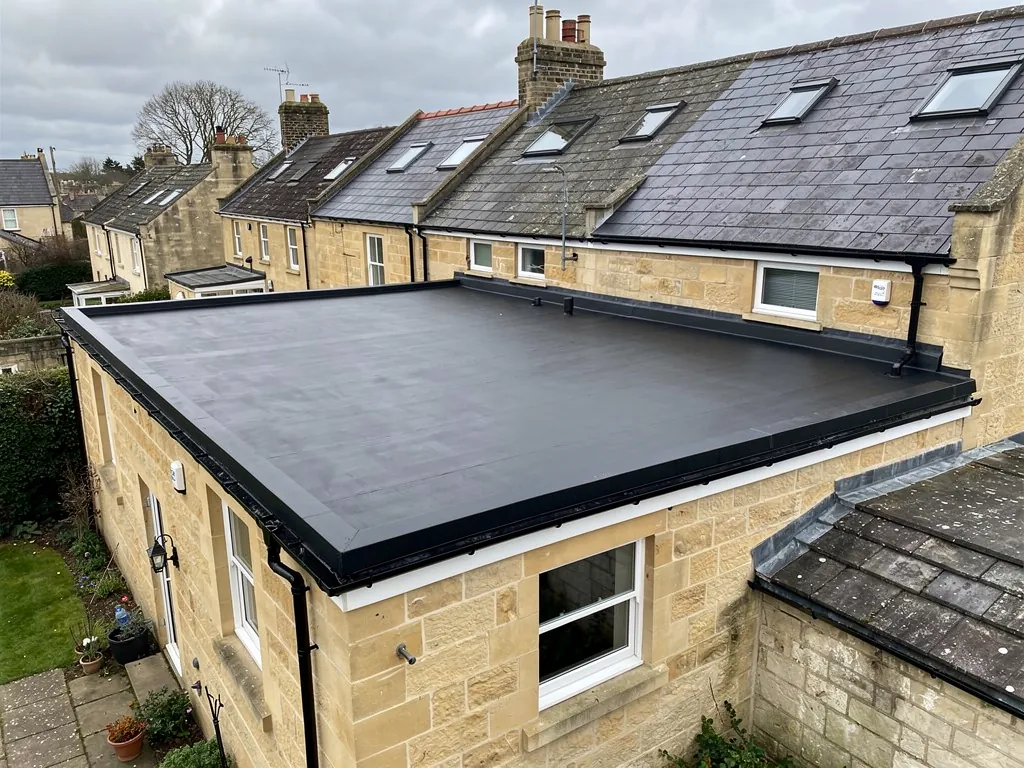
For most simple extension roofs, a single sheet of EPDM rubber is a sound choice. GRP fibreglass suits small, awkward shapes and roofs that are walked on, three-layer torch-on felt suits larger plain roofs, and lead or zinc suit dormers and period buildings. The deck, the falls and the edge details matter as much as the covering you pick.
A recommendation by situation
Start with what the roof is for. A flat roof over a kitchen extension has different demands from a balcony floor or a dormer cheek, and the covering should follow the use.
| Situation | Covering we would look at first | Why |
|---|---|---|
| Plain extension roof, few penetrations | EPDM rubber sheet | One sheet, very few joints |
| Small roof with awkward corners | GRP fibreglass | Cured in place, no seams |
| Roof terrace or balcony floor | GRP, or a membrane under paving | Takes foot traffic |
| Dormer cheeks and period roofs | Lead or zinc | Matches the building |
| Large plain commercial roof | Built-up felt or single-ply | Suits big, simple areas |
Those are starting points, not rules. A survey of your own roof is what settles the choice.
Small extensions, porches and garage roofs
For the typical rear extension, EPDM is hard to beat on simplicity. EPDM is a rubber membrane made from a synthetic compound, and on a modest roof it can often be laid as one piece with the edges turned up the walls and sealed. Every joint avoided is one less seam that can fail.
GRP is fibreglass, meaning glass matting saturated with resin that cures into one hard skin. It copes well with small roofs that have several corners, a rooflight upstand or an awkward outlet, because it is formed around them rather than cut and folded. The deck beneath must be stiff and stable, since a springy deck can crack a rigid skin over time.
Torch-on felt is a bitumen product laid in two or three layers, the top one sanded or finished with mineral chips. It is a familiar choice on garage and larger plain roofs. Its quality depends heavily on how carefully the layers are fused together and how the laps are finished. Our guide to flat roof materials sets the main coverings side by side.
Roof terraces and roofs people walk on
Foot traffic changes the answer. Every footstep loads the covering, and the usual failure on a roof used as a terrace is punctured or scuffed membrane, then a leak that appears in the room below weeks later.
GRP is a common choice for balcony and terrace floors because it is hard wearing and can carry a non-slip finish. Where a terrace is laid with paving slabs or decking, the usual approach is a membrane underneath with pedestals or battens above it, so the weight is spread and the covering is protected. A terrace needs a drained, level-enough surface, a threshold that sits high enough above the finished floor and safe edge protection, and much of that is a design question before it is a material question.
If you only walk on the roof to clean the gutter or reach a rooflight, a separate set of walkway tiles is a modest way to protect a rubber or felt covering. Our page on walking on a flat roof goes into this.
Dormers, period buildings and where the look matters
Dormer cheeks and the flat tops of bay windows are often covered in lead, and lead has a very long record on older buildings. Lead is sold in codes that describe its thickness, so a higher code is thicker and heavier. Code 5 and above is the usual choice for gutters and flat areas, while thinner codes are kept for soakers and flashings. A flashing is a metal strip that weatherproofs the joint where roof and wall meet.
Zinc is a lighter alternative that weathers to a soft grey and suits some modern designs. A listed building, or a house inside a conservation area, brings the council into the decision. The conservation area covers about half of Bath, so speak to B&NES planning first if the material will change on anything the street can see.
On most ordinary houses, a lead dormer is a matter of cost against appearance. The sourced cost for lead is higher than for the other coverings, as the next section shows.
Typical costs and lives side by side
MyBuilder's 2026 cost guide reports these typical UK figures per square metre, and they are not our prices: bitumen felt £70 to £100, EPDM £90 to £130, GRP £95 to £150 and lead £150 to £200 or more. Whole roof replacement is typically £2,800 to £7,500 on the same guide.
Lifespans are just as variable and depend on exposure, workmanship and upkeep. Published figures put EPDM at 20 to 30 years or more, GRP at 25 to 40 years, and torch-on felt at 10 to 20 years, with well-made multi-layer work at the top end. Lead flat roofs are reported at 50 to 100 years. A cheap covering laid well can outlast an expensive one laid badly, which is why the price per square metre is only part of the picture.
Your own figure is a fixed price in writing after we have surveyed the roof, because roof size, deck condition and edge count all move it.
What matters as much as the covering
Most flat roof failures trace back to something other than the sheet itself. A wet, rotten or springy deck will shorten the life of any covering laid over it. Falls matter too. Guidance based on BS 6229 recommends a minimum finished fall of 1:80, and designing to 1:40 allows for the tolerances of real construction. A roof that holds water ages faster, as our page on ponding explains.
Edges, upstands and outlets are where the work shows. An upstand is the short upturned edge where the roof turns up against a wall. If it is too low, or the trim is poorly fixed, water gets behind it however good the sheet is.
For care once the roof is down, see flat roof maintenance. For timing, see how long a replacement takes. Our overall approach is on the flat roofing service page, and the survey costs nothing and we send photographs taken on your roof.