The short answer
For a small, simple extension roof, EPDM is usually quicker to lay and copes well with movement, while GRP forms a hard jointless surface that suits roofs with awkward shapes or foot traffic. Neither is better in every case. The choice follows the roof's shape, the deck underneath and how the surface will be used, and the quality of the edges matters more than the material.
What each one actually is
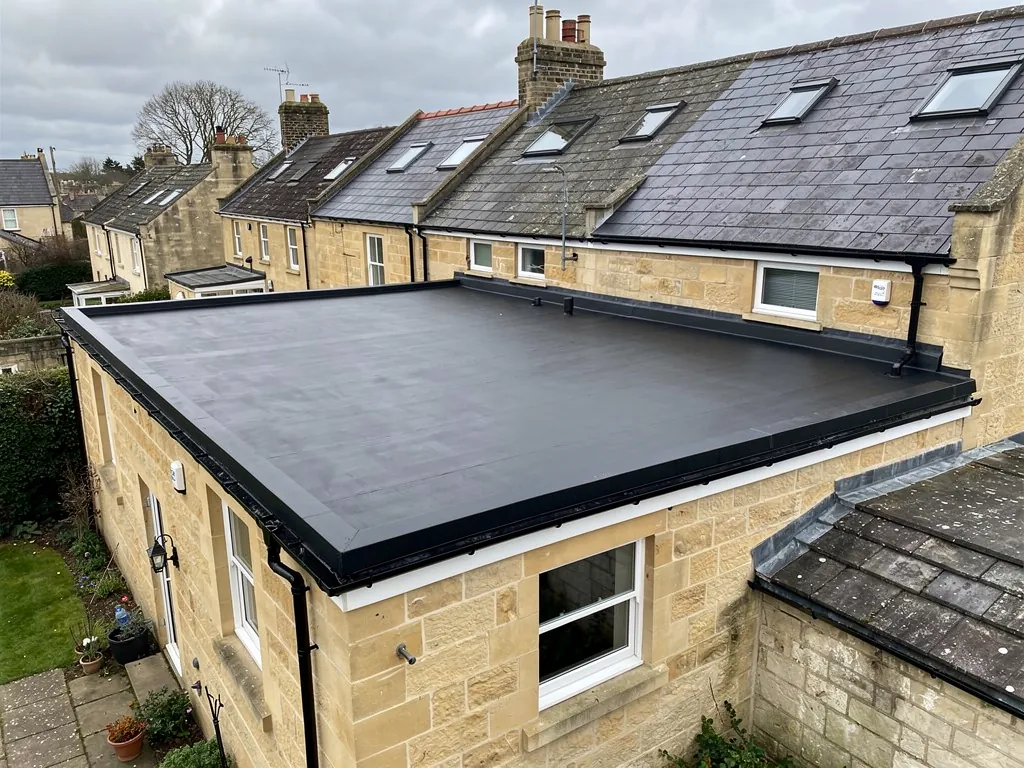
EPDM is ethylene propylene diene monomer, a synthetic rubber that arrives on site as a large roll. A roof is covered by unrolling one sheet, gluing it down onto the deck or insulation, and forming the corners and edges with the same rubber and tapes. A small extension roof can often be covered by one sheet without a seam running across it.
GRP is glass-reinforced plastic, sometimes called fibreglass. It is made on the roof itself. Layers of glass matting are laid on the deck and soaked with resin, which sets hard into a single shell. A coloured topcoat finishes the surface. Because it is liquid before it cures, GRP follows odd shapes without joints, which is why it is often used around rooflights, chimneys and curves.
The two behave differently in the hand. EPDM stays flexible for its whole life. GRP is rigid, so it relies on the deck underneath being stable. That one difference explains most of the advice below.
Years of service, then money
The sourced lifespans overlap. Typical figures for EPDM run from 20 to 30 years, with some sources giving longer, and GRP is quoted at 25 to 40 years when it is well maintained. Both depend on exposure, workmanship and care, and neither figure is a promise for a particular roof. Independent testing of GRP's very long-term weathering is thinner than for older coverings, which is one reason to choose a reputable resin and topcoat.
On price, MyBuilder's 2026 flat roof guide reports typical UK ranges per square metre of £90 to £130 for EPDM and £95 to £150 for GRP, for the covering as installed. A replacement flat roof overall typically costs between £2,800 and £7,500. Treat those as national guide figures and not as Empire prices, because the real cost of your roof depends on its area, how sound the deck is and how the edges are finished. Your fixed quote comes after the survey.
The gap between the two per-metre prices is small. What moves a quote far more is whether the old deck needs replacing, whether insulation is added and how many upstands, outlets and rooflights there are to detail.
Movement, shape and the deck underneath
Timber moves. It swells with damp, shrinks with warmth and flexes under load. A flexible membrane like EPDM absorbs that without complaint. A rigid GRP shell on a flexible deck can crack at the joints between boards, particularly at the edges, which is why a GRP roof needs a well-fixed, stable deck, usually of exterior-grade plywood or similar boards laid with care.
On a small, simple rectangle with few penetrations, EPDM is hard to beat for speed. The sheet goes down in one operation. On a roof with several rooflights, a curved edge, an irregular outline or many pipes, GRP's liquid nature makes the details neater, because it is formed in place and there are no folded corners to wrinkle.
Fall matters for both. A roof needs a slope to its outlet, as the fall a flat roof needs explains, and neither material rescues a roof that holds water. GRP is a little more forgiving of shallow ponding than EPDM, but standing water shortens the life of both.
Edges, repairs and foot traffic
Edges are where flat roofs fail. EPDM is finished at the perimeter with trims and sealed details, and a good fitter pays most attention to the corners, where a flat sheet has to fold into a three-dimensional shape. GRP edges are formed with a trim or drip fitted before lamination, which gives a clean line and sheds water away from the wall.
Repairs differ. A puncture in EPDM is patched with primer, adhesive and a piece of cured sheet, and a good patch is durable. A crack in GRP is ground back, matted and resined again, with the topcoat touched up. Both repairs work, though matching the colour of an aged GRP topcoat is harder than hiding a patch on a black rubber sheet.
Foot traffic favours GRP. Its hard surface tolerates regular use and takes a non-slip finish, so it is the more usual choice where the roof is a route to a window or a small terrace. EPDM can be walked on lightly, but it needs protection from sharp objects and from grit, and a path of paving slabs on pedestals where use is regular. Our answer on whether you can put felt over felt looks at the older alternative to both for roofs that are being renewed on a budget.
Making the choice for your own extension
If the deck is sound, the roof is a simple shape and you want a quick, flexible, low-maintenance covering, EPDM is a strong candidate. If the roof is fussy, will be walked on, or you want a jointless finish that you can colour, GRP is a strong candidate. Where a terrace is planned, see the page on a balcony or terrace on a flat roof, because that decision tilts towards GRP.
Do not choose on the material alone. Ask who will lay it, how they will detail the edges, and what is being done about the deck, the insulation and the fall. A well-laid roof in either material beats a badly laid roof in the other. So ask any installer how they will treat the edges, the upstands and the outlets, because those details are where a flat roof usually fails first.
If you are still weighing the wider list, our overview of flat roof materials compares felt, lead and the single-ply options as well. Our flat roofing service describes how we survey and price a roof for Bath and the surrounding area.