

A Wiltshire market town street with stone and brick houses and clay tile roofs

Roofers in Lacock

Lacock lies 13.6 road miles east of Bath, around an abbey and a National Trust estate that has owned the village since the 1944 gift. Its houses are old, its listed buildings are many, and its roofs reward slow, careful repair. We keep what is sound, match what has to change, and explain what Wiltshire Council will want to hear first.

Local roofs

A village the National Trust was given whole

Few villages arrive in a single gift. Lacock did. In 1944 Matilda Talbot gave the Lacock estate of 284 acres, which includes the Abbey and the village, to the National Trust. Most of the surviving houses in the village date from the 18th century or earlier.

The listed buildings begin at the top. Lacock Abbey, the 14th-century church of St Cyriac and a 14th-century tithe barn are all Grade I. The Sign of the Angel, a late 15th-century house that is now an inn, is one of four Grade II* listed structures in the village. A roof on any of these, or on a cottage in their shadow, is a matter for careful questions before any tiles move.

Beyond the village, the landscape has its own houses. Lackham House overlooks the Avon north of Lacock and was built between 1791 and 1796 as a three-storey country house in the Palladian style. For centuries the only ways across the river here were the packhorse ford and the bridge at Reybridge.

Our own work here is unhurried. Our survey is free and comes with photographs. A fixed written price follows, and where consent is likely to be needed we tell you at the start and not at the end.

Council
Wiltshire Council
From central Bath
13.6 road miles, east
Grade I listed
Lacock Abbey, St Cyriac's Church and the tithe barn
National Trust gift
284 acres, given in 1944
Grade II* structures
Four, including the Sign of the Angel

What we find

Old timbers, true lime and chimney lead in Lacock

Old timbers under old coveringsA house built in the 18th century or before has a roof structure to match. We look for rafters that have bowed, ridge timbers that have dipped and wall plates that have rotted where the gutter has leaked behind them.
Lime where lime belongsStonework and old brickwork were laid in lime, and they depend on it. We check for cement pointing and cement flaunching, which hold water in and push the damage into the stone.
Lead at chimneys and abutmentsThe lead at the join between roof and wall or stack keeps the loft dry. Old lead splits at folds, lifts at its edges and pulls out of the joint, so we look at every length and not just the one that stains the ceiling.

Houses of the 18th century and older

A roof that has stood for two hundred years or more has been repaired many times, and the repairs tell a story.

When most of a village is 18th century or older, a roof survey becomes a form of reading. Each patch is a decision someone took in another era, with whatever material was to hand. A slate replaced with a clay tile, a flashing renewed in the wrong metal, a run of mortar laid over a broken edge: all of these can be read from the loft and the ladder if you know where to look.

The first thing we want to know is whether the structure is sound. In a house this age the rafters were cut by eye and often reused, and the timbers may have moved by a few centimetres over the centuries without anyone noticing. A roof that is slightly out of true is not necessarily failing. A roof where the slope has suddenly dipped, or a ridge has sagged since the last survey, deserves a closer look at what is carrying it.

The second question is the covering. Where a roof is made of one natural material from end to end, the right repair is to keep that material. A patch in something visibly different shows from the road, and in a village where many buildings are listed, it can also draw the attention of the council. So we match: the same material, the same size, laid in the same pattern.

The third is moisture. Old walls do not have a damp-proof course, and old roofs do not have a modern membrane. They manage water by letting it dry out, which is why too much cement or too tight a seal can do more harm than the leak itself. We choose repairs that let the building breathe.

If the plan is a bigger intervention, from stripping a slope to reinstating battens, our pitched roofing page explains the stages and how we sequence them so that no slope is left unprotected overnight.

Grade I, Grade II* and the Trust estate

When a village's finest buildings are listed at the highest grades, everything around them is handled with care.

Lacock Abbey, St Cyriac's Church and the tithe barn are all Grade I, the top tier of listing, and the Sign of the Angel is one of four Grade II* structures. Their influence reaches well past their own walls. The way a roof in the village is repaired, the colour and size of what goes on it and the lead and mortar that surround it, is read against that setting.

A listed house is protected as a whole, roof included, and changing the roof needs listed building consent from Wiltshire Council. The council's advice is to get in touch before anything starts. It is a separate permission from planning, and roof work done without it can be a criminal offence. Repairs that keep the same material and detail, piece for piece, draw the fewest questions. Swapping the covering or taking down a stack draws more.

Not every house in a village like this is listed, and some that are not may sit inside a conservation area, which can bring its own controls. We cannot say from a distance whether your street is covered, and nor should anyone. Ask the council, which holds the maps, including any Article 4 direction withdrawing permitted development.

Ownership is a further layer. The estate passed to the National Trust in 1944, and a property that belongs to the Trust, or is let by it, may carry conditions on what a tenant may change. If your home is one of those, speak to the landlord before you commission anything, and ask us to put the scope in writing so you can send it on.

Chimneys are where these conversations most often land, and the chimney repairs page sets out how a stack is repaired in lime and when a rebuild is the better course.

284

Acres of the Lacock estate given to the National Trust

1944

Year of the gift by Matilda Talbot

4

Grade II* listed structures in the village

Figures: Lacock village entry, Wikipedia, checked October 2026

Lackham House and big-house roofs

A three-storey country house of the 1790s has roof details that cottages never had.

Lackham House, north of the village above the Avon, was built between 1791 and 1796 as a three-storey country house in the Palladian style. A building on that scale has a roof to match, with more hips, more valleys and more places where water has to be gathered and led away. We do not assume the details of any particular house, but we know the kinds of problem such a roof tends to have, and they are not the problems of a terraced cottage.

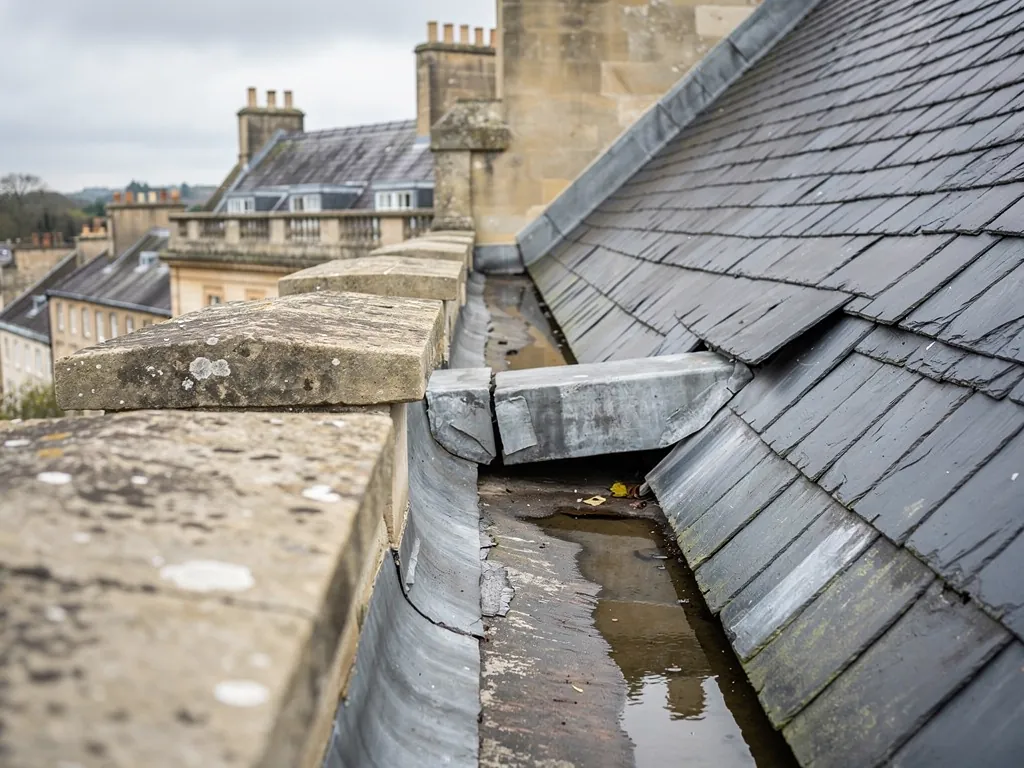
Gutters are the first. On a big house the water from a large roof has to go somewhere, and it may run in a lead-lined channel concealed behind a parapet, the low wall at the roof edge. Builders call that channel a parapet gutter, or a box gutter where it runs between two slopes, and it is the part of a large roof most likely to be forgotten until the plaster below stains. Lead there splits at its laps and its drips, and a blocked outlet turns the channel into a bath.

A valley forms in the angle where two slopes join, with lead or another lining under the slates or tiles that border them. Every drop of rain from both slopes passes through it, which makes it the point where leaves, moss and old nests do the most damage.

Finally there is access. At three storeys, any inspection needs a scaffold, a tower or a camera, and it is more sensible to plan for one than to climb up on a ladder and guess. We survey carefully, photograph the gutters and valleys, and put the results in front of you before suggesting any work.

The lead roofing page describes lining and relining such channels on a historic building.

Words you will hear

Parapet gutter
A channel lined with lead and tucked behind the edge wall of a roof, draining to an outlet.
Box gutter
A similar lined channel sitting between two roof slopes or against a wall.
Valley
The inward angle between two slopes, lined so it can carry the run-off of both.
Drip
A step in a lead or metal channel that lets water fall to the next level.

By the Avon: damp, moss and old trees

Old walls and mature trees can keep a roof here wet for longer.

Reybridge and a packhorse ford were the only places to cross the Avon at Lacock until the 18th century. Mature trees and old stone walls slow the drying of a roof, and a slope that never gets full sun can hold moss on its tiles all year.

Moss is not just ugly. On a roof laid with overlapping units, it holds water against the lap, lifts the edge of a tile as it grows and fills gutters with fragments when it dries and flakes. Left alone for many years, it will shorten the working life of a covering. The cure depends on the material. Pressure washing can damage soft or aged tiles, so on an older roof we prefer a gentle brush, a biocidal wash and patience. On a listed roof we always check what the council would expect before doing anything more aggressive.

Trees add leaves to the problem. A gutter under an oak or lime can fill in an autumn, and a valley that clogs will overflow into the wall and soak the stone beneath. Clearing these twice a year is not heroic, but it is the cheapest roof maintenance there is, and a failure to do it is behind a lot of the damp we are asked to investigate.

Birds and bats also use old roofs. Nesting birds and bats are protected, so if either is present we plan the work around them and take advice from the right body before disturbing a roost. This is not common knowledge, and it is better raised at the survey than discovered with a tile in your hand.

For the cleaning and treatment side, our roof cleaning page explains the methods and when each is suitable.

Clean or re-cover

If the tiles are sound under the moss, a gentle clean and a gutter clear-out will do more good than a new roof.

Map showing the location of Lacock.

Nearby

Roofers near Lacock

Roofing services in Lacock

Local questions

Questions on Trust estate and listed roofs

My Lacock cottage is not listed. Do I still need to think about consent for a roof repair?

Possibly, and it is worth a short call. An unlisted house may still be in a conservation area, or have its permitted development rights restricted by an article 4 direction. Wiltshire Council holds the maps. A like-for-like repair is rarely controversial, but swapping one covering for another is worth checking before you order anything.

Does the National Trust have a say over my roof if I rent from it?

It may. A tenancy can carry conditions on alterations, and a roof is a structural part of the building. Ask your landlord what is needed before you commission work. We can put the proposed scope, materials and method in writing, so that the Trust and the council have the same description in front of them.

Can a roof that is slightly out of true be repaired, or does it need rebuilding?

Slight irregularity in a house this old is normal, and the roof can often be repaired as it stands. A sudden dip, a sagging ridge or spreading at the eaves is different, and then we look at the timbers and walls carrying the slope. The survey photographs show you which case yours is before any price is set.

How do you deal with bats or nesting birds in an old Lacock roof?

We plan around them. Both are protected by law. If the survey turns up signs of either, work is retimed and advice is sought before a roost is touched. It is raised at the start so that you are not surprised by a pause in the middle.

Get your free survey

Get your free roof survey

Tell us what's happening and we'll call you back to arrange a visit. Prefer to talk? Call 01225 285181.

  • Photos of your own roof
  • A fixed price in writing
  • 10-year workmanship guarantee
Call Free survey