Most people hire a roofer once or twice in their lives, usually in a hurry, with a stain spreading across a ceiling and no clear idea what good looks like. That is the wrong moment to learn. This guide sets out the process in the order it unfolds: the first conversation, the survey, the quote, the paperwork, the start date and the handover. It is aimed at owners of older Bath houses, where the roof is rarely a plain pitch of identical tiles and where the hidden parts, such as lead gutters behind a parapet or timbers under a stone-tiled slope, decide whether the work lasts. Checking a firm's credentials is a separate subject, and our page on how to check a roofer covers it. Here the focus is the hiring itself, and the questions that show whether someone has understood your roof before they price it.
Start with the roof, not the price
The first thing to judge is whether the person who turns up is looking at your roof or at a generic one. A sound roofer asks what you have seen before they climb a ladder. Where is the stain? Does it appear in heavy rain only, or after a dry spell too? Is it near a chimney, a wall or the middle of a slope? Those questions point towards a cause, and a cause is what you are paying someone to find.
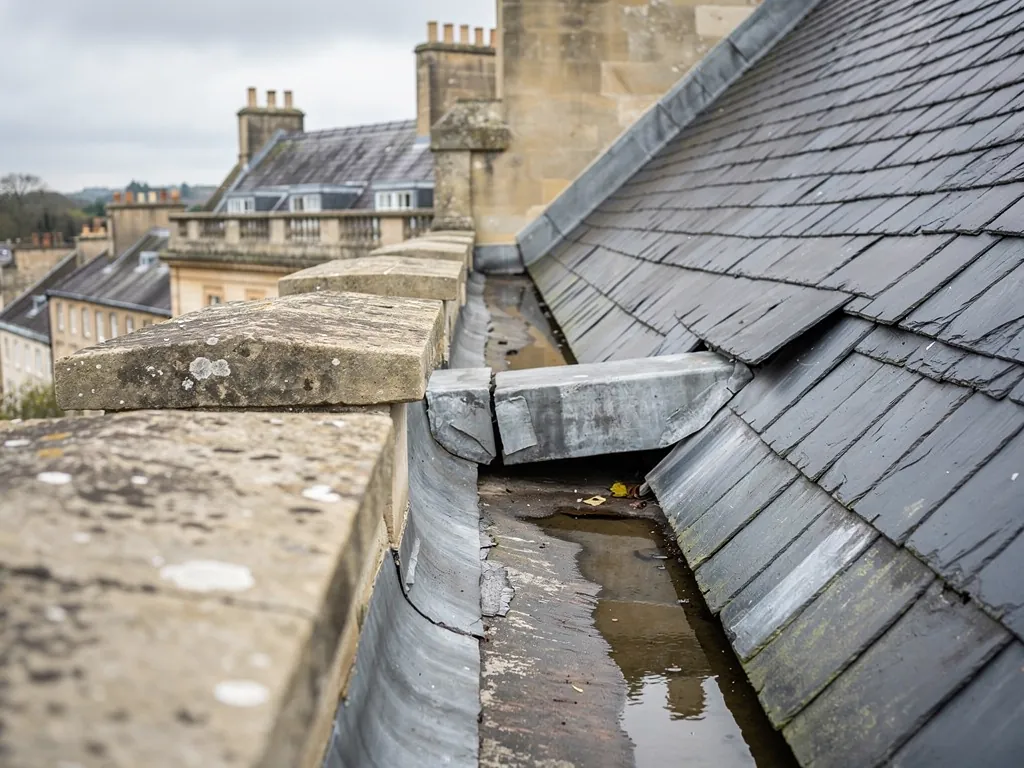
Older Bath houses make this harder, because the visible roof is only part of it. A Georgian terrace may have a parapet wall at the front, with a lead-lined channel behind it (a parapet gutter) that carries the water of the whole roof to a downpipe. A Victorian villa may have valleys, the internal angles where two slopes meet, lined with lead. Each of these is out of sight from the street, and both are places where water gets in. If a roofer talks only about tiles or slates and never asks about the gutters and flashings, they may be pricing the part they can see from the pavement.
Good signs at this stage are practical. They ask to see the loft, not just the slopes. They ask how old the covering is, whether it has been repaired before, and whether the building is listed or in the conservation area. They tell you when they cannot judge something from the ground. Poor signs are just as practical: a price offered within minutes, a diagnosis delivered from the drive, or a firm view that the whole roof must come off before anyone has been up.
A repair-first attitude is also worth listening for. Plenty of leaks come from one failed detail, and a roofer who proposes a repair where a repair will work is not leaving money on the table. They are telling you they have found the actual fault.
Questions to ask about the work itself
Once someone has seen the roof, put these to them. None needs technical knowledge to ask, and the answers show how they think.
- What is causing the problem? You want a named part and a named cause, for example split lead beside a drip, or slipped tiles above a failed valley. "Age" is not a cause.
- What exactly will you do, and what will you leave alone? The boundary of the job matters as much as the job. If the lead at the chimney is not in the scope, you should know that before you sign.
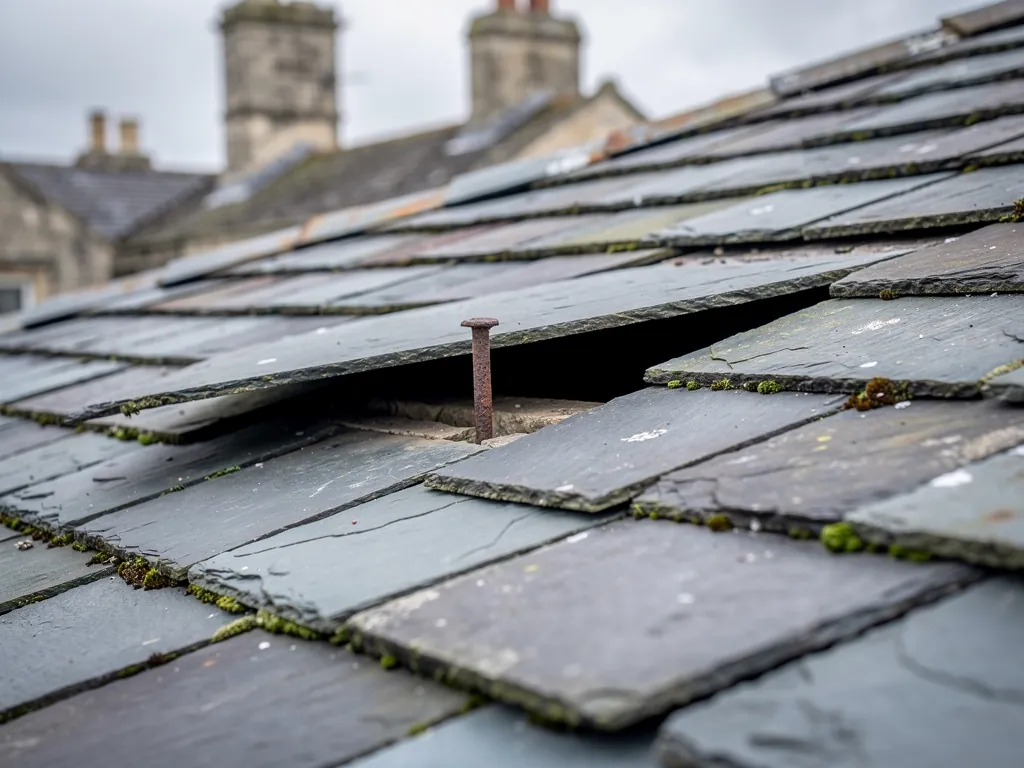
- Can the roof be repaired, and if not, why not? The answer should come with something you can see, such as photographs of the nails, the battens or the underlay.
- What will the new covering be, and will it match? On an older house, natural slate should stay slate and stone tiles should stay stone. A cheaper substitute changes the look of the street and, on a listed building, may need consent.
- What happens underneath? Ask about battens (the laths the covering is fixed to), underlay (the membrane beneath them), and the condition of the rafters.
- Who deals with building control and consent? Some roof work needs Building Regulations approval, and a listed house needs consent granted by B&NES Council. A roofer should be able to say which applies to your job without being prompted.
It helps to ask each question of every roofer you speak to, and to write the answers down. Differences become obvious when the same question gets three different replies, and you can then ask the more thorough roofer why the others left something out.
Watch also for how questions are received. A roofer who answers directly and invites more questions is easier to work with for the next three weeks than one who treats every query as an insult. The way someone explains a hidden detail on day one is usually the way they will explain a problem found on day five, when the old covering is off and the timber is not what anyone hoped.
Questions that suit Bath's older houses
General advice about hiring a roofer stops short of the details that matter here. A house in Bath is more likely than most to have lead, stone, lime and historic slate in its make-up, and a few extra questions show whether a roofer is used to them.
Lead and the hidden gutters
Ask who will do the leadwork and how it will be detailed. Lead is dressed in sections with rolls, drips and laps to allow for the movement of the metal as it warms and cools, and the way those are formed decides whether a gutter lasts. A roofer who has worked on parapet and box gutters (a box gutter runs in a trough between slopes or against a wall, lined with lead) will explain what they do at the outlets and the laps. One who has not may suggest a surface coating or a sealant, which on an old lead gutter is usually a short-term answer.
Matching what is there
Ask where replacement slates or stone tiles will come from. Reclaimed material, sorted by size and colour, often matches a weathered roof better than new. The Bath Preservation Trust, in casework on a Grade I terrace, backed the swap of an artificial slate for a natural Welsh one, which shows how closely the look of a roof on a significant building is watched.
Pointing, flaunching and mortar
If chimney stacks are involved, ask what mortar will be used. In another Trust case, the Trust asked for lime mortar on a listed stack and warned that cement can add to stone damage. A roofer who reaches for cement on a lime-built stack has not read the building.
Access and scaffold
Terraces, basement areas and narrow streets make scaffold a real question. Ask who arranges it, whether it needs a licence from the council if it stands on the pavement, and what it costs. Our page on the scaffold licence explains the process.
The paperwork you should expect
A proper job leaves a paper trail, and each piece protects you. None of it is unusual, and a roofer who is reluctant to put things in writing is telling you something.
A written quote with a scope
The quote should say what is being done, where, with what materials, and what is excluded. It should name the covering, the underlay, the battens, the lead, the ridge fixings and the scaffold, rather than offering one lump sum for "re-roof". Our page on what a roofing quote should contain goes through the list line by line. A fixed price is the aim: one figure, set after the roof has been inspected, with a clear process for anything uncovered once the work begins.
Payment terms
Ask what is payable and when. Large payments before any work has been done are a concern, and our answer on the roofer's deposit explains what is reasonable and what is not. Card or bank transfer leaves a record; an insistence on cash does not.
A guarantee you can read
If a roofer offers a guarantee, ask to see it. A useful one is in writing, states how long it lasts, says what it covers, and is clear about who stands behind it. A guarantee backed by nothing but a promise is worth only what the promise is worth, and you are entitled to know which kind you are being offered. Ours is a 10-year workmanship guarantee, issued in writing; the wider principles sit on our page about the roofing guarantee.
Building control and consent
If the work needs Building Regulations approval, someone must make the application and receive the completion certificate, which you will want when you sell. If your house is listed, consent must be granted before any work starts. Ask who is responsible for each, and keep copies.
A start date and a programme
A realistic start date, an expected duration and a plan for bad weather are all fair requests. Roofs are open to the sky during a re-roof, and the plan for rain should be something other than hope. See our answer on roofers working in the rain for what to expect.
Quotes: how many, and how to compare them
One quote is not enough to judge, and a dozen is a project in itself. Two or three, from firms that have each been up and looked, give you a spread without exhausting you. We look at the question of numbers separately in how many roofing quotes to get.
Comparing quotes is where most people go wrong, because the figures at the bottom are rarely for the same job. A quote from one firm might include new battens and a breathable underlay while the next skips both. Lead at the chimney may be renewed in one and left in the other. One may allow for scaffold and skips; the other may list them as extras. Lay the quotes side by side and compare line by line, not total by total.
If a price is far below the others, find out why. It may reflect a smaller scope, a cheaper material or a roofer working with fewer overheads. It may also mean the price will grow once the job starts. If a price is far above, ask what it includes that the others do not. A good roofer will not mind being asked, and the answer is often a detail that was missing from the cheaper quotes.
Typical UK prices for common jobs are available if you want a sense of scale before the quotes arrive, and our overview of what roof work costs sets them out by job type. Use them to read the figures on a quote, not as a price for your roof.
A cheap quote that leaves out the hidden parts is not cheap. It moves the cost to a later date and, often, to a second roofer.
Red flags worth walking away from
Some warning signs deserve a polite goodbye. None proves bad faith alone, and several together are a pattern.
- A knock on the door about "loose tiles". Unsolicited callers who claim to have spotted a fault from the street, and who can start straight away, are a well-known route to overpriced and poor work. Our page on doorstep roofers explains what to do.
- Pressure to decide today. A good price will still be good tomorrow. A quote that expires at the end of the visit is a sales tactic.
- Vague scope. "Sort out the roof" is not a specification.
- A request for a large sum up front, especially in cash, before materials are ordered or work begun.
- Dramatic claims. A roofer who says the roof is about to collapse and who offers a solution only they can deliver is selling fear. The honest picture is usually calmer, and a sound roofer deals with the immediate danger and talks about the rest afterwards.
- No interest in the loft or the gutters. A roof cannot be judged from the outside alone.
- Refusal to put a guarantee in writing. If it matters enough to mention, it matters enough to sign.
- Cement, sealant or bitumen offered as the cure for old lead or slate. These can hide a fault for a season and make the proper repair harder later.
None of this needs confrontation. If something feels wrong, say you will think about it and ask for the quote in writing. A firm that is confident in its work can wait.
Roofer or builder, and when the job needs more than one trade
A roof is a specialist job, and the choice of trade matters more on an older house. A general builder may be well suited to a project that includes a roof, such as an extension or a loft conversion, and may subcontract the roof itself. A roofer is the better first call for a leak, a re-roof or a repair to the covering, flashings or gutters. We set out how to decide in roofer or builder.
Some jobs involve several trades. A chimney rebuild may need a mason for the stonework and a roofer for the flashings, while a loft conversion may bring in carpenters, plasterers and electricians. It is reasonable to ask who is responsible for the whole job and who coordinates the others, because roofs fail at the joins between trades more often than in the middle of any one of them.
Where a property is shared, such as a flat in a converted house, the roof may belong to the freeholder or be a shared responsibility, and the decision to hire may not be yours alone. Our page on the homeowner's roof guide covers the practical steps of managing roof work from start to finish, including the questions of ownership and neighbours.
Finally, think about the long term. A roof is not a job you want to repeat, and the best arrangement is a roofer you could call again. You will find out how they behave when something goes wrong, and the first sign is how they handle the small things: whether they return your calls, whether they clear up each day, and whether the site is left safe overnight.
The survey, the handover and what good looks like
A survey should leave you with pictures taken on your own roof, plus a clear account of what was found and a fixed price in writing. At Empire Roofing Bath the survey is free, and the pictures mean you see what we saw rather than relying on a description. You do not need to take our word for it, and you should expect the same from anyone else.
During the work, a good roofer tells you what they find when the covering comes off. Old roofs hold surprises: rotten rafter feet beneath a failed gutter, battens that have given up, lead that was patched with something unsuitable years ago. A roofer who photographs these and discusses them before charging for them is treating you fairly. One who presents a larger bill at the end with no explanation is not.
At the handover, expect a tidy site with the rubbish removed. Expect any consent or certificate to be passed on, the guarantee in writing, and a short account of what was done. For a re-roof that needed approval, the completion certificate is the document you will be asked for when you sell the house.
It may take an hour or two to follow this process properly, and it can feel like a lot of effort for a roof. The time is well spent. Most roofing disasters come from a hurried decision, a vague scope or a payment made before anything had been agreed, and each of those is preventable with a few questions asked at the right moment.