Few people think about a roof until it fails, which is a pity, because its life follows a fairly predictable course. A new roof is a sealed, tight system. Over the years it weathers, the small parts wear, and the maintenance it needs shifts from almost nothing to regular attention and then to a decision about the future. Each stage has its own jobs, its own risks and its own sensible spending. This guide follows a house roof through that arc: the installation and what to keep from it, the settling-in period, routine care, the repair years, and the point at which replacement becomes the better choice. It is written for homeowners, whether the roof is a new build, a Victorian slate roof in Bath or a 1930s tiled semi in one of the surrounding towns. Timings vary with material and exposure, so the focus is on signs, not dates.
Installation: what to get and keep
The first chapter starts before the first tile goes on. A good installation is set by its specification: what covers the roof, what lies beneath it, how the ridge and verges are fixed, how the lead is detailed and how the loft breathes. Ask for each to be named in the quote. If a roofer cannot tell you what is going under the covering, that is useful information in itself.
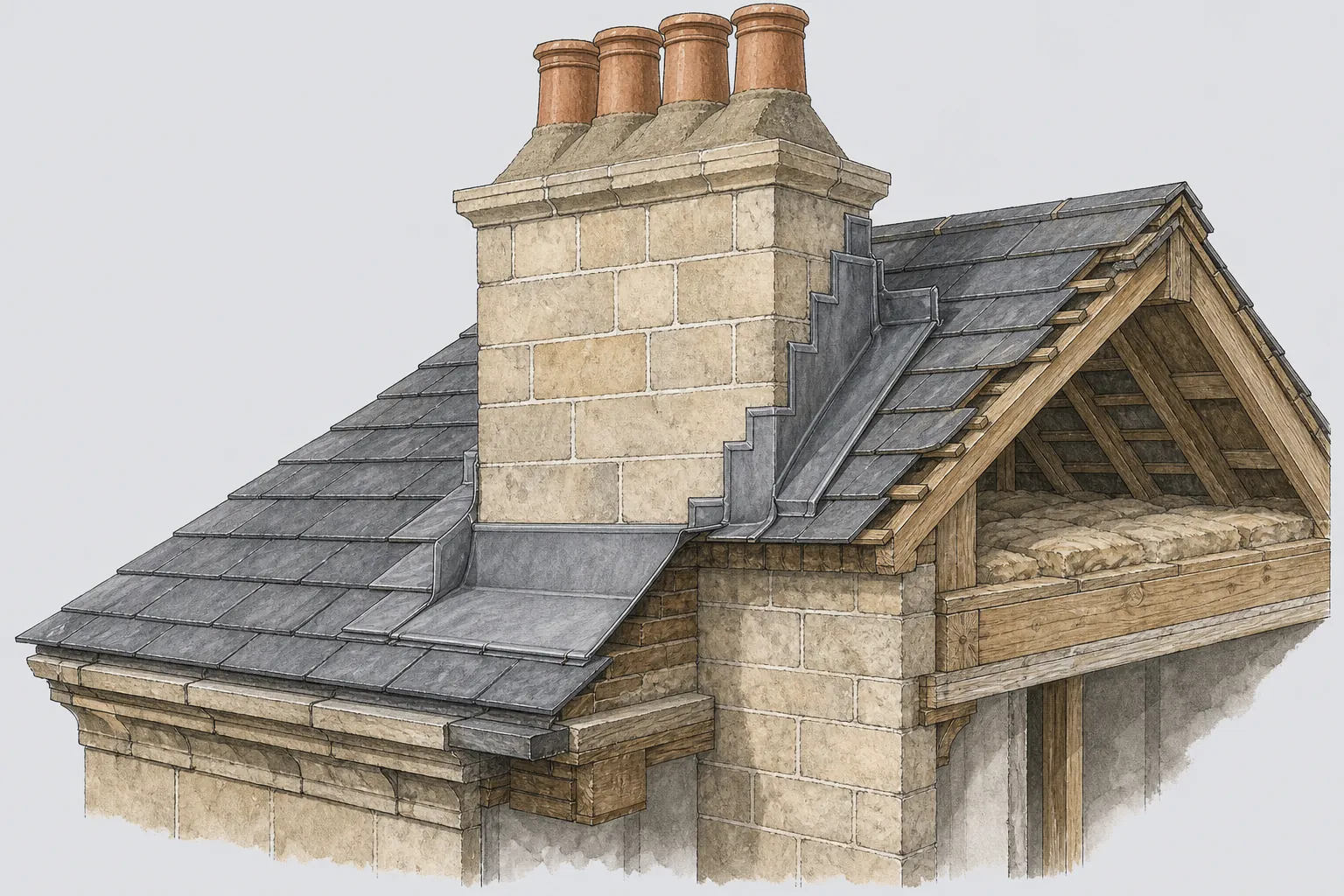
On a replacement, the order of work matters. Out comes the old covering, then the timbers get inspected and anything rotten is cut away. New underlay and battens go on before the covering, and the details follow: valleys, flashings, ridge, hips and verges. Fixings for ridge, hip and verge pieces have to be mechanical, since BS 5534:2014 no longer treats mortar alone as enough, and dry-fix systems are tested under BS 8612:2018. A re-roof can also bring in Building Regulations, as the Planning Portal sets out, particularly where a large share of the roof is renewed or the new covering is noticeably heavier. We explain which applies and handle notification where required.
Keep paperwork. A written specification, the guarantee, any building control certificate and photographs taken during the work are all worth filing together. They answer questions years later, when a buyer's surveyor asks what was done or a neighbour wonders whose gutter is whose. Ours is a ten-year guarantee on workmanship, issued in writing. It is a promise about our work and not an insurance policy.
Finally, ask for the site to be cleared properly. Spare slates, tiles and ridge pieces are worth keeping in the garage or loft, labelled, because matching a weathered roof from scratch is difficult. Our guide to choosing a roofer lists the questions to put to anyone quoting.
The first seasons
A new roof settles. Slates and tiles bed in, timbers dry out and adjust to the weight above, and the system shows whether any detail was rushed. The first few winters are when installation mistakes show up, so it is worth looking more closely at a new roof than an old one.
After the first heavy storm, take a walk round the house and study the roof from the ground. You are checking for slipped or missing pieces, a ridge that no longer looks straight, and gutters that overflow or hang away from the wall. Inside, go up to the loft with a torch while it is raining or just after, looking for damp patches on timber, drips at the chimney and daylight around the edges of the roof. Any of these in the first years is a matter for the installer, not an expense for you, and a written guarantee exists for exactly this.
Condensation is the other early lesson. A well-sealed house with a sealed roof can trap moist air in the loft, which condenses on cold timber and the underside of the underlay. The effect resembles a leak, though no water is coming in from outside. Roof ventilation, whether eaves vents, ridge vents or breathable underlay, is meant to prevent it, and blocked soffit vents are a frequent cause. Never stuff loft insulation hard against the eaves, because it cuts the airflow.
If you move into a house with a roof of unknown age, treat the first year as a get-to-know-it period. A roof inspection, rather than a leap to conclusions, gives you a baseline that records the covering, its state, and the item likely to want attention first. The roof inspections service page lists what a survey records.
Routine care through the middle years
For most of its life, a roof asks for very little. The job is to catch small things before they become large ones, and the routine is short.
Gutters and outlets
Gutters and downpipes want clearing once a year, ideally when the leaves are down. If an outlet clogs, water spills across the fascia, and in a lead gutter it can rise and creep beneath the slates. A hose or a gutter vacuum from a safe position will tell you whether the water runs clear. Do not climb a ladder onto a slope.
Moss and growth
Moss keeps the covering damp and lifts tile edges, so it should come off, but gently. MyBuilder's 2026 cleaning guide warns that a pressure jet can harm delicate tiles, which makes soft washing the safer method on a weathered roof. Cleaning is a maintenance job and does not repair a failing covering, so a roof that has gone badly needs inspecting before it is washed.
Looking from the ground
Binoculars are an underrated tool. From the garden or the pavement they show missing slates, cracked ridge tiles, leaning chimney pots, gaps in pointing and sagging gutters. Take a photograph each year from the same spot and you build a record of change.
Professional inspection
A roofer going up for a look is worth the cost every few years and after major storms, and certainly before a house sale or purchase. MyBuilder's inspection guide (2026) reports typical UK costs of about £150 to £500, depending on method. The report gives you condition notes and photographs to act on, or to keep.
This is also the stage to read our wider guide, roofing services explained, so you know which kind of firm to call for which problem.
The repair years
Sooner or later a roof starts to need repairs. This is normal. The question is whether the repairs are isolated or part of a pattern.
Isolated repairs have a clear cause and a local fix. A tile broken by a falling branch, a flashing lifted by wind, a ridge piece loosened by frost: each can be repaired, and the roof carries on. MyBuilder's repair guide (2026) reports typical UK costs that vary widely with how much is damaged and how hard the roof is to reach. Our own fixed price is set after the survey, with the access, scaffold and materials itemised.
Patterns are a different story. Slipped slates on several slopes point to nail failure, since each slate hangs on a nail and those corrode with age. Cracked tiles across the roof suggest frost damage or brittle material. Staining on ceilings in more than one room suggests the underlay or the timbers have given out. When faults appear in different places, treating each in turn costs more than the sum suggests, since every visit carries access costs.
Leaks need urgency. Water in a roof does damage out of sight, and wet insulation or timber loses its value quickly. A leak gets our attention ahead of routine work, and we stop water entering before anything else. If you plan to claim on household insurance after storm damage, note that insurers often define a storm by a wind gust of 55 mph or above, and that wear and tear is commonly excluded. A roofer's report and photographs help your case. Whether a claim succeeds is for your insurer to decide, not us.
For detail on single faults, our pages on roof repairs, ridge and verge repairs and chimney repairs describe how each is done.
Access, scaffold and who needs to know
Work on a house roof is controlled by more than the roofer's skill. Access is the main practical limit. A low extension roof may be reachable from a ladder. Anything higher normally needs scaffold, which is a safety requirement for work at height and, on a full replacement, a significant cost. MyBuilder's new roof guide (2026) reports a typical UK scaffold cost of about £1,125 for such a job.
Scaffold that has to stand over the footway or road can need permission from the highway authority. Our answer on the scaffold licence explains when that applies and who arranges it. In Bath, narrow streets and basements under the pavement can make this a real consideration, so raise it early.
Neighbours matter too. A terraced or semi-detached roof shares walls, stacks and sometimes valleys with the next house. Tell them before the scaffold goes up, and give them a rough timeline. If work touches a shared wall, the Party Wall etc. Act may come into play; our page on party wall roof work covers it.
Wildlife is a final check. Bats and nesting birds both have legal protection, so signs of either on your roof call for care before work begins, and Natural England handles bat licensing.
These are boring points, but they are where jobs get delayed. A roof that is ready for replacement is a roof where the paperwork, the scaffold and the neighbours have been dealt with first.
When replacement makes sense
A time comes when repairing stops being the economical choice. It is rarely marked by a single event. Usually the roof gives a run of signs together.
- Slipped, cracked or crumbling slates and tiles on every slope, not just one.
- Daylight showing from the loft, or a sag in the line of a slope.
- Underlay that has perished and crumbles when touched.
- Rotten battens or rafters found during repair visits.
- Leaks that move around the house as you fix them.
- A covering that has worn through its surface layer, with patches of bare, soft or flaking material.
Any one of these may be repairable. A cluster of them says the whole system is reaching its end. The honest comparison is between the cost of a long run of repairs and the cost of a roof that should not need attention again for a long time. Your roofer should give you the evidence for that comparison, with pictures of what lies underneath.
Replacement is the biggest single piece of roofing work, and it should be a planned project, not an emergency. MyBuilder (2026) reports typical UK costs spread across a wide range, driven by roof size, covering, shape and access, and the firm number comes only after a visit. On an older house in Bath, matching the original covering and lead detail adds care and time, and listed buildings need consent first. Our pages on roof replacement and on the Georgian terrace roof go deeper on both.
The best moment to plan is before the emergency. A roof inspected every few years gives you time to save, compare quotes and choose a good season for the work, instead of buying under pressure with water coming in. For a list of what every firm offers, start at the Empire Roofing Bath home page.