The word "roofer" covers a surprising range of work. One call might be to clear a blocked valley, another to strip and rebuild a whole slope, and a third to replace the fascia boards that run along the eaves. Each is roofing, and each calls for different skills, materials and sums of money. If you have only a stain on a ceiling and a vague sense that something is wrong, it helps to know the categories before you phone anyone. This guide walks through what a roofing company does under each heading: new roofs and replacement, repairs, leadwork and weatherproofing details, the roofline of gutters and boards, and ongoing maintenance. It explains what is involved, what tends to drive the price, and how to match your own symptoms to the right job, so that the quote you receive is for the problem you actually have.
Five kinds of roofing work
Roofing work sorts into five groups, and most quotes are a mixture of two or three of them.
- Installation and replacement: building a roof covering from the timbers up, whether on a new structure or in place of an old covering.
- Repair: putting right a specific fault, such as slipped tiles, a cracked slate, a failed flashing or a leaking valley.
- Leadwork and details: the sheet-metal work that seals the junctions, such as chimneys, walls, dormers and gutters.
- Roofline: the fascias, soffits and guttering at the eaves, which gather and carry water off the roof.
- Maintenance: inspections, cleaning and small preventive jobs that keep the other four away.
The groups overlap in practice. A replacement roof includes new leadwork. A repair may uncover timber that needs replacing, which moves the job towards a larger one. A maintenance visit may find a failed flashing and turn into a repair. Keeping the groups in mind helps you read a quote: each line should say which of the five it belongs to, and what is being renewed rather than kept.
Empire Roofing Bath works across all five, for homes and commercial buildings, in Bath itself and in the surrounding towns, as far as 30 road miles away. What links the work is a habit of looking at the roof as it was built, then putting it right in kind. Repair is our starting point whenever the roof will take it, and where it will not, the quote says why.
The headings below take each group in turn. Skip to the one that fits, or read through to see how the others connect to it.
Installation and replacement
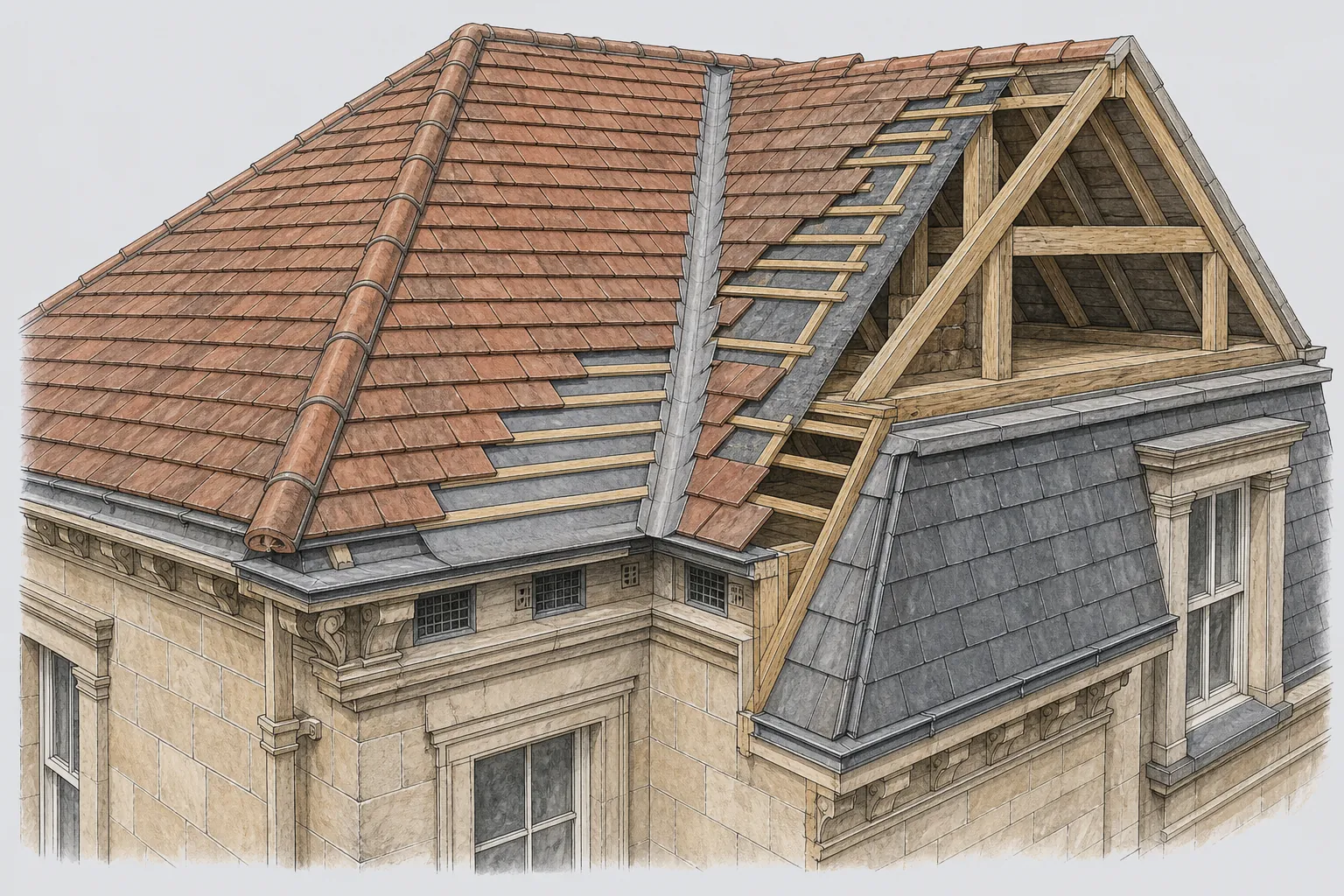
Replacing a roof covering sounds simple: take the old one off and put a new one on. The sequence on site is more involved than that. Scaffold goes up first, because a roofer working off ladders cannot handle slate or tile safely at height. The old covering comes off in stages, which keeps the house covered at the end of each day. Battens, the timber strips carrying the slates or tiles, are lifted so the rafters can be inspected. If timber has rotted or been attacked by beetle, it is cut out and renewed. Underlay then goes on, a sheet beneath the battens that deals with water blown past the covering, and fresh battens follow.
The covering itself is laid course by course, working up from the eaves. The detail work comes last or in parallel: ridge and hip pieces, verges, valleys and the lead around chimneys. Ridge and verge work follows BS 5534:2014, a standard that does not treat mortar by itself as a fixing, so each piece also needs a mechanical fastener. Dry-fix, a clip-and-seal alternative to bedding in mortar, is tested under BS 8612:2018.
Replacement is the biggest single type of roofing job, and it brings the Building Regulations into it. The Planning Portal explains the thresholds that decide whether building control approval applies and whether the roof has to be upgraded for insulation. We explain which side of those thresholds your job falls on and look after the notification where it applies. Replacement sits, on MyBuilder's 2026 figures, between about £5,000 at the low end and £12,000 at the top for a typical UK house, shifted by roof shape, covering and access. We set our own figure once we have surveyed, and put it in writing.
Our pages on roof replacement and pitched roofing describe the work for houses, and flat roofing covers membrane systems.
Repairs: finding the real fault
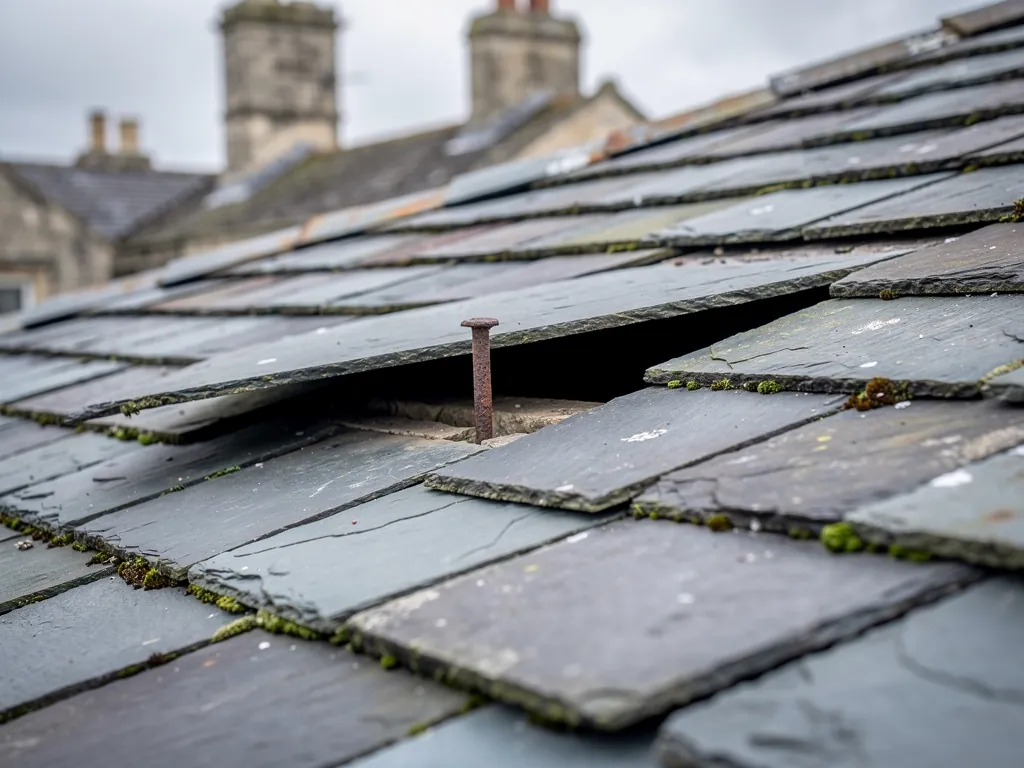
A repair is not just replacing what has fallen off. The slipped slate on the lawn is a symptom, and the nails that failed are the cause. A sound repair begins with why the fault arose, and deals with that before the visible damage. If a tile has cracked because a batten beneath it has rotted, replacing the tile alone buys a few months.
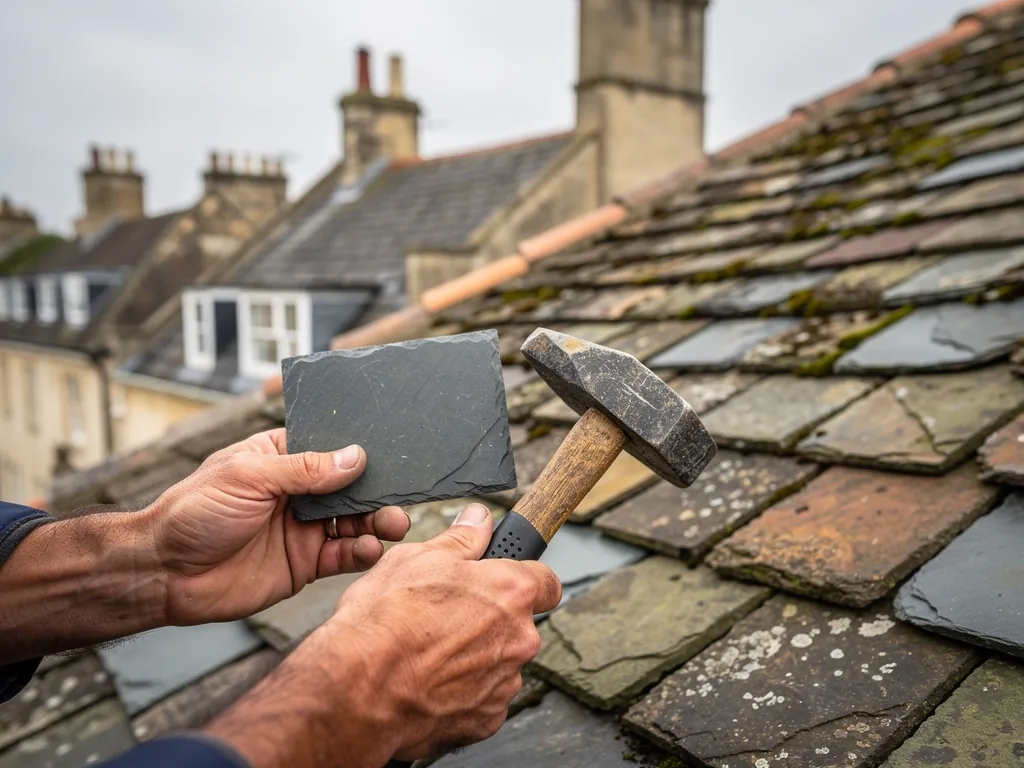
Common repair jobs include replacing slipped or broken slates and tiles, relaying ridge tiles that have loosened, re-dressing or replacing a failed flashing, clearing and repairing a valley, and patching a flat roof membrane. A slate that has slipped is pinned back with a tingle, a thin copper or lead strip fixed to the batten and turned up across the slate's tail. A cracked flaunching on a chimney stack is re-formed in mortar, with lime on older stonework.
MyBuilder's 2026 repair guide puts a minor job at roughly £100 to £300 across the UK. A moderate repair is placed in the region of £500 to £1,000, while storm damage lands between £500 and £1,500. Access often swings the total. Low on a rear extension, a fault may be reachable by ladder, while the same fault up at the ridge of a tall house could need scaffold, which can cost more than the labour. The firm figure for your roof is written down after the survey.
We prioritise leaks and storm damage. Water coming in is stopped first, perhaps with a temporary cover, and the lasting repair follows when the cause is clear.
The question every repair raises is how long it will hold. If the whole roof is in decline, with nails failing and the underlay perished across all slopes, then repeated visits cost more than a plan for replacement. Where that is the situation on your roof, we explain it with photographs. Read our page on roof repairs for the process, or slate roofing if your roof is natural slate.
Leadwork and weatherproofing details
Most of the water that gets into a roof gets in at a joint, a point where the covering meets a wall, a chimney or another slope. Sealing these joints is leadwork, and it is a trade of its own.
Four terms recur. A flashing is lead dressed across a junction so water is carried out onto the slope. Soakers are small lead pieces interleaved with the covering beside a wall or stack. A valley is the channel in the fold between two slopes. A parapet gutter lies behind a low front wall on a terrace and drains the slope behind it, and a box gutter is the squared version running between slopes or walls.
Lead is a soft metal that can be shaped to a junction and will tolerate movement, but it fails in particular ways. It splits at folds and drips where it has been pushed past its working length. It creeps down a slope under its own weight if it is fixed too rigidly. It is damaged by cement mortar, and by being walked on. We specify the lead by its code number, which describes the sheet's thickness, to suit the position and length of the run.
Chimney leadwork is the most frequent job in this group. For chimney leadwork, MyJobQuote's September 2026 guide reports typical UK costs of £150 to £250 for a patch and about £570 for a full replacement on average, with scaffold changing the total either way. Lead across a whole flat roof is a larger commitment, and MyBuilder (2026) reports a typical UK range starting around £150 per square metre.
The hidden detail work matters most on older houses, where the roof's weak points are the lead gutters and stacks, not the open slope. We look at those in how Georgian terrace roofs fail, and describe the work itself on our pages for lead roofing and chimney repairs.
The roofline: gutters, fascias and soffits
The roofline is the strip where the roof meets the wall at the eaves. It holds three components. The fascia is the board along the rafter ends, and it carries the gutter. The soffit is the board on the underside, closing the gap between the fascia and the wall, often with vents to let the roof void breathe. The gutter catches water running off the slope and leads it to a downpipe.
These parts get less attention than the covering, but they decide where the water goes. A sagging or blocked gutter overflows past the fascia and runs down the wall, soaking the masonry and rotting the boards. Fascias and soffits in timber rot if they stay damp. In uPVC they warp and crack, and in aluminium they can dent. Cast iron guttering, found on older houses, is long-lasting but heavy, and rusts through at the joints if it is not painted and cleared.
Replacement means taking off the old gutter and boards, checking the rafter ends behind them, which are sometimes rotten, then fixing new boards, a new gutter run and new downpipes. It is a job of straight lines and clean joints, and it often goes alongside re-roofing, because the boards need to come off to finish the roof edge. MyBuilder (2026) reports typical UK figures per metre run of £30 to £70 for guttering, £80 to £150 for fascias and £100 to £180 for soffits, with scaffold adding to that. A firm price follows our own look at the eaves.
On a listed house or in the conservation area, replacing cast iron with plastic may raise consent questions, which we discuss elsewhere. The gutters, soffits and fascias hub has the full picture.
Maintenance and inspection
Maintenance is the quietest of the five groups. It is the work you do so that the others are needed less often. It breaks into three parts: looking, cleaning and small fixes.
Looking means a roof inspection. A surveyor goes up, or uses a drone or a camera on a pole where that is safer, and reports on the condition of the covering, the flashings, the gutters and the timber visible from within. MyBuilder's 2026 inspection guide reports a typical UK outlay anywhere between £150 and £500 depending on method, with drone and thermal work towards the upper end. An inspection is small money next to the faults it can head off.
Cleaning means removing moss, lichen and debris. Moss holds moisture against the covering and clogs gutters, but the method matters. MyBuilder's cleaning guide (2026) cautions that harsh jet washing can harm delicate coverings, which is why soft washing, a gentle rinse with a treatment applied to the growth, suits older roofs. Typical UK figures start at roughly £300 and run higher for slate.
Small fixes cover the clipping of a loose ridge tile, the re-bedding of a slipped slate, the clearing of an outlet. They take little time on a scheduled visit and a great deal more on an emergency one.
None of this needs a calendar. A walk round the house after a heavy storm, a glance round the loft with a torch for chinks of daylight or damp timber, and a clear-out of gutters in autumn are the sort of routine that catches problems early. The homeowner roof guide follows a roof through these stages from new to old, and our pages on roof inspections and roof cleaning describe the services.
Matching your problem to the right service
Use the table to work out which group your symptom belongs to. It is a starting point; the survey confirms it.
| What you see | Likely cause | Service |
|---|---|---|
| Slates or tiles on the ground | Failed nails, wind or frost | Repair |
| Damp patch beside a chimney | Failed flashing or flaunching | Leadwork or chimney repair |
| Water running down an outside wall | Blocked or dropped gutter | Roofline |
| Sagging, daylight in the loft, widespread slipped slates | Covering that has given out | Replacement |
| Moss, a damp loft smell, no active leak | Slow build-up of growth or condensation | Inspection and maintenance |
Real faults often cross the lines. A stain below a parapet may involve lead, timber and the gutter at once. If you are unsure, an inspection gives you evidence to work from before you commit to a bigger job.
How the work runs
With us, the process is the same for each group. We survey, photograph your own slopes and junctions, and walk you through the pictures. The written price is fixed and itemised. Afterwards we clear the site, take the rubbish away, and send photographs of the finished work so you can compare them with the pictures taken at the survey.
If a neighbour is involved, through a joint chimney or a dividing wall, mention it at the start. What to raise with the neighbour is covered in party wall roof work. The Empire Roofing Bath home page gives the full list of services.