Most roofs do not fail suddenly. A nail works loose, a piece of lead lifts at a corner, a gutter fills with silt, and for a while nothing shows. Then a wet winter finds the weak spot and the first sign is a stain on a bedroom ceiling. Regular checks interrupt that sequence. They do not need a ladder or any roofing skill, only a few minutes in each season and a habit of writing down what you see. This checklist follows the UK year because the weather sets the pattern: autumn leaf fall and winter storms test the roof, spring shows what they did, and summer is the time to get work done. It separates what an owner can safely look at from what should be left to someone with the equipment and training to work at height. Use it as a record. A dated note of what you saw and when is also useful if you ever make an insurance claim or sell the house.
How to check a roof without climbing on it
The rule for owners is simple: keep your feet on the ground. Falls from ladders and roofs are a serious risk, and a roof covering can be damaged by someone walking on it. Slate cracks under a boot, and old tiles can snap. Everything in this checklist can be done from the garden, a window, or the loft.
Gather three things before you start: a pair of binoculars or a phone with a good zoom, a torch, and a notebook or the notes app on your phone. Binoculars bring the roof to you. Walk round the house and look at each slope in turn, ideally in daylight with the sun low enough to throw small irregularities into relief. Photograph anything that looks odd and write the date next to it.
From inside, take a torch up through the hatch. Scan the rafters for pinpricks of daylight, dark tide-marks on the timber, and droplets forming beneath the covering. Check that insulation is not pushed against the eaves, where air needs to move. Ceilings and the tops of walls on the upper floor should be checked too, because water often shows on plaster before it shows anywhere else.
What you are looking for is change. A roof that looks the same this month as it did last season is probably fine. A slate that was straight and is now slipped, or a stain that was pale and is now brown and larger, is the thing to record and report. Where you have no idea what is normal for your roof, your first set of photographs becomes the baseline, and every later check is compared with it. If you are weighing up a house, the checklist for buyers uses the same approach before exchange.
Spring: reading what the winter did
Spring is the season for finding damage while there is time to deal with it before the next autumn. Walk round and look first for anything that has moved. Tiles or slates that have slipped, cracked or dropped are the obvious ones; check lawns, flowerbeds and paths below the roof, since fallen pieces often lie where they landed.
Look at the ridge, the line of capping along the top, and at hips and verges, the sloping and gable edges. On older roofs these are often bedded in mortar, and frost loosens mortar that has absorbed water. Cracks, gaps or a section that has shifted should be noted. Under British Standard 5534, bedding mortar by itself cannot be counted on to hold ridge, hip and verge pieces, so a roofer rebuilding them will usually add mechanical fixings.
Check the chimney from the ground. Look at the pot and the top of the stack, the mortar joints, and the lead dressed around the foot of the stack. Staining on the chimney breast inside a bedroom is a prompt to look harder.
Then look at the gutters. After winter, spring is a sensible time to check that they carry water away. If you can, run a hose over a section, or watch during rain. Overflowing at a joint, a gutter that sags, or water running down the wall behind the downpipe should be noted for repair. In the loft, look at the insulation and the timbers for any damp that appeared over winter.
If there was a storm, treat it as a reason to check immediately instead of waiting for spring, and keep photographs in case you need to make a claim. Our guide to claiming for roof damage explains what to record.
Summer: dry weather jobs and moss
Summer is the best time to commission work because the weather lets a roofer open up the roof and the supply of materials is steady. It is also when growth takes hold. Moss and lichen spread where a roof stays damp, usually on the north-facing slope or beneath trees, and they are easy to see from the ground.
Moss itself is not a crisis. The worry is a deep cushion of it keeping the covering wet, nudging up tile edges, and then clogging valleys and gutters as it breaks away. How you remove it matters more than whether you do. MyBuilder's 2026 pricing warns that a pressure lance can harm delicate tiles. Its typical UK figures begin at about £300, with pitched roofs commonly £450 to £850 and slate £500 to £1,000. Soft washing and a biocide treatment are gentler, and on slate or old stone tiles the method should be chosen to suit the material. Our roof cleaning page covers the options.
Summer is also when you should check for birds and bats. Nesting birds and bats are protected by law, so if you see activity in the eaves, leave it alone and ask before any work that would disturb it.
If your spring notes list repairs, summer is when to book them. Ask for a written quote that names each repair, and read our note on paying a deposit to a roofer before you agree payment terms. Put planned work in the diary for early in the season, because good roofers book up when the weather is dry.
In a heatwave, flat roofs deserve a look. Felt and some membranes soften and blister in strong sun, and blisters or open seams are easier to spot when the surface is warm and dry.
Autumn: gutters, leaves and getting ready
Autumn matters most, because a clear roof drains quickly and a blocked one does not. Start with the gutters and downpipes. Leaves, moss, seeds from nearby trees and grit washed from the tiles collect in them and eventually block the outlets. A gutter that overflows sends water over the wall face, where it can soak stonework and find its way in at the eaves. In Bath, where many houses are built in stone, that can become a long-term damp problem.
Clear gutters from the ground with an extendable tool, or have them cleared by someone with a safe access method. Do not lean a ladder against a gutter, which is not designed to take the load. Check each outlet, the joints between lengths, and the brackets. A gutter that has pulled away from the fascia or holds water in a puddle needs re-fixing or resetting to a fall. In MyBuilder's 2026 guide, new guttering is typically £30 to £70 a metre across the UK, and scaffold is extra on a tall house. Our page on gutters, soffits and fascias explains the work.
Look at trees. Branches that overhang or touch the roof drop leaves, scrape tiles and can fall in a gale. Cutting them back is a job for a tree surgeon if the branch is large or high.
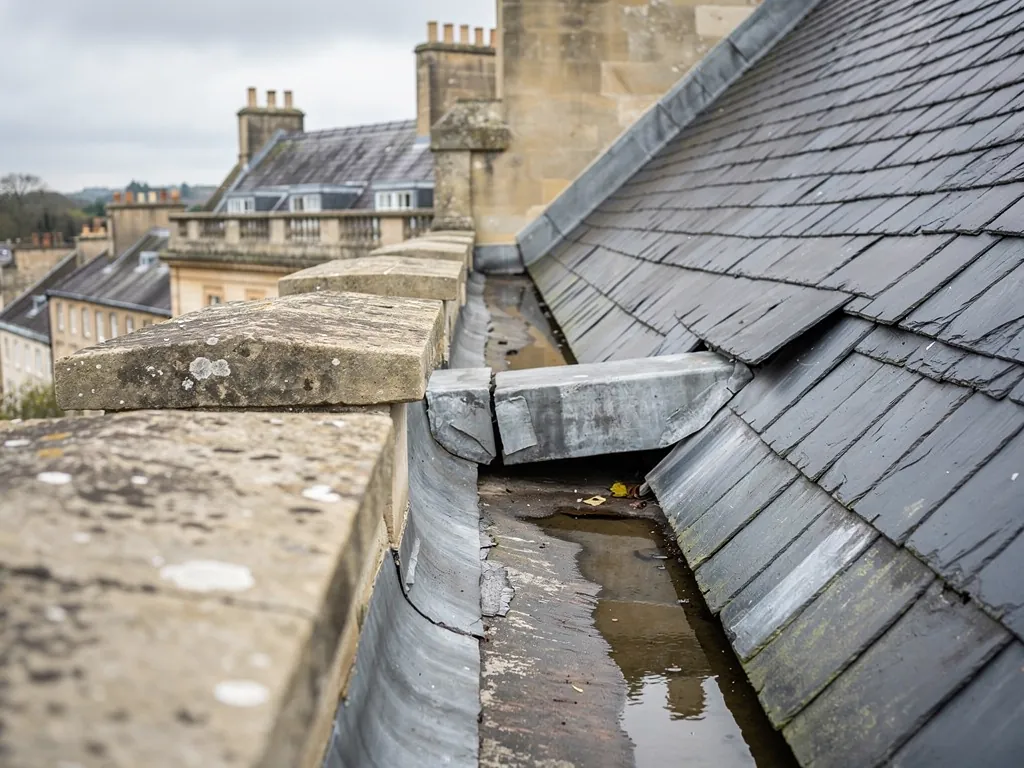
Look also at the valleys and flat areas, where leaves collect. Debris on a lead valley or parapet gutter holds water and increases the weight on the lining. A soft brush or gloved hand from a safe position is fine; stepping onto the lead is not.
Finally, check the loft for ventilation. Make sure insulation has not been pushed into the eaves and that any vents are clear, because condensation in a loft from warm damp air in winter can mimic a leak.
Winter: after storms and during cold snaps
Winter is not the time for inspection by ladder, but it is the time to watch. Rain and wind find faults that dry weather hides, and a quick look after each gale is worth the effort.
After strong wind, walk round and look for anything that has fallen, then check the roof with binoculars for gaps and displaced pieces. Check the ridge, the chimney and any flat roof or lean-to. If you find missing tiles, a lifted flashing or a leaning pot, photograph it, take safe steps to limit water entry, and arrange for someone to make the area safe. A make-safe holds the problem where it is while the proper repair is planned, and for us a leak or storm damage is the first thing to be dealt with.
During rain, look at the roof from outside if the weather allows. Water running over the edge of a gutter, pouring from a joint or dripping from the eaves tells you where the system is failing. Inside, check ceilings and corners after heavy rain, especially under chimneys, valleys, dormers and flat roofs. A drip that appears only in wind-driven rain often means a flashing or a gap under a tile.
In cold weather, watch for ice and snow. Snow can sit on a roof as a significant load and then slide in one piece, taking gutters with it. Do not rake snow off from a ladder, and keep people away from the foot of the wall. Where meltwater refreezes at the eaves, check for ice damming that sends water back under the tiles.
Winter is also when condensation shows. Black spots of mould in the top-floor corners, damp near the eaves or water on the underside of the covering are often condensation, not leaks. A roofer can tell the difference by looking at the pattern and the timing.
Jobs to book a roofer for
Some jobs are not for owners. Anything that needs working at height on the roof itself belongs with a roofer who has the right access equipment and training. Use your seasonal notes to build a list, then book the work in order of urgency.
Book promptly
Active leaks, missing or broken tiles and slates, slipped ridge or hip pieces, split or lifted lead, a chimney that leans or sheds mortar, a flat roof with open seams, and a gutter that has come away from the wall. These let in water, and the cost of delay is damage to timbers and ceilings.
Book within the season
Worn mortar at the ridge and verge, cracked flaunching (the mortar bed that seats a chimney pot), failed pointing on a chimney stack, ageing flashings, a valley with signs of wear, and moss that has built into a thick mat. These are the repairs that prevent bigger ones.
Plan ahead
A covering that is simply worn out, repeated repairs in the same area, a perished underlay, or lead that has split in several places. This is the point where a repair-or-replace decision is needed, and an inspection with photographs is the way to make it. MyBuilder (2026) lists a typical standard inspection at £150 to £250 nationally.
If a roofer says a repair is possible, ask why a replacement is not needed, and the reverse. We repair where repair works, and we match materials on older roofs, which keeps a slate roof in slate and a stone-tiled one in stone.
Some work needs consent, particularly on listed houses and inside designated conservation areas. The separate page on planning rules for roofing sets out which jobs do and which are repairs. Everything starts with the owner's eye, and our home page lists the services behind the jobs above.