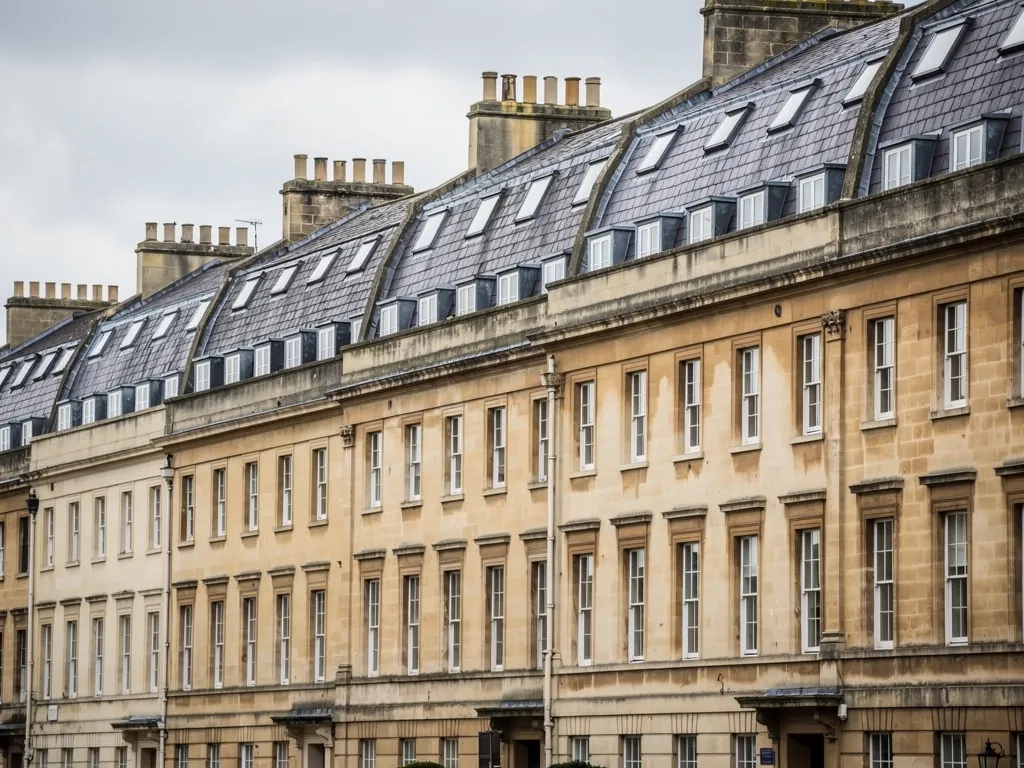
A roof is one of the costliest parts of a house to put right, and it is also the part a buyer sees least of. On a viewing you look up at it from the street, perhaps glance at the loft, and then your attention moves to the kitchen. A general homebuyer survey will comment on the roof, but often from the ground or a hatch, and a surveyor is not there to price a repair. That leaves a gap which you can narrow yourself with a few careful minutes and some well-aimed questions to the seller. This guide is written for buyers in and around Bath, where roofs range from lead-lined parapet gutters on Georgian terraces to stone-tiled cottages and 1930s semis. It sets out what to look at, what to ask about age, past work, guarantees, consents and spray foam, and the point at which a specialist roof survey is better value than guessing.
What you can see from the street and the garden
Start outside, before you go in, and stand far enough back to see the whole roof. Binoculars or the zoom on a phone help more than you might expect. You are looking for shape and pattern rather than a diagnosis.
Check the roof line first. A ridge line that dips, or a slope that ripples or sags between the walls, can point to timber or support problems, or to a covering that has been laid heavily over weak rafters. Then look at the covering itself. On a tiled or slated roof, note gaps, slipped pieces, cracked or broken ones, and any patch where the colour or the size of the tiles changes. A patch is not a fault in itself, because it shows that a repair was made, but a roof covered in patches may have little repair left in it.
Junctions come next, since leaks tend to begin there. Examine the strip of lead or mortar where the roof meets a chimney, a side wall or a dormer. Mortar fillets that have cracked and pulled away are a common sign of a flashing (the metal or lead strip that seals a joint) that has worn out. Check the chimney stack for leaning, open joints, and a pot or cowl that is not firmly held, and look at the ridge and verge, the angled edge where a gable finishes, for crumbling mortar.
Finish with the gutters and downpipes. Water staining on a wall below a gutter, green growth at a joint, or a sagging run all say that rain has not been carried away cleanly. A moss-covered roof is common and not alarming on its own, but heavy growth can lift tiles and hold damp against the covering.
Inside, look at the top-floor ceilings for brown rings, flaking paint or fresh patches of paint that look newer than the rest. Our year-round roof maintenance checklist lists the same signs from the owner's side, and they apply equally to a house you are about to buy.
Asking the seller about age and past work
A seller usually knows more about the roof than the listing says. Ask direct questions and write the answers down, because they can later be matched against the replies your solicitor receives on the property information forms.
The first question is age. Ask when the roof was last re-covered or substantially repaired, and by whom. A roof that was stripped and relaid has new battens, underlay and fixings; one that was patched has only the patches. Ask whether the whole house was done at once, or whether, as often happens on extended houses, the older and newer parts have different coverings.
Next, ask about leaks. Has the roof ever leaked, where, what was the cause, and what was done about it? Sellers have a duty not to mislead, so a clear and consistent account is reassuring, and a vague one is a prompt to look harder. Ask whether any insurance claim has been made for storm or water damage. Claims on the roof are not a bar to buying, but you should know about them, and our guide to how a roof insurance claim works explains what a claim normally leaves in the paperwork.
Then ask about maintenance. Are there invoices for gutter clearance, chimney repointing, moss treatment or lead repairs? Receipts show that the roof has been looked after, and they tell you who did the work, which matters if a problem returns.
Finally, ask about access and the loft. Is there a hatch, is the loft boarded, and has the seller seen the underside of the roof lately? Ask to see the loft yourself. Look for daylight through the covering, damp patches on the rafters and the underside of the sarking or boards, and any smell of mould. Do not step off the joists, and take a torch.
Guarantees, certificates and consents
Paperwork is where a good-looking roof is separated from a well-documented one. Ask the seller, through your solicitor, for any of the following that exist.
Guarantees
If the roof was replaced, ask for the guarantee and who gave it. A workmanship guarantee depends on the firm that wrote it still being in existence, so ask whether that firm is still trading and whether the guarantee passes to a new owner. Treat it as a document to read, not as proof the roof is sound. Check too whether the guarantee names the address and the work done, since a vague certificate that could apply to any roof is of little use if a dispute arises later.
Building Regulations evidence
Small re-covering jobs normally sit below the Building Regulations threshold, a limit the Planning Portal frames as a quarter of the envelope and half of the roof. A complete re-roof is beyond it, and a switch to a covering with a weight gain of 15% or above calls for approval and a structural check. If the seller had a whole roof replaced, ask for the completion certificate. A loft conversion, a dormer or a new solid conservatory roof also needs a Building Regulations application, so ask for the certificate for those.
Planning and listed building consent
About 5,000 of Bath's buildings are listed, and the consent for work on them is issued by B&NES Council. Alterations made to a listed property without consent are a criminal offence, and the problem can follow the house to its next owner. If the house is listed, ask whether the roof alterations had consent. If the house stands within Bath's conservation area (roughly half the city), ask whether any visible change to the roof, such as a rooflight or a changed covering, was allowed. Our page on roofing regulations in Bath sets out how those routes fit together.
If a certificate is missing, your solicitor can raise it before exchange. The cost of putting right an unconsented alteration should be weighed in what you offer.
Spray foam and other loft treatments
One loft treatment deserves its own check. Spray foam insulation, sprayed onto the inside face of the roof, can hide the very timbers and tile fixings you would want to see. RICS issued a consumer guide on it in March 2023. It cautions that condensation can go unchecked and that building fabric may suffer, and its advice to owners is to put the question to their mortgage provider first.
That lender point matters if you need a mortgage. Reporting in November 2024, drawn from a BBC investigation, found that some lenders would not lend on a home with spray foam in the roof, and that others assessed each case on its merits. Policies change, so treat that as a reason to ask early, not as a current list. If the loft looks as though it has been sprayed, a pale or yellowish foam stuck hard to the underside of the tiles or the felt, tell your solicitor and your mortgage broker before you commit.
Ask the seller when it was installed, by whom, whether any paperwork or guarantee exists, and whether a surveyor has commented. If the foam is there, the timbers behind it cannot be inspected without cutting into it. Removal is possible, and typical UK ranges reported by MyBuilder (2026) are £20 to £50 per square metre, averaging about £1,500 across a typical loft, and a pre-removal assessment of £100 to £200. That is a national guide, and the price for a particular loft depends on foam type and the condition of the timber behind it. Removal is not automatic: whether it is needed depends on what a specialist finds.
Other loft treatments are worth a glance. Boards laid straight over insulation, a damp-stained chimney breast, or loose insulation pushed tight against the eaves, where air should pass, each tell you something about how the loft has been used.
Our page on spray foam insulation goes into assessment and removal.
What fails first on older Bath houses
If the house is older, the thing to look for is less the covering and more the hidden detail beneath it. Natural slate and stone tiles are long-lived materials. What reaches the end of its life sooner is the lead, the mortar and the timber that support them.
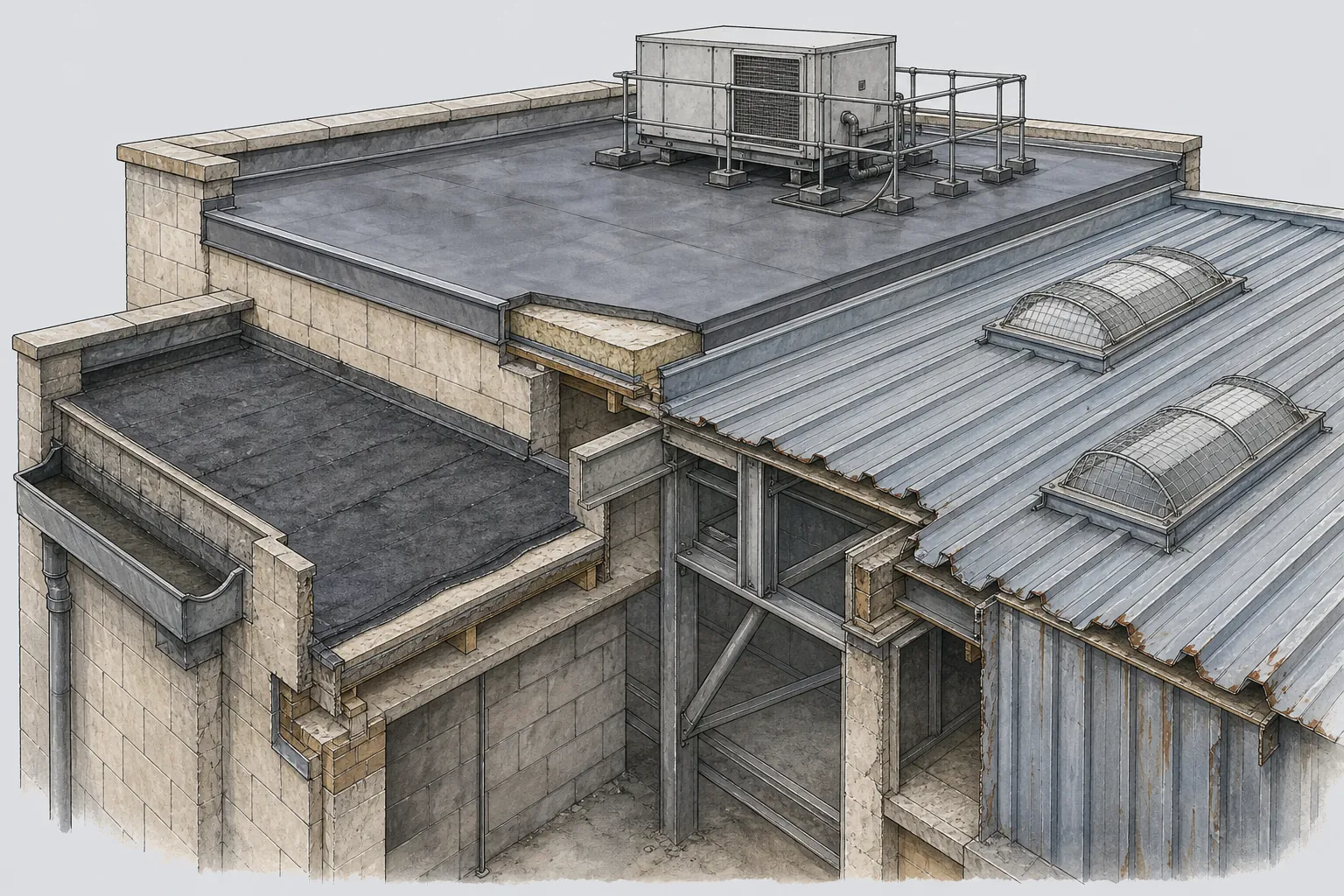
On a Georgian or Victorian terrace the usual suspects are the parapet gutter, which is lined with lead and runs behind a stone parapet wall, and the box gutter, a lead trough tucked between slopes or behind a front wall. Each gathers a great deal of rain, neither can be seen from the pavement, and the weak points are splits, laps and drips (the small steps in the lead that pass water along). A stain on a top-floor wall or ceiling beneath a parapet is a prompt to ask when that lead was last renewed.
Valleys, where two slopes meet, are another place to look, along with chimney flashings and flaunching, the mortar that holds a chimney pot and sheds water from the top of the stack. Mortar that is hard, grey and cement-rich on a stack built in lime can trap moisture and speed up decay of the stone. The Bath Preservation Trust has made that point in casework on a listed house in Walcot Buildings.
Where a house has a mansard (steep lower slopes, dormers built in), the covering is often on view, which makes its condition and its match with neighbours easy to judge. A replacement in a different material on a visible slope is something to ask about in a listed or conservation setting.
None of this means older roofs are a bad purchase. Many have been kept in good order for generations. It means the useful question is not how old the covering is, but when the lead and the flashings were last looked at.
When to commission a specialist roof survey
A general survey is a good start, but a roof-specific inspection is worth paying for in several situations. Commission one if the general report flags the roof for further investigation, if you can see slipping slates, sagging, damp stains or patched lead, if the house is listed or has lead gutters you cannot reach, or if the seller cannot say when work was last done.
It is also sensible when the loft has been sprayed or heavily boarded, when there is an extension or dormer with a flat roof, or when you intend to convert the loft, since the roof's condition affects what you can build on it. Do it before exchange, when the findings can still change the price or the terms.
The cost is modest against what it may reveal. MyBuilder's 2026 inspection pricing is a national guide only: a standard visit is typically £150 to £250, a drone survey £200 to £400, and thermal imaging £300 to £500, so the whole spread covers £150 to £500. Choose the type to suit the roof. A drone helps on a high or steep roof you cannot reach, while a thermal survey is more useful on a flat roof where moisture may be trapped.
Ask for a written report with photographs taken on the roof, labelled by slope. It should state what is sound, what needs repair now, what can wait and roughly what each costs, so you can set the figure against the asking price. Our page on roof inspections describes what a survey covers.
Once you have the report, get written quotes for anything it recommends, and compare like with like. The page on roofing quote contents shows what to look for. After completion the checklist continues from the Empire Roofing Bath home page, and a maintenance plan for your first year will keep the roof in the condition you paid for.