
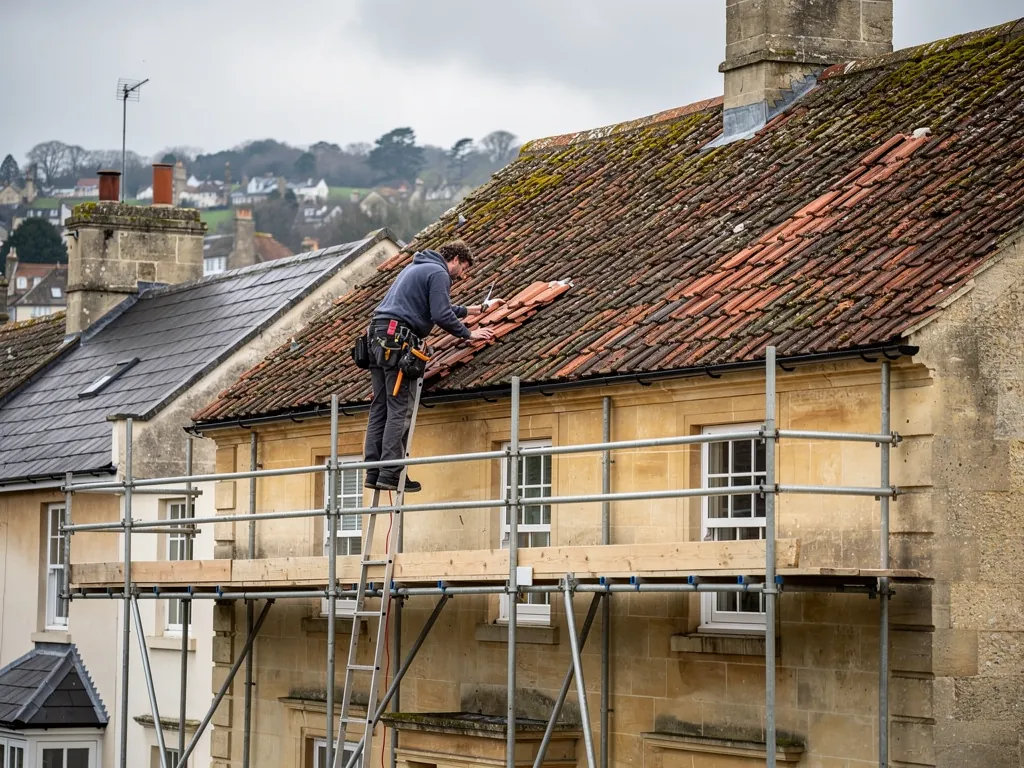
Two questions come up on almost every old tiled roof in Bath. Can the tiles be replaced with something close, and does the council need to be told first? The honest answer to both depends on the building. A Grade I terrace, a listed cottage, an unlisted Victorian house in the conservation area and a 1930s semi on the edge of the city sit in four different positions, even if the roofs look similar from the pavement. This guide explains the logic behind matching, what the tile itself is made of and why it matters, and where consent comes into the picture. It does not replace a conversation with B&NES planning, and nothing here is legal advice. It is meant to get you to that conversation knowing what to ask. If you are comparing tile types in general, the pitched roofing hub is the wider starting point.
Why matching matters on an old roof
A roof covering is not a neutral layer. On an older house it is the largest visible surface, and its material, texture and colour define how the building reads against its neighbours. Clay tiles, stone tiles, natural slate and concrete tiles all shed water, but they look different, weigh different amounts, weather differently and age at different rates.
Matching is the practice of keeping the roof the same kind of roof. A slate roof is mended in slate, a stone-tiled roof in stone, and a clay roof in clay of similar size and surface, never in a flat factory tile that only imitates the shade. The principle is simple, but the detail takes work, because tiles of the same type still vary in thickness, texture, colour range and edge finish.
Matching also affects how the roof performs. A heavy stone tile is carried by timbers sized for its weight. Substitute a lighter covering and the roof behaves differently in wind, with greater uplift. Substitute a heavier one and the timbers may be overloaded. Even when the replacement looks fine, mixing materials can lead to uneven wear, leaks at the junction of old and new work, and an obvious patch when the sun hits the roof.
Planners and conservation officers look at the same things for a different reason. A mismatch changes the character of a building and the street it belongs to. B&NES makes the point in its Freshford and Sharpstone appraisal: natural clay is common in that village, a good many buildings still carry Cotswold stone, and concrete re-covering harms the area noticeably. A planning officer reads an application with exactly that sort of view in mind.
How tiles are matched, step by step
Our first job on a protected roof is to find out what really covers it. That sounds obvious, but old roofs are rarely uniform. A slope may have been patched with several generations of tile, and the tile you see from the street may differ from what is on the back.
Identify the material and the pattern
The first check is the material: clay, stone, slate or concrete. Then the pattern. A plain tile is a small flat tile laid in overlapping courses. A pantile is the S-shaped single-lap tile, which our guide to pantile roofs covers. Some stone and slate roofs use diminishing courses, where the tiles get smaller from the eaves to the ridge, a detail that has to be reproduced.
Judge size, thickness and colour
Next we measure a sample of sound tiles and note their size, thickness, edge finish and colour range. Weathered tiles are rarely a single shade. A new tile in a flat colour looks wrong next to them, so we look for tiles with a similar variation.
Source the replacements
Where the roof is sound but incomplete, salvaged tiles are often the best match, because they have already weathered. Our page on roof pitch and tile choice matters here too, because a replacement tile must still be suitable for the slope it will cover. For a larger re-tile, tiles are sorted on site: sound ones are kept for the visible slopes, and new matching tiles make up any shortfall on the less visible ones.
Keep the hidden parts right
The tiles are only half of the roof. Underlay, battens, lead valleys, flashings and fixings are renewed where they have failed. These are the parts that make the matched tiles last, and they are rarely visible from the pavement.
When consent is needed to change the tiles
This is the part that causes most worry, and it is also the part where we are careful to point you to the council. The rules differ for listed buildings, conservation areas and ordinary houses, and the right answer depends on the case.
Listed buildings
The council's own advice is to speak to planning before touching a listed building at all. A listed building has its own consent application, quite distinct from planning permission, and anyone who skips it risks prosecution. Whether a simple matching repair needs consent is the council's call, so begin with a conversation instead of a guess. Changing the covering, altering the pitch or replacing a dormer is far more likely to need consent than replacing a few slipped tiles. How to apply, and whom to ring, is explained on the council's listed buildings pages. With roughly 5,000 listed buildings in the city, the conservation team is used to roof queries.
Conservation areas
About half the city sits in the conservation area. If your unlisted house there gets the same material back on the roof, that will seldom cause difficulty, whereas a different material or look deserves an early word with the planning team. Certain streets also carry Article 4 directions, a council tool that removes some permitted development. B&NES lists porches, windows, doors, painting and sheds as examples and does not name roofs, so look up your own address on the policy map.
Building Regulations
Consent for appearance is separate from Building Regulations. Work beyond small repairs, or a new covering that outweighs the old by 15 per cent or more, brings in building control. We deal with the notification where it applies.
Bath roofs, the Trust and what casework shows
There is no published B&NES guidance on re-roofing listed buildings that we can point you to, so the best evidence of what the council and its advisers look for comes from individual cases. Bath Preservation Trust publishes its comments on planning applications, and they show a consistent pattern.
- On a Grade I building in St James's Square, the Trust noted Welsh slate across the pitch and some clay pantiles behind, and backed new lead in the valley gutters and the removal of asbestos slates.
- For a terrace at Lambridge Place with mansard roofs and built-in dormers, it supported natural Welsh slate instead of the man-made type.
- At Walcot Buildings it asked for lime mortar, so old stone can breathe, and observed that cement had probably added to the harm at a chimney stack.
These are examples, not rules, and each building was judged on its own merits. They do show that the Trust favours natural materials, lime mortar and like-for-like repairs, and they show that the hidden parts, such as lead valleys, are within scope.
The same attention applies in the villages around Bath. The Wellow appraisal describes steep pitched roofs in red clay, with a few original Cotswold stone tiles that it calls rare and worth keeping. For a village owner, that kind of line tells you that the old tiles on your slope are part of what the council wants to keep, and that salvaged stone tiles are worth far more on the roof than in a skip.
If your roof is a mansard, the leadwork around the dormers needs special care. Our page on mansard roof leaks explains where those roofs fail.
Practical steps before you tile a listed or conservation roof
Whatever the building, a few steps keep a heritage re-tile on track.
- Check the status. Establish whether the building is listed and whether it lies in the conservation area. B&NES will confirm both, while Historic England publishes the national register.
- Talk to the council early. Ask the conservation team whether your proposed work needs listed building consent. The B&NES conservation team has an email address and a phone line, both on the council's listed buildings page. Ask before you buy materials, not afterwards.
- Get the roof surveyed. A survey tells you what is on the roof, what condition it is in, and how much can be kept. Photographs of your own roof help the council understand the proposal, too.
- Describe the work in terms the council understands. Name the material, the size and the source of the tiles, the fixings, and any change to lead or ridges.
- Get consent in writing. If consent is needed, wait for the decision before starting. If it is not needed, keep the council's reply on file.
- Keep records. Photographs before, during and after work are useful for future owners and for any buyer's solicitor.
We repair where repair works, and on a listed roof it usually does. A few failed tiles, a split valley and a ridge that has lost its mortar do not call for a new covering. Where a larger re-tile is justified, we match the material and explain the consent route without trade jargon. After the survey you receive a written fixed price, and our workmanship guarantee runs for ten years in writing.
Common mistakes on heritage tiled roofs
Most of the problems we are asked to put right on old tiled roofs come from a small number of mistakes, and they are worth knowing about before you commission work.
The first is substitution. A roof covered in hand-made clay tiles gets a patch of machine-made concrete tiles because they were available and cheap. The patch looks wrong, weighs more, and often fits poorly at the laps. The second is hard cement. Pointing or bedding a stone or brick stack in cement, instead of lime, traps moisture in the stonework and can speed up the damage the repair was meant to stop. The third is ignoring the hidden parts. Fresh tiles on tired battens or split lead are a short-lived repair, because the next leak comes from the parts nobody replaced.
Another common mistake is treating the roof as a separate job from the walls. Water coming into a Bath terrace often enters at a parapet gutter, a box gutter or a chimney flashing, and a re-tile will not cure it. We trace the leak to its source before proposing work, so the money goes on the real fault.
Finally, there is timing. A scaffold goes up, the tiles come off, and only then does someone ask about consent. The sequence should be the other way round. Work on a listed building without consent is an offence, and the cost of putting it right can far exceed the cost of asking first. If you are unsure, a short phone call to B&NES before the work is booked is cheap, and it protects the building and the owner.
The same discipline applies on unlisted homes. A homeowner who keeps the original tile, fixes it properly and records what was done has a roof that is easier to sell, easier to insure and easier to maintain.