
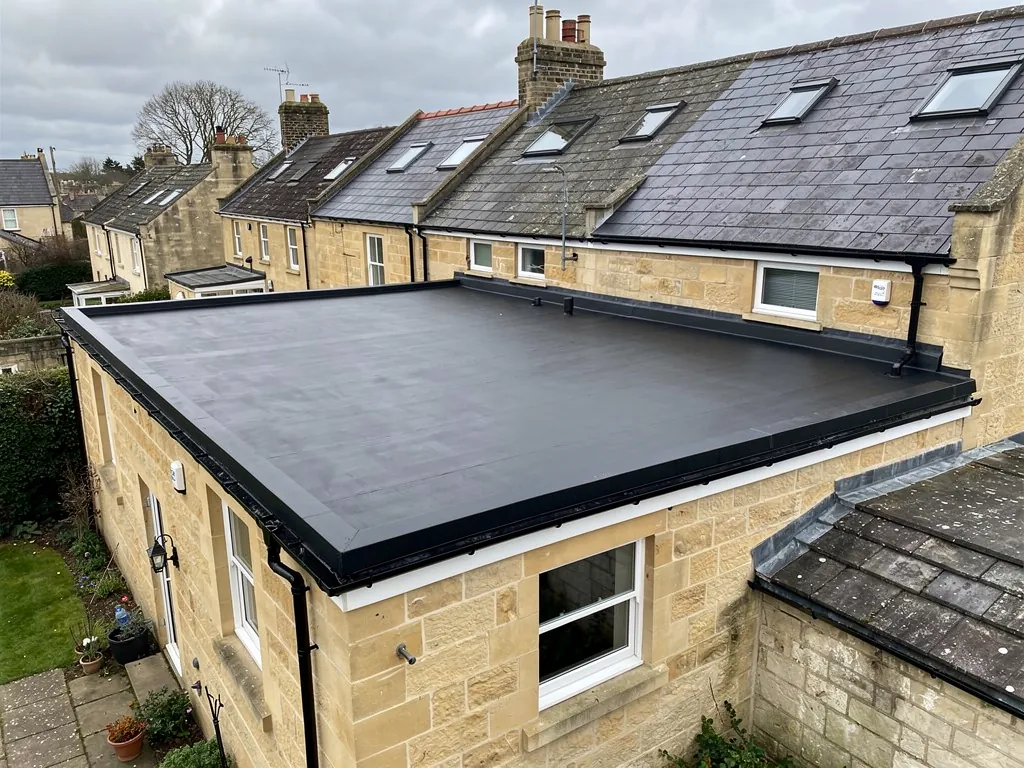
A flat roof usually tells you something is wrong before it leaks. A shallow pool that does not drain by the next day, a bubble under the felt, a hairline crack in a fibreglass edge, a corner where the rubber has pulled away: each is a warning, and each has a known cause. This guide takes the defects in turn, says which coverings suffer from them, and describes the repair we would normally recommend. It is written for an owner whose roof is already some years old and who wants to know whether the fault is cosmetic, repairable or a sign that the covering has reached the end. We cannot diagnose a roof from a page, so where a repair depends on what lies beneath the covering, we say what we would look for on the survey. If you are still choosing a covering, our guide to flat roof pros and cons is the better starting point.
Ponding: water that stays put
Ponding is standing water that has not drained by the following day. Every flat roof stays damp for a while at its lowest points, so a wet patch alone proves nothing. A pool with a visible edge, a tide mark or a film of algae is.
Causes
The usual cause is a lost fall. Joists sag, a deck board swells, the fixing of the insulation gives way, or the roof was laid with too little slope in the first place. A blocked outlet or a gutter set too high produces the same pool with a different cause. Heavy items such as a planter or an old roof-mounted aerial base can press a dip into a soft deck.
Effects by covering
Felt softens and blisters under standing water, and the surface granules wash into the pool. GRP top coats craze and can let water through to the laminate. EPDM tolerates immersion better than the other two, but silt and moss collect, and a pool that freezes puts stress on the seams.
Fixes
The cure depends on the cause. Clearing an outlet is a quick job. Where the fall has gone, the roof can be re-laid with tapered insulation, or a new firring (tapered timber strips fixed to the joists) can build the slope back. A shallow pond on an otherwise sound EPDM roof is sometimes left alone and watched. For more on the causes and the options, our page on ponding on flat roofs goes further.
Blisters and bubbles in felt
A blister is a raised bubble in torch-on felt, usually the size of a fist and sometimes much larger. It forms where moisture or air is trapped between two layers, or between the felt and the deck, and expands when the sun warms the roof.
Small blisters that are firm and intact do not always need repair. They are a sign that damp was present when the roof was laid or that it has found its way in since. Pressing on one gives a hint: a soft, squelchy blister holds water, while a dry, crisp one holds air.
A blister that has split open lets water straight into the layers below. The usual repair is to cut a cross through the blister, dry the area, fold back the flaps, and bond them down with a fresh patch of felt that extends well beyond the cut on every side. That is a sound repair when the blister is isolated. When the surface is covered in them, the felt is saturated, and patching treats the symptoms, not the cause.
Where blisters and wet insulation go together, the roof is a candidate for replacement. Dry insulation over a dry deck can be kept, but wet boards cannot. Our guide to laying felt over felt explains why a new layer on top of a blistered one is rarely a good plan.
Splits and cracks: felt, GRP and the movement behind them
Cracks come from movement. Something under the covering is shifting, and the covering has stopped being able to stretch with it.
Felt
Old felt dries out, loses its flexibility and cracks, often in a pattern that follows the edges of the deck boards, or along an upstand where the felt turns up a wall. Cold weather shows the cracks up. A short split can be repaired with a patch. A crazed surface across the whole roof means the bitumen has aged beyond help.
GRP
GRP is a rigid shell, so it cracks rather than stretching. Cracks often appear at board joints, at the junction of roof and wall, or at a door threshold where people step. A cracked GRP roof is repaired by grinding back the damaged area, laying new glass matting and resin, and finishing with a top coat. If the crack returns, the movement beneath it has to be dealt with first, which can mean re-fixing boards or adding a better support at the edge.
EPDM
EPDM rarely cracks in the way the other two do. Its splits are more often a puncture, a cut from a tool, or a failed seam where the adhesive has given up. A patch of cleaned rubber and primed tape is the usual repair.
In every case the rule is the same. A repair that ignores the cause fails again, and the cause is nearly always movement, water in the deck, or an edge detail that was never right. A like-for-like repair costs less than a replacement, and we recommend it where it works.
Edges, upstands and flashings: where most leaks start
A flat roof sheds water well across its field and badly at its perimeter. Walls, corners, outlets, trims and rooflight kerbs are where different materials meet, and where movement collects. A leak that appears at a ceiling corner is far more likely to start at an upstand than in the middle of the covering.
Lifting upstands
The upturn where a roof meets a wall can lift away if the adhesive has failed or the felt has shrunk. Water then runs behind it. The fix is to clean the wall, re-fix the upturn and seal the top edge under a new flashing. A flashing is the thin metal cover, usually lead, that closes that junction against rain.
Open or perished flashings
Lead flashings can lift in the wind, and mortar that holds them in a joint can crumble. Chasing the top edge into a mortar joint and sealing it with lead wedges, or using a proprietary system, restores it. On a stone wall in Bath, the joint is repointed in lime to suit the stone.
Outlets, trims and corners
An outlet that has lifted or a drip trim that has pulled away from the deck leaves a path for water behind the covering. Rubber corners are formed from moulded pieces, and a lifted corner is one of the commoner sights on a ten-year-old rubber roof.
Lead gutters on older buildings
Older houses with a flat section behind a parapet carry lead-lined gutters, called parapet or box gutters. Splits at the drips and laps, and cracks where the lead has fatigued, show as stains below. These are lead repairs and are separate from the covering.
How these edges are drawn on a new build is covered in the guide to designing flat roofs on extensions.
Hidden problems: wet decks, condensation and failed insulation
Some faults cannot be seen from the surface. They show up as a damp ceiling and an apparently unbroken roof above it, or as a roof that feels spongy underfoot.
A soft deck
Timber boards soaked over many winters lose their strength. The covering sinks into them, ponds form over them, and the roof begins to flex. A soft deck is replaced before a new covering is laid, because a membrane is only as sound as what carries it. Rot can be local, near a failed outlet or flashing, or spread across a whole slope.
Condensation in a cold deck
If the ceiling is damp, the covering is intact and the stain appears in cold weather, the cause may be condensation inside the roof void, not a leak. Warm moist air from the room rises into the cold space, meets the cold underside of the deck and condenses. The answer is better ventilation, a vapour barrier at the ceiling, or converting to a warm deck. Our guide to condensation in a flat roof sets out how to separate that from a true leak.
Wet insulation
Insulation that has taken on water stops working and holds moisture against the deck. It is cut out and replaced, and the layer above it is renewed, not patched.
Finding where water enters takes time. Water can run along a membrane or a joist before it drops, and the stain on the ceiling may sit metres from the hole. Our page on a leaking flat roof explains how we trace it.
Repair or replace: where the line sits
On MyBuilder's 2026 roof repair figures, a typical UK small leak repair costs £100 to £300, mid-sized work £500 to £1,000, and major repairs begin around £2,500. The same site's flat roof guide gives £2,800 to £7,500 as a typical replacement. These are national ranges, and the number you pay comes after our survey.
These figures show why repair is the first thing to consider, and why a run of repairs adds up. Three questions help to decide.
- Is the deck sound? If boards are wet or soft, a new covering will fail, so the question is the deck, not the surface.
- Is the fault local? One split, one lifted corner or one blocked outlet suits a repair. Faults across the whole surface do not.
- Has it been patched before? A roof that is mostly patches has told you what it needs.
Age matters less than condition. A well-laid roof in good order can still be working when a badly laid one has been replaced. Our guide to how long a flat roof lasts covers that, and the page on repairing or replacing sets out the whole decision.
When we survey, we go on the roof, photograph the faults and the cause behind them, and write up what we would repair and what we would renew. It helps to note where water stands a day after rain and where any stain shows inside, as those two marks often point to the same fault from either side. The flat roofing hub lists everything else we fit and repair.