The short answer
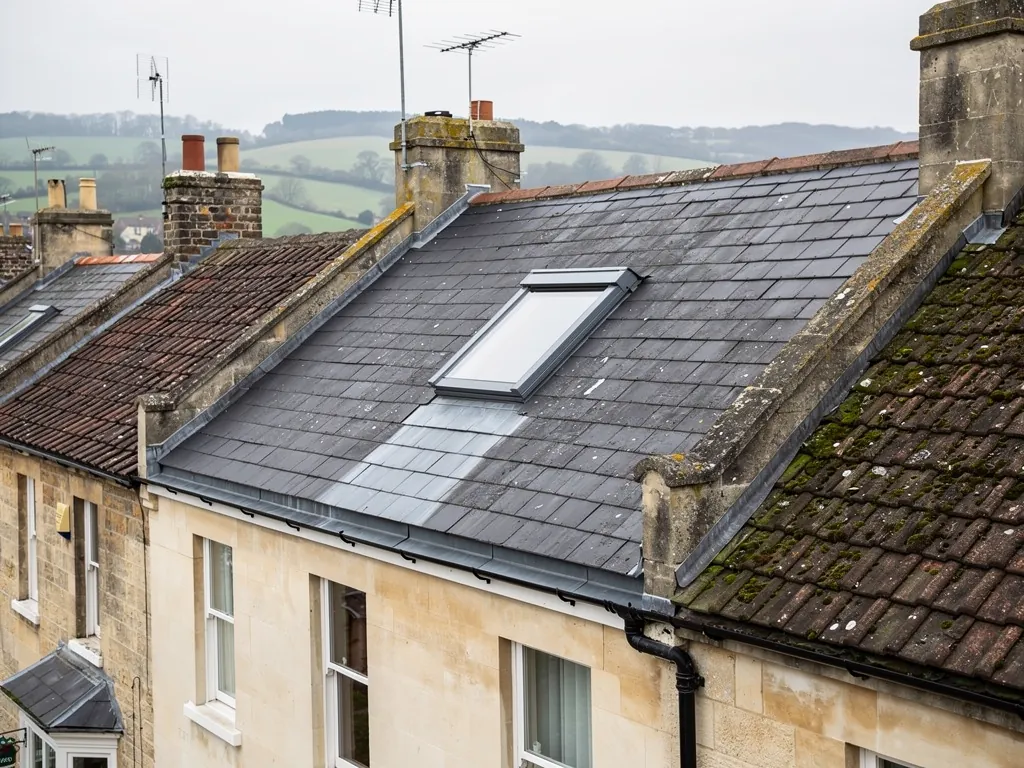
Most dormer leaks begin where two surfaces meet: the cheek and the main roof, the dormer roof and the face, or the valleys either side. Split or lifted lead flashing, failed soakers, rotted cheek timbers and a worn flat roof membrane are the usual culprits. Note where the stain appears, then inspect the junction above it, since the water may have run some way first.
Why dormers leak more than plain roof slopes
A plain roof slope is a single surface that sheds water downhill. A dormer interrupts it. What it adds is a miniature roof, a pair of side walls known as cheeks, a front face holding the window, and the joints where each meets the main slope. Water running down the roof has to be steered around the dormer, and the steering is done by metalwork whose value depends on how well it was laid and how old it is.
Every joint is a place where movement and weather act together. Timber shrinks and swells, lead moves with every change in temperature, and sealant breaks down in sunlight. A joint that coped for years can open slightly and let rain pass, usually at the lowest point or the most exposed corner.
That is why the answer to a leaking dormer is seldom to replace the whole thing. It is to find the failed joint, and in a typical case the cure is a section of leadwork or a repair to the cheek, not a new dormer. Our roof windows and skylights page sets out how this kind of repair work fits alongside the rest of our services.
The cheeks and where they meet the roof
Of the parts of a dormer, the cheeks give the most trouble. Many are timber frames clad in tiles, slates, lead or boarding. Where a cheek meets the main roof slope, the junction is sealed by a flashing, or by soakers, which are small rectangles of lead interleaved with each slate or tile along the edge, each one bent to turn up the side of the cheek.
Those soakers are a frequent weak spot. They are hidden under the covering, so a split or a missing one goes unnoticed until a stain shows indoors. Cheek cladding can fail too: slipped tiles let rain onto the felt behind, and if the timber frame becomes saturated it softens and rots, taking the fixings with it.
Lead flashing along the cheek is exposed to wind and sun. It can lift at its upper edge, where it is tucked into the face or the wall, or crack where it has been folded repeatedly. Lead for dormer work is normally code 4 or 5, which are the thicker grades, so a patch of thin material or a smear of mortar suggests an earlier cheap fix.
The dormer roof and the face
The roof on top of a dormer is either pitched, covered in the same slate or tile as the main roof, or flat, covered in lead, a membrane or similar. A pitched dormer roof can leak at its ridge, at its valleys where it meets the main slope, or under slipped covering, just like any other roof. Valleys are the troughs at either side, lined with lead or a made-up channel.
A flat dormer roof has other failure modes. Ponding, where water stands in a dip, shortens the life of a membrane, and so do splits at the edges and at the upstand where the roof turns up against the main slope. The fall, the slope that lets water drain, should still be present on an old deck. Where it has been lost to sagging, water collects and finds a way in. Our answer on noise from roof windows in rain touches on how the covering behaves under a downpour.
The face is the front wall holding the window. The joint between frame and surround can open, and the sill, the horizontal edge under the window, can let water behind the cladding. A rotted sill often shows as soft, dark timber under the window board.
Tracing the leak
Where the stain appears is rarely where the water entered. Water follows rafters, felt and insulation, and can travel a metre or more before it drips from a ceiling. A methodical search starts at the stain and works uphill and outward.
- Stain at the window head. Suspect the dormer roof, its upstand or the back gutter behind the face.
- Stain at the side of the window. Look at the cheek flashing, the soakers and the cheek cladding.
- Stain below the dormer, on the main ceiling. Check the lower junction where the dormer roof meets the main slope, and the valleys.
- Damp only in heavy, wind-driven rain. Suspect a lifted flashing or a gap in the cladding, where wind pushes water uphill.
Condensation inside the glass or on the lining is a separate issue and can look like a leak, so it is worth ruling out first. We survey from inside and out, photograph the joints, and tell you what has failed. The glazing is covered in our answer on which glazing suits a roof window, but glass itself seldom leaks.
Repair, rebuild and keeping it watertight
We repair where repair works. A split flashing is replaced in the right lead code, with the right laps and fixings. Failed soakers mean lifting a few courses of slate or tile and relaying them. A tired flat membrane can sometimes be patched, and sometimes needs a new covering with the fall corrected. Where the cheek frame has rotted, it has to be opened up and rebuilt, because sealing over wet timber hides the problem for a season.
On older houses we match what was there. A slate dormer stays slate and a lead-clad cheek stays lead. In a conservation area or on a listed building, the details of lead, slate and glazing bars matter to the council as well, and the conservation rooflights page shows how such details are judged.
A dormer that is not well looked after will leak again, so a routine look is worth having. Clear leaves from the valleys, keep gutters running, and have the lead checked after severe weather. Once we have surveyed, the price is fixed in writing, and where water is coming in we make the roof safe first, usually by sheeting the dormer cheek or flat top until the lead or covering can be redone in dry weather. Ring 01225 285181 to arrange a visit.