The short answer
A roof window usually leaks because the flashing around the frame has lifted or split, a seal has perished, or the slates or tiles beside it have slipped. Cracked glazing and a blocked channel above the frame are less common. Before calling anyone, check whether the wetness is condensation, which looks like a leak but starts inside the room.
Start by deciding whether it is really a leak
Water on a window sill does not always come from outside. Warm, damp air from cooking, bathing and drying washing meets the cold glass and turns to droplets, which run down and pool on the sill or stain the lining. It can look exactly like rain getting in. Our page on why a roof window gets condensation explains that cause in full.
A few simple observations help you tell the two apart. A true leak shows up during or just after rain, and often only in certain wind directions. Condensation appears on cold mornings, mostly on the glass, and eases when the room warms and the air dries. Staining that sits in one corner of the lining, or a drip that falls from the top of the frame, points outside. Misting between the two panes of a sealed double-glazed unit is a third problem altogether: that is a failed glazing seal rather than a leak into the room.
If you can safely look from the loft, torch the timbers around the frame. Dark, damp rafters or a stained insulation edge mean moisture has found a way in over a long period.
Flashing is the first place to look
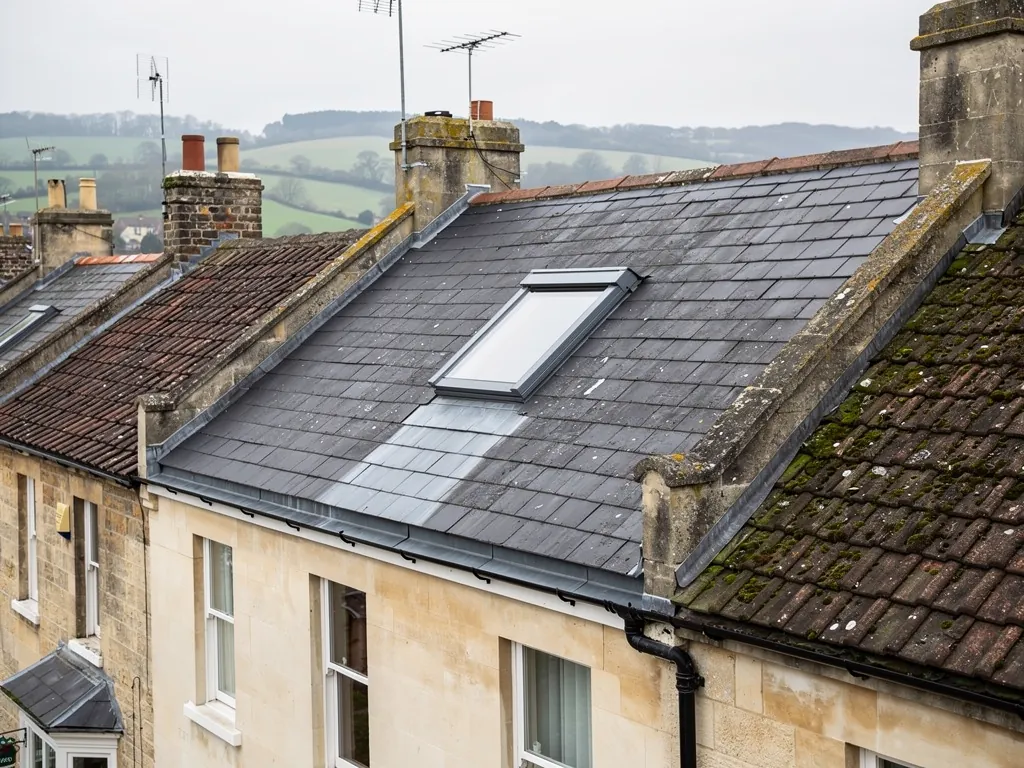
The flashing is the strip of metal dressed around the frame where the window meets the roof covering. It exists to carry rain out over the covering and clear of the opening. Over slate or plain tiles it is usually a manufacturer's kit of aluminium pieces, sometimes with lead at the top and sides. On older openings it may be hand-formed lead.
Flashing goes wrong in several familiar ways. Lead can crack where it was bent too tightly, or lift in strong wind when it was not secured well. Aluminium kits leak when the pieces were fitted out of order, so that water runs under rather than over a joint. A kit chosen for the wrong thickness of covering will never sit properly. And where a window has been fitted into an existing roof without the surrounding slates being lifted and rebuilt, the lap between flashing and covering is often too small.
A soaker is a folded tab of lead or similar metal, woven in with every course of covering alongside the frame, so that water is carried out over the covering. Missing or flattened soakers are a common reason for a leak at the side of a window. Our guide to roof window flashing covers how the pieces fit together.
Seals, glazing and the frame itself
The rubber seal between the opening sash and the frame can harden, shrink and split with age and sunlight. When it does, wind-driven rain gets past the closed window and runs down inside the frame. That leak tends to show around the sides and bottom corners and often only in storms. Replacement seals are available for many makes, which makes it a repair rather than a replacement in many cases.
Trickle vents and ventilation flaps are another way in. If a vent flap does not close fully, or its filter is clogged, rain can follow the same path as the air.
The glass itself can crack from a thrown stone or from thermal stress, and a cracked pane lets water straight through. A double-glazed unit with a failed edge seal will fog between the panes, but it does not normally leak into the room. Frames in timber, especially if unpainted on the inside surface, can rot at the bottom corners where condensation sits. A rotten frame that no longer holds a seal is hard to cure with sealant. Whether to mend or swap is set out in repair or replace a roof window.
The roof around the window and the channel above it
Sometimes the window is blameless. A slipped slate or cracked tile beside the frame can send water under the covering and into the opening, and the leak then looks as though it belongs to the window. Roofers see this on older roofs where nail fixings have failed, and the window simply happens to be the nearest thing to the damp.
Above the frame, many installations include a small gutter or back gutter, a channel that carries water from the slope above around the window rather than onto it. If that channel is blocked with moss, leaves or grit, it overflows and the water drops onto the top of the frame. A larger window on a long slope gathers more water at this point than a small one.
Failed sealant is a further suspect. A bead of mastic smeared around the outside of a window by a previous repair often hides the real fault and fails itself within a season or two. If you can see a thick line of sealant on the roof covering, the original flashing may never have been right.
Roof lanterns have their own causes and details, set out on our page about a leaking roof lantern.
What to do now and what we do on a visit
Put a bowl or towel under the drip and, if the leak is heavy, move furniture clear and lift any electrical items out of the way. Do not climb onto the roof in wet weather, and do not press sealant over the problem from a ladder. It will rarely last and it makes the real fault harder to read later.
A survey of a leaking window starts outside and continues in the loft. We check the flashing in sequence, the condition of the covering beside the frame, the channel above, the seals, the glazing and the lining timbers. Photographs of your own roof show you the fault as we found it. The cause decides the work: refixing or renewing flashing, lifting and rebuilding the slates around the frame, replacing a seal, or in the worst cases replacing the whole unit.
A leak is dealt with ahead of routine work, starting with a make-safe so the room stops getting wet. The lasting repair follows, priced as a fixed figure in writing once we have surveyed. For the typical UK spend on fitting and replacing a unit, see our roof window cost guide, and for the wider picture, our roof windows and skylights hub pulls the topics together.