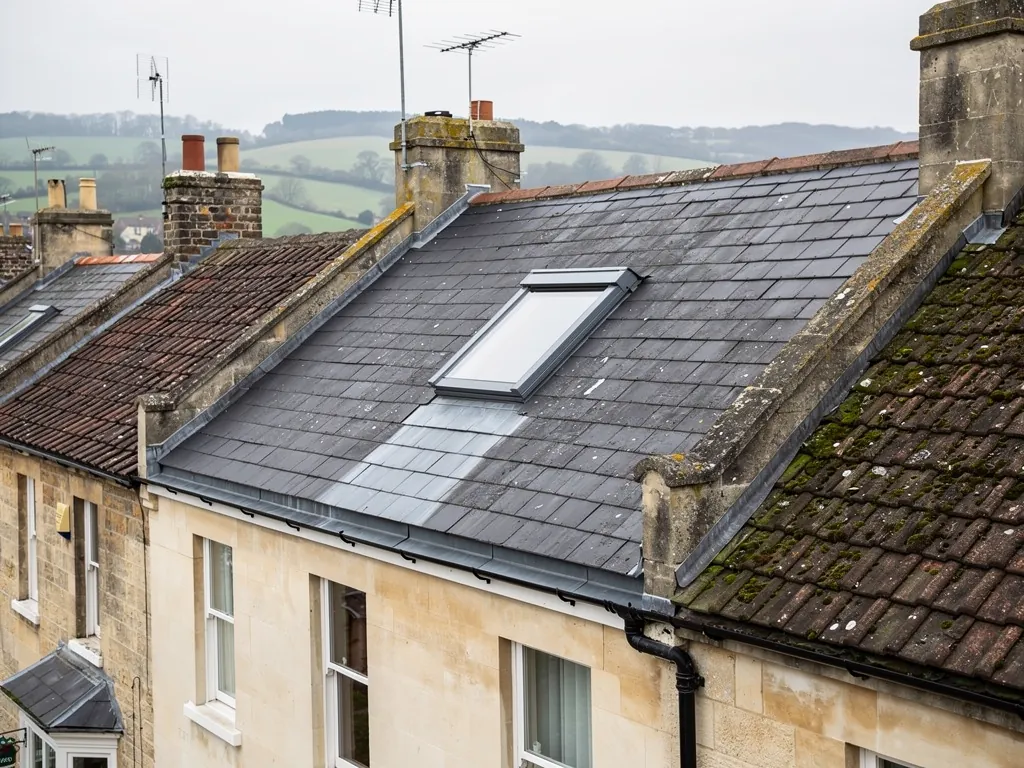
The short answer
Repair a roof window when the fault is limited: a perished seal, a lifted flashing, a cracked pane or a jammed hinge in a frame that is still sound. Replace it when the frame is rotten, the glazing units have failed, parts are no longer available or the window leaks again after a proper repair. One fault is a repair. Several together usually mean replacement.
The test is the frame
The frame is the part you cannot easily fix, so judge it first. Press a screwdriver tip gently into the lower corners of a timber frame, inside and out. Sound timber resists. Soft, crumbling or spongy timber means rot, and rot spreads. A frame that has been repeatedly wet from condensation or a long-running leak can look fine on the surface while the corners are hollow.
Metal-clad and polyurethane frames fail differently. Where the cladding is cut, the metal can start to corrode and the coating can lose its grip. Light surface wear is cosmetic. Water coming through the corners or along the joints is not.
If the frame is sound, nearly everything else can be put right in place. If it is not, you are paying for repairs that sit on something unfit to hold them, and the next leak is only a matter of time. That is the heart of the decision, and almost every other fault follows from it.
Faults that are normally worth repairing
Some failures are small and cheap to put right relative to a new unit.
- A perished seal. Replacement gaskets exist for many makes and fit in minutes once the right part is identified.
- Lifted or split flashing. The flashing is the metal trim that runs around the frame and turns rain aside. Refixing or replacing it leaves the window as it was.
- One cracked pane. On many windows the glazing unit can be changed without replacing the whole window.
- Stiff or jammed hinges and handles. These are mechanical parts and are often sold separately.
- Slipped slates or tiles beside the frame. That is a roof repair, and the window can stay.
The principle is simple: repair where repair works. If the fix lasts as long as the part it protects, there is no case for replacement. Our guide to a leaking roof window lists where water usually gets in, so you can match symptoms to causes.
Signs that replacement makes more sense
Several things tip the balance.
Rot in the frame. As above, this is the strongest argument. Cutting out and splicing in new timber is possible on some openings, but the result rarely matches a new unit for weathertightness.
Glazing units failing in more than one place. Misting between the panes of a sealed unit means the edge seal has gone. One unit can be changed. If several are misting, the window as a whole is being outlived by its parts.
Parts no longer made. Manufacturers retire models. If a seal or glazing size can no longer be bought, repair becomes a matter of improvisation.
Repeat leaks. If a professionally repaired window leaks again, the problem is likely in the frame, the opening or the original installation, not the component that was replaced.
Poor thermal performance. A very old single-glazed or early double-glazed unit loses a lot of heat. When a replacement element is fitted, Approved Document L expects it to meet the benchmark in the document, which for a roof window is a U-value of 1.4 W/m²K. The other accepted route is a Band B Window Energy Rating. That is a reason to replace rather than keep patching.
Replacing the whole unit, and what comes with it
A like-for-like swap is the simplest replacement. The old window comes out, the flashing is checked and usually renewed, and the replacement unit is set into the existing opening. If the new window is a different size, the rafters and surrounding covering must change, which is a larger job. Our guide to replacing a roof window runs through the sequence.
On older roofs, the covering around the opening is a factor. If the slates are tired or nail-sick, it makes sense to rework them while the window is out. Doing it later would mean disturbing a new flashing.
Homes that are listed or in a conservation area often need a particular window design. A cast metal conservation rooflight sits flush with the slates, and it is a replacement in a different class. Our page on conservation rooflights describes them, and if your home is listed, the council must agree to changes to the roof before they are made.
How we decide on a survey
The first visit covers the window from outside and, where we can reach it, from inside the loft. The order is: frame condition, flashing, covering around the opening, seals, glazing, and the lining and insulation behind it. Each stage is photographed, so you can look at the same evidence we are looking at.
Then you get the choice with reasons attached. If a repair does the job, the price you receive is for the repair alone. If the frame has gone, you hear it clearly, with the rotten timber shown to you. Sometimes it helps to ask for both prices side by side, a repair and a replacement, so the difference is visible before you commit. Whichever route you take, have the window's make and serial number ready, usually printed on a label inside the sash, as it tells us whether replacement parts are still available.
If the window is only a few winters old and already failing, the cause is probably the installation, and it is better to fix that than to buy a second unit and repeat it.
Age is a hint, not a verdict, and the roof windows and skylights hub holds the rest of the series. A well-fitted window with a good frame can outlast one that has leaked for years. For typical working lives of the parts, see how long roof windows last.