

A Wiltshire market town street with stone and brick houses and clay tile roofs

Roofers in Colerne

Colerne stands 545 feet above sea level and 8.1 road miles out of Bath on the north-east side. It is windy and wet in winter, and it can sit in fog when the lower villages around it are clear. Up on that ridge, the 18th century houses on narrow streets and the late 20th century estates beyond them both take the weather head on, and any repair or re-covering has to be fixed down to cope with it.

Local roofs

A hilltop village open to the weather

Colerne is high and exposed. At 545 feet (166 m) above sea level it looks south over the Box valley, and the village is known for being windy and rainy in winter, and for sitting in fog on days when the lower-lying places around it are clear. A wet January afternoon on the High Street explains why we pay such close attention to Colerne's weather.

The houses tell a story of their own. Many were built in the 18th century, partly as a result of a large fire in 1774. Daubenys, a former farmhouse on the High Street, is much older: a Grade II* listed long house from around 1400. Its church, St John the Baptist, is early 13th century and had its nave clerestory and roof renewed in the restoration of 1875 to 1877, and was listed Grade I in 1960.

Around that old core, the village has grown outwards. Modern estates were built north of the ancient, narrow streets, and Thickwood, a separate development of mainly late 20th century houses, lies about a mile to the north-east.

That gives three kinds of roof in one place: old roofs rebuilt in the years after a fire, roofs on exposed streets with little shelter, and estate roofs now reaching an age when their first big repairs fall due. We look at each on its own terms, and we write up what the survey turns up.

Council
Wiltshire Council
From central Bath
8.1 road miles, north-east
Height
545 feet (166 m) above sea level, overlooking the Box valley
Daubenys, High Street
Grade II* listed long house, around 1400
St John the Baptist
Early 13th century, roof renewed 1875 to 1877, Grade I listed 1960

What we find

Driven rain and fog on the hilltop

Driven rain finding gapsWind-driven rain goes sideways, up under the lap of a slate and past a worn flashing that would hold in still weather. We look at laps, abutments and the gaps around pipes and vents.
Damp air and what grows in itWhere fog and rain linger, moss and algae settle on north-facing slopes and in the valleys of a roof. We check whether the growth is cosmetic or is trapping water on the covering and filling the gutters.
Age shown at the edges of estate roofsOn the newer estate houses, the first failures tend to turn up at ridges, verges and the felt under the eaves. We catch those before the covering itself is affected.

Building a roof for 545 feet

At altitude, the question is less what the roof is made of and more how well it is held down and sealed.

Colerne's height is not dramatic, but it is enough. The village is high and exposed, and its winters are windy and wet. A roof here does a harder job than the same roof in a Bath side street, and the details that cope with that are the ones to check.

Lap is where it begins. Slates and tiles overlap so that water runs over each course and off the next, and the amount of overlap is chosen with the pitch and exposure in mind. On a low pitch in an exposed place, wind-driven rain can be pushed up the slope beneath the lap. If an old roof has been patched with a different size of slate, or re-laid to a shallower pitch than it was designed for, that is a real risk. We check what the roof was built for and whether it is still doing it.

Fixings matter as much. Every slate and tile is held by nails, clips or both, and a roof in a gale puts those fixings under repeated load. A single missing nail does little; a row of corroded ones lets a whole course shift. When we refix, we use fixings suited to the covering and to the exposure. A tile can also be given an extra clip at the eaves and verge, where wind pressure is highest.

Then there is the roof's underside. A well-laid underlay and ventilated loft keep condensation out of the timbers, which matters in a place where damp air is part of the climate. If we find dark staining on rafters, or a musty smell, we look for the cause before recommending a repair.

The commonest decision on an exposed roof is whether to patch or re-cover. The pitched roofing service describes how that call is made, and the answer depends on what is under the covering as much as the covering itself.

Patch or strip

Mend locally while the timbers and fixings hold; strip and relay once nails or battens are failing across the slope.

After the fire of 1774

Many Colerne houses date from the rebuilding, which gives them a common age and a common set of weak points.

A large fire in 1774 explains why so many houses in Colerne are 18th century. Houses put up in the same period tend to share details: similar pitches, similar chimney positions, and similar ways of holding the roof to the wall. That helps a roofer, because a fault found on one house is worth looking for on its neighbour.

After more than two centuries, those houses have had many repairs. Coverings have been renewed, sometimes in a different material, and chimneys have been rebuilt or capped. The first job on a visit is to establish what is original and what is a later alteration, because the weakest part of the roof is often where an old and a newer section meet.

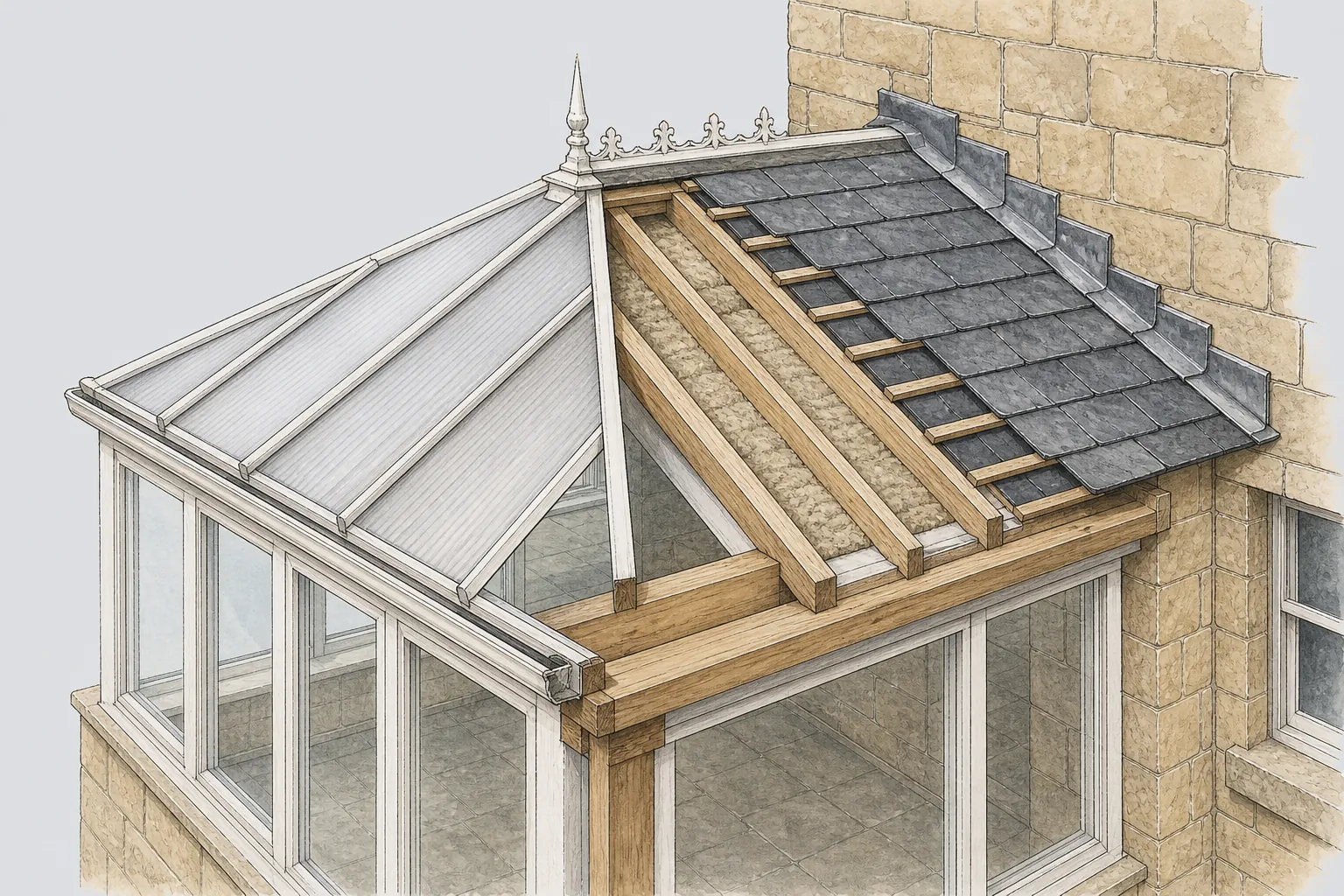
Common places include the junction between a main roof and a rear lean-to, where a lead flashing has to turn a corner; the point where a chimney stack was rebuilt in different stone from the wall below it; and the eaves, where old rafters can rot at their feet if the gutter has leaked behind the fascia for a long time. Soakers, the little folded lead pieces interleaved with slates at a wall, hide inside these junctions and are easy to overlook.

In narrow streets, access is part of the problem. A tall house set back behind a footpath may need a scaffold tower or a platform, and a lorry cannot always stop in front. We agree these points before the job begins, and tell neighbours when the work is going to affect them.

Where the roof is slate, slate roofing covers the matching and refixing in detail; roofs that use other materials fall under pitched roofing.

Daubenys, St John's and listed roofs

A long house of around 1400 and a Grade I church show what a roof in this village can be asked to carry.

Daubenys, the former farmhouse on the High Street, is a Grade II* listed long house from around 1400. A long house is a building where family and animals once shared a single long range under one roof, and the roof of such a building is among the oldest working structures in the village. Colerne's church, early 13th century in origin, had its nave clerestory and roof renewed in the restoration of 1875 to 1877 and was listed Grade I in 1960.

Neither is a typical house, but both set the standard for the village. Own a listed house here and the roof is protected along with the walls. Consent comes from Wiltshire Council, whose conservation team should hear from you before work begins. Planning permission is no substitute, and working without consent can be a criminal offence.

What the council wants to see is detail. For a roof, that means which covering you propose, which size of slate or tile, how it will be fixed, and where lead will be used. We can give you that detail in writing after our survey, with photographs of the roof as it stands. For small repairs using the same materials in the same way, the questions are often brief; if you plan a new covering, a rooflight or a rebuilt stack, expect a longer exchange.

An unlisted house in the older part of Colerne is a different case, but the council's maps will show if a conservation area or an Article 4 direction touches it.

Older roofs also hold wildlife. Bats use roof spaces and nesting birds use eaves, and both have legal protection, so where signs appear we pause and tell you what to do.

For lead work on older stone buildings, from flashings to gutters, see lead roofing.

545 ft

Colerne's height above sea level

1774

Year of the large fire that shaped the village's houses

1960

Year St John the Baptist was designated Grade I listed

Figures: Colerne entry, Wikipedia, checked October 2026

Thickwood and the modern estates

Late 20th century roofs are reaching the age where small faults begin to add up.

North of the old streets, modern estates were built to a very different pattern. Thickwood, about a mile to the north-east, is a separate development of mainly late 20th century houses. Roofs from that period have their own habits of failure, and they are worth knowing.

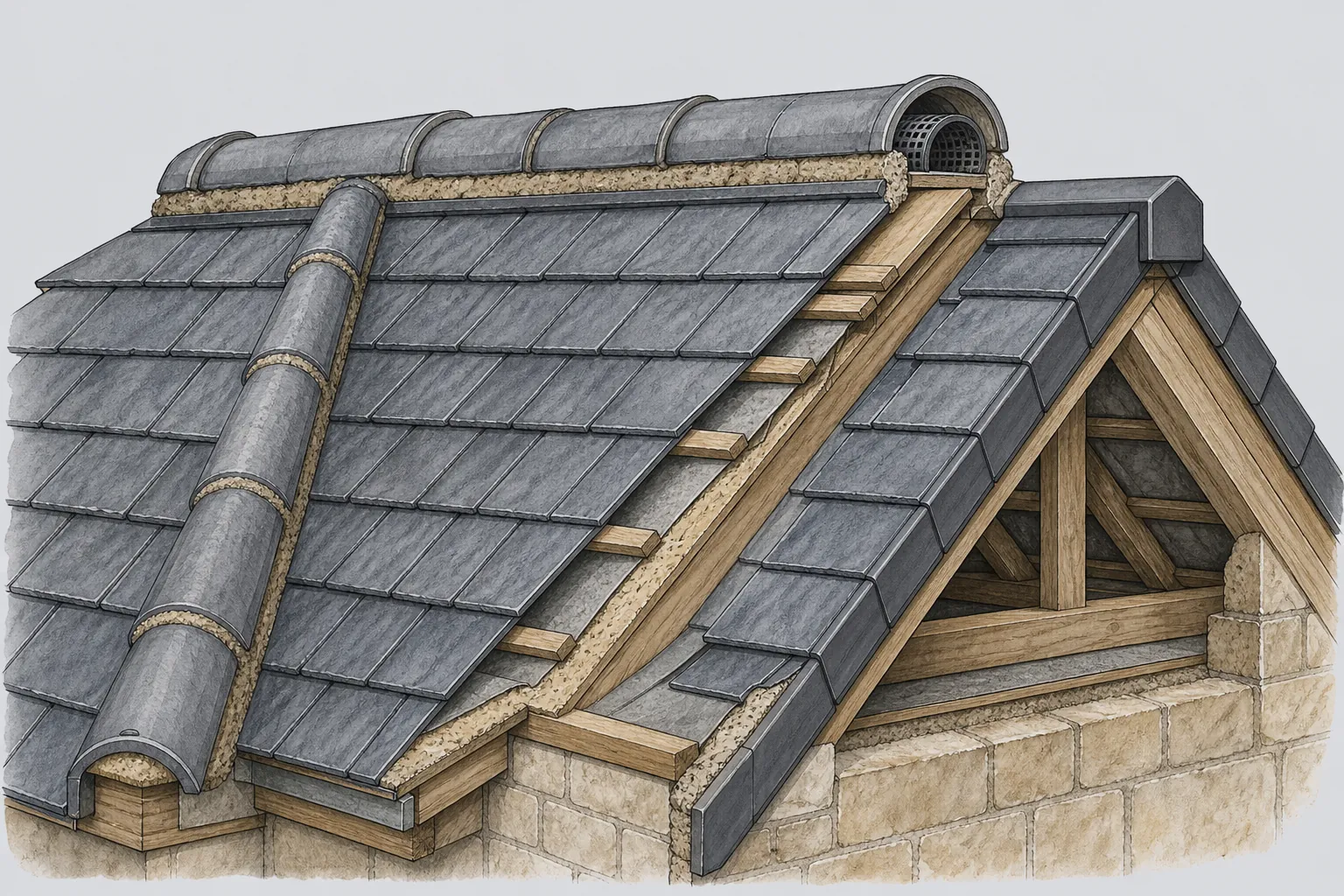
Look first at the ridge and the hips. Some of these roofs have mortar-bedded ridge tiles, and after years of weather the bedding cracks and lets go. Today they are fixed mechanically, with screws or clips through the ridge piece, or with dry-fix units that use no mortar at all. The same goes for the verge: where old pointing has gone, a dry verge unit is the tidier fix.

Underlay is the next issue. The bitumen felt under older estate roofs can tear or perish, most of all along the eaves. If the tiles are good and just the lowest felt has failed, a local eaves job may do. If it has gone all over, the tiles are lifted, fresh battens and underlay are laid, and the good tiles go back.

Then come the small items: a cracked tile, a displaced vent, a flashing around a soil pipe that has lifted. They seem minor, but a small leak into insulation can spoil a ceiling before anyone sees a drip. An inspection by a roofer is cheaper than a ceiling repair, and our roof inspections service is designed for that purpose.

For moss and algae on a damp, north-facing slope, roof cleaning explains the options and what to avoid. Pressure washing can damage a tile surface, so the method is chosen to suit the covering.

Words you will hear

Soaker
A folded lead piece interleaved with slates at a wall or chimney.
Long house
An old building in which people and livestock lived under one roof in a single range.
Clerestory
The upper tier of a church nave wall, pierced by windows above the aisle roofs.
Dry verge
Mechanical units closing the roof edge above a gable wall with no mortar bed.

Map showing the location of Colerne.

Nearby

Roofers near Colerne

Roofing services in Colerne

Local questions

Asked at 545 feet above the Box valley

Does Colerne's exposed hilltop mean my roof needs a different covering?

Not necessarily. Most coverings do well in exposed spots if they are laid to the right pitch and fixed properly. What matters is whether the lap suits the pitch and whether the nails, clips and ridge fixings are in good order. We check those during the survey, and if a re-cover is needed we choose fixings for the exposure instead of changing the material.

My house survived the 1774 fire rebuild. Should I worry about the roof timbers?

Worry is the wrong word, but looking is sensible. Old rafters, purlins and wall plates can be sound after centuries, or rotten at the ends where damp has crept in. We go into the loft, check for staining, softness and insect damage, and tell you what we find. Many old frames need nothing; some need a section spliced.

I live on Thickwood. Is the felt under my roof likely to be failing?

Possibly at the eaves, where felt does most work and ages fastest, but it varies from house to house. Lifting a tile or two at the lowest course lets us look, and from the loft we can see whether daylight, damp or sagging is present. If only the eaves have failed, a local repair is often enough.

Does the fog at Colerne affect how quickly moss builds up on tiles?

Damp air helps moss and algae spread, particularly on shaded slopes, so roofs in places like this can need attention sooner. Cleaning is not always needed, though. We judge whether growth is merely cosmetic or is blocking gutters, lifting tiles or holding moisture, and recommend a gentle method over pressure washing where the covering is delicate.

Get your free survey

Get your free roof survey

Tell us what's happening and we'll call you back to arrange a visit. Prefer to talk? Call 01225 285181.

  • Photos of your own roof
  • A fixed price in writing
  • 10-year workmanship guarantee
Call Free survey