The short answer
You can walk on some roof tiles if you tread on the right part, but it is not advised, and the roof is not designed for it. Tiles crack under a heel placed mid-span, and slate and old clay break most easily. Roofers use roof ladders, crawling boards and walkways to spread weight, so the covering stays whole and the person stays safe.
How a tile is supported
A roof tile hangs from a timber batten, or rests on the course below it, and is designed to carry rain and the occasional gust. It is not designed to carry a person. Most of a tile is unsupported: it spans the gap between battens, and the only places it rests firmly are at the head, where it hooks or nails to a batten, and across the lap, where it overlaps the tile below.
Put a foot in the middle of that span and the load goes into a thin piece of fired clay, concrete or stone with nothing underneath. It may hold once. It may crack in a way you cannot see from the ground, and then leak the next time it rains. A hairline crack in a tile is easy to miss and annoying to find.
How old the roof is counts as much as the tile itself. A covering that has weathered for many winters is more brittle than a new one. Damp battens grip nails less firmly, so a tile that looks fixed may be loose. A roof with moss may also be slippery, which adds the risk of a fall to the risk of a break.
Which coverings take foot traffic and which do not
Coverings differ in how forgiving they are. Concrete interlocking tiles are thick and the lugs on them link with their neighbours, so a careful step near the top edge of a tile, where it is supported, often does no harm. Our page on concrete roof tiles covers how they are made and fixed.
Clay plain tiles are thinner and curve slightly. They are laid overlapping, so each part of the roof has at least two layers, which helps, but they chip and crack readily at the edges, and old clay tiles can be fragile. See our page on clay plain tiles for more on how they behave.
Natural slate is hard but brittle. It can snap across its width under a heel, and an old slate held by a worn nail may slip with the weight. Stone tiles, such as the Cotswold stone tiles that survive on some village roofs south of Bath, are heavy but also split along their layers if stepped on in the wrong place. Man-made slate and fibre cement can crack, and become slick when wet.
The plain answer for all of these is the same: avoid it. If someone has to go up, spread the load.
How roofers move across a roof
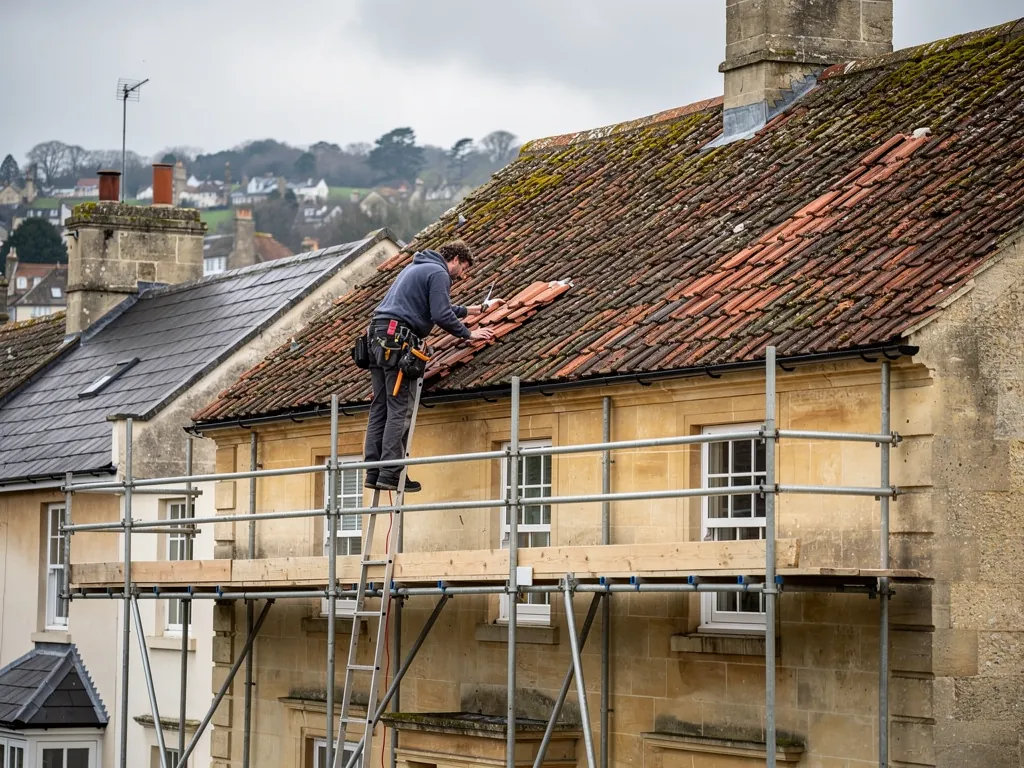
A roofer on a pitched roof does not simply walk about. The usual aids are a roof ladder, a crawling board and a scaffold. A roof ladder is a ladder with hooks at the top that hang over the ridge, so the person climbs on the rungs and the weight goes through the ladder, not through the tiles. A crawling board is a plank set on battens that spreads the weight across several tiles.
On larger jobs, a scaffold with edge protection goes up around the building, and working platforms are built at eaves level. This is the safest way to work, and it is part of why scaffold is one of the main cost drivers on a re-roof. Where roof edges or valleys must be reached, lines, harnesses and netting add further protection.
When a person must step on the covering, the routine is to place the foot on the lower part of the tile, close to the batten that supports it, and keep the weight low and spread. Wet moss, frost or loose tiles all change the plan. A careful roofer will often say no to a roof that is unsafe to step on and look for another way, such as a cherry picker or a lift.
What damage walking does, and how to spot it
The harm from walking on a roof often appears only later. A cracked tile leaks slowly. Water works under it, runs along the batten, and appears as a mark on the loft timber or the ceiling below, sometimes weeks after the footprint was made. By then the link has been lost.
Pieces of tile may lie in the gutter, and slipped or displaced tiles may show as a break in the line of the courses. From the loft, look for daylight at a point you did not see before. If anyone has been on your roof, such as an aerial fitter, a sweep or a neighbour, check the loft soon after.
Where you want to check the covering, a camera on a pole or a drone survey avoids the need to climb at all. Our guide to trusses, rafters and purlins explains what lies under the battens when the covering is lifted. Most of that frame is not designed to be stood on either, and tiles are fixed to it in ways that matter when you plan access.
What to do if you need someone on your roof
For a quick look, the best route is from the ground with binoculars, or from the loft hatch with a torch. Look at the line of the ridge, the courses of tiles, and the lead around the chimney. Moss alone is not damage, though it keeps moisture against the surface.
If work is needed, ask how the roofer plans to reach the roof. A sensible answer mentions a roof ladder or a scaffold, not simply walking about. Tiles walked on without protection often come back as repair jobs.
The same care applies to roofs with no underlay. Where there is no felt beneath the tiles, nothing catches water if a tile breaks, so a crack can mean rain straight into the loft. Our page on a roof without felt goes into what that means.
We survey your roof free, with photographs of what we find. Any repair is priced in writing afterwards, and where repair works, we repair, matching the tile that is already on the roof. The wider picture is on our pitched roofing page.