
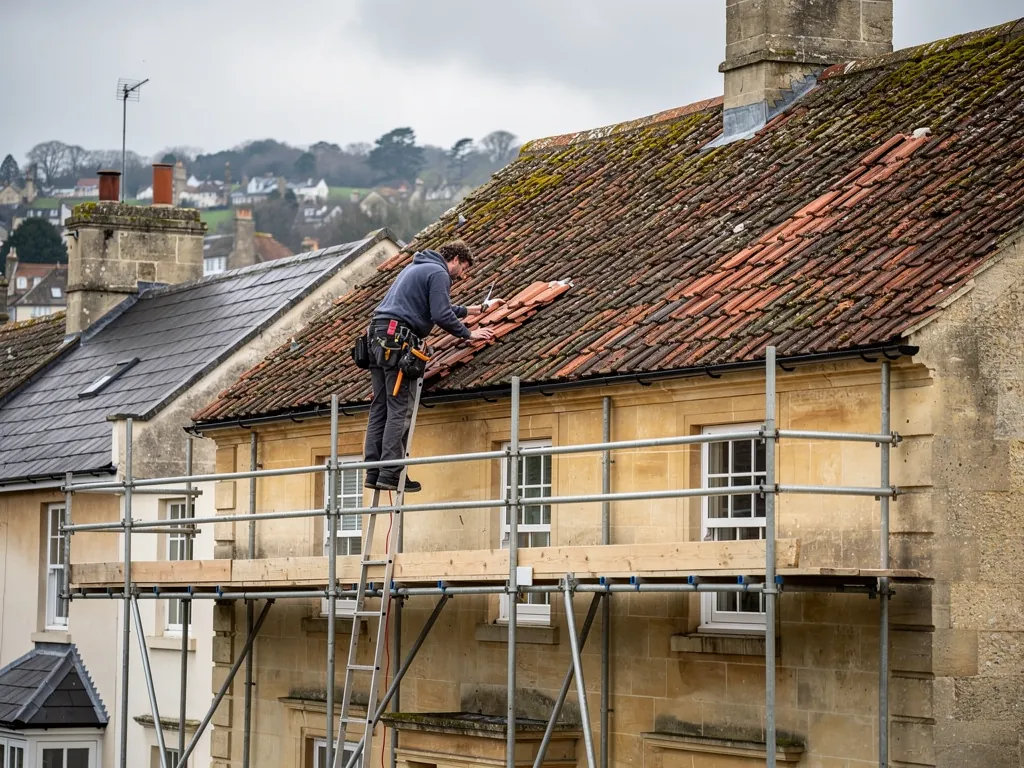
Clay plain tiles are small, flat, slightly curved tiles, laid in overlapping courses so that every part of the roof is covered by two or three layers. They are among the oldest roof coverings in England, and on the right house they are the roof that the building was designed to wear. Owners of a clay plain tile roof usually ask three things. How does it behave over time? How can a tile that has gone be replaced with one that looks right? And what does a repair involve when the tiles are old and the timbers beneath them have moved? We answer those here, from the point of view of what we see on site: the colour range, the weight, the fixings and the usual faults. If the house has a listing, or lies inside a conservation area, matching the covering is more than taste, and we explain where permission fits.
What a clay plain tile roof is
A plain tile is a flat rectangle, with a gentle camber across its width and sometimes along its length, and two small holes for nails and two nibs on the back to hook over the batten. Each course overlaps the course below, and a joint in one course is covered by the tile above. The overlap is called the headlap, and the minimum is set by the pitch of the roof.
Plain tile roofs are steep as a rule. The steepness, usually at least 40 degrees and often more, helps the many small joints shed water. Because the tiles are small, they follow curves well, which is why clay plain tile suits hips, valleys, bonnets and the sweeping cat-slide roofs of older houses.
A clay plain tile is made from fired clay, so it is heavy for its size when laid in double lap. The roof is therefore a substantial load for the rafters. This is the first reason a decision about an old tile roof is also a decision about the timber beneath it. Before agreeing a plan, we inspect the rafters, wall plates and ridge beam. The batten and its spacing is another detail that matters for this covering; see our guide to roof battens.
How clay tiles perform over time
Fired clay does not rot, rust or burn, which is a large part of why old clay roofs are still on houses today, and a good tile will keep shedding water for a long span if it is fixed properly and not damaged. The covering rarely wears out. What fails is usually something else: the nibs that hold a tile to its batten, the nails, the underlay beneath, the battens or the lead at the chimney. When a clay roof leaks, the tiles are seldom the culprit.
There are two clay faults worth knowing. The first is frost damage. A tile that absorbs too much water can have its face flake away when that water freezes and expands. This is called spalling. A spalled tile still sits on the roof but is weaker and may let water through. The survey includes a close look at the tile faces, since damage here shows up well in photographs, and our piece on frost-damaged tiles deals with this in detail. The second is delamination, where thin layers peel from a poorly fired tile.
Moss and lichen grow on clay in damp, shaded spots, especially on slopes under trees or on the cold side of a house. They are mainly cosmetic at first, yet a thick mat keeps damp against the clay and clogs the joints between tiles. Careful cleaning is possible, though aggressive pressure washing can damage soft clay and its surface, so we use gentle methods.
Clay is also more attractive to look at as it ages, which sets it apart from coverings that simply fade. The colour mellows and the moss and mineral staining that develop give the roof a depth that a new tile does not yet have. This is part of what we mean by character, and it is the reason matching matters when a repair is needed.
Handmade and machine-made tiles
Clay plain tiles come in two broad families, and they look and behave differently.
| Feature | Handmade | Machine-made |
|---|---|---|
| Shape | Slight variation in camber and edge | Uniform and flat-faced |
| Colour | Wide natural range within one batch | Even colour, sometimes with a sanded or textured face |
| Look when laid | Soft, varied surface that catches light | Crisp, regular lines |
| Typical use | Period houses, repairs to older roofs | Newer houses and large re-roofs |
A handmade tile is shaped in a mould by hand and fired, which is why no two are quite identical. The slight differences in shade and surface are what give an old roof its unmistakable look. A machine-made tile is pressed or extruded, so it is more uniform. Both are real clay and both perform well when laid correctly.
The choice for a repair is about the roof you already have. A handmade tile in a machine-made roof stands out as a patch, and a machine-made tile on a handmade roof looks too flat. The camber also matters, since a tile with a different curve can sit proud of its neighbours and let water in.
Both families come in many colours and sizes, and a merchant will usually supply sample tiles so you can hold one against the roof in daylight. A roof tiled in a particular red or brown that has weathered for years will not match a brand-new tile out of the pack. Blending is the answer, and that is covered in the next section.
Matching tiles for a repair
Matching a clay tile is a three-part job: size, shape and colour. Size comes first. A plain tile is made to a standard format in most cases, but older tiles can differ in length and width, and a small mismatch breaks the line of the courses. We measure before ordering. Shape follows, because camber and nib position both need to agree. Colour is last and hardest, because weathering has changed the old tiles.
The best source for an older roof is often reclaimed tiles, taken from another building and sorted. These have already weathered, so they blend into a repair. Our piece on reclaimed roof tiles sets out the sorting and the checks involved. For larger areas, new handmade tiles chosen from a colour range can be mixed with reclaimed ones, so the new face sits in among the old.
When a whole slope needs re-covering, the sound old tiles can be kept and re-laid on the visible slope, with the replacement tiles used on less visible parts such as a rear pitch. This keeps the front elevation as it was built. It is a common approach on period houses, where the street view matters.
Where consent is needed because of a listing or a designated area, the choice of tile forms part of it. In Bath, listed building consent is issued by B&NES Council. We talk through what applies during the survey, and we do not start work that needs consent before it is in place.
Keep one or two spare tiles if you have them. A tile from your own roof is the best colour sample you can show a roofer.
Weight, structure and what changes if you swap material
Clay plain tiles are heavy, and the roof structure was built to carry them. That has a practical consequence when somebody suggests changing to a different covering. A lighter material, such as artificial slate, may seem to put less strain on the timbers, but the roof was designed around the original weight and a change can affect fixings, battens and the way the roof moves.
Going the other way, to a heavier covering, needs more care still. The Building Regulations draw a line at 15 per cent: a covering heavier by that margin needs approval from building control and a structural check, as the Planning Portal explains. Our note on concrete interlocking tiles compares the two materials in more depth.
Where old rafters have deflected, or purlins have settled, a roof may sag under the tile load. A sag is not always a covering fault. It is sometimes a sign that the timbers need strengthening before any new covering goes on. We look for it from the loft with a straight edge and from the ground, and the survey report describes what we found.
The amount of work counts as well as the weight. Small repairs sit below the thresholds for approval, whereas a full re-tile goes beyond them, and where approval applies we handle the notification side.
How a clay tile roof is repaired
Most clay tile repairs are small. The usual jobs are replacing cracked or slipped tiles, re-fixing nibs that have lost their grip, renewing a few battens, and repairing the lead around a chimney or at a valley. Owners often worry that a clay roof will be costly to keep. The reverse is frequently true, because individual tiles can be swapped without disturbing the rest. A clay roof can be repaired for as long as the main structure is sound, and we repair where repair works. A short run of failed tiles is a repair, not a reason to strip the roof, and the survey will tell you that clearly. It is routine work within our pitched roofing service.
- Survey. We inspect the roof at ground level, up a ladder and under the rafters, with photographs of each area.
- Strip the repair area. We lift the tiles in the affected area and set the sound ones aside, face up, in the order removed.
- Check below. We examine the underlay and battens, and renew whatever has failed.
- Re-lay. We re-lay sound tiles with new fixings, blend in matched replacements, and clip tiles at the eaves, verge and ridge as the roof requires.
- Clear up. We remove debris and waste from the site.
The same method applies if a hip or ridge is loose. BS 5534:2014 requires bedded ridge and hip tiles to be mechanically fixed, since mortar on its own cannot be counted on to hold them. We fit fixings as part of the repair.
Once a roof is spent, because the battens are widely rotted or the tiles are badly spalled, replacement gives better value. A repair that covers failing timber only delays the cost. The survey tells you which side of that line you are on.