
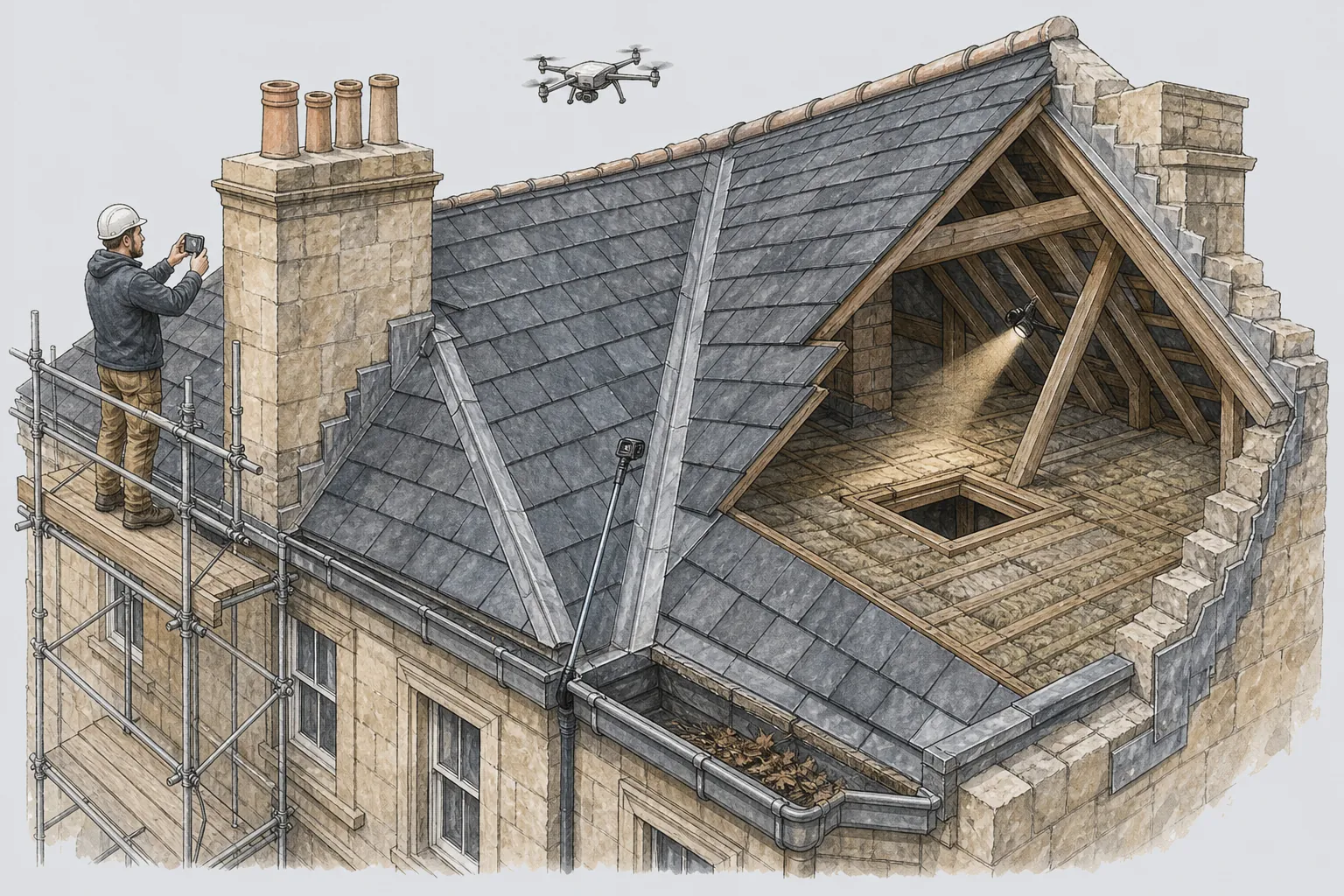
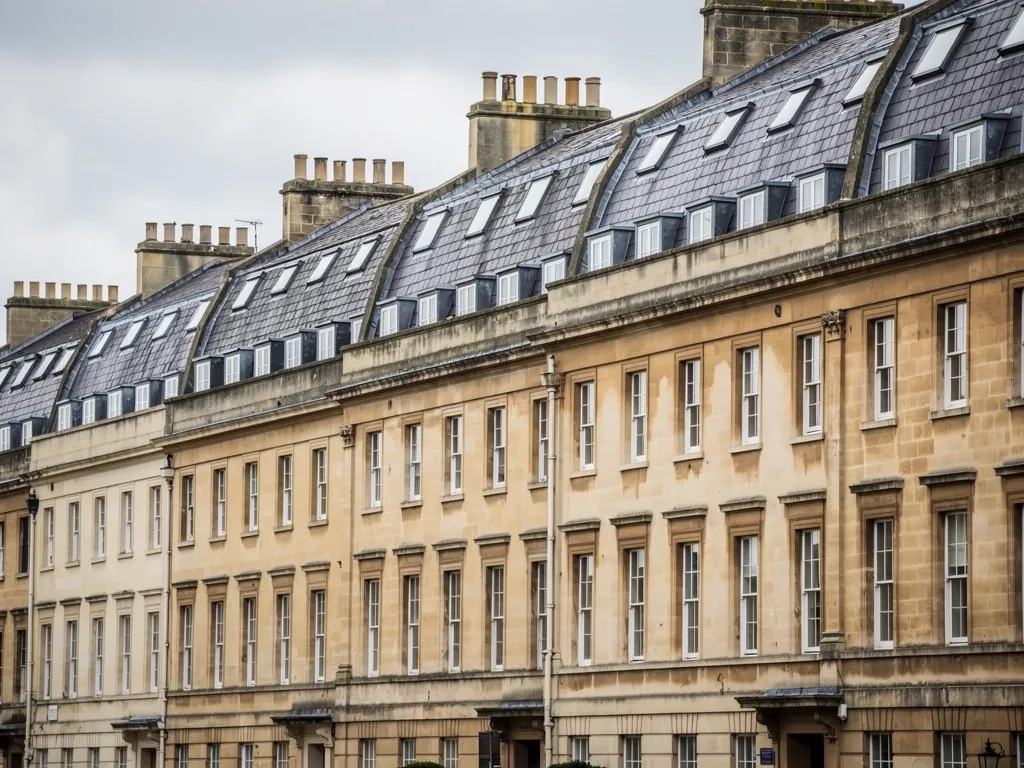
Georgian terrace of honey Bath stone with natural slate roofs and chimney stacks

Roofers in Newbridge

Newbridge is 2.3 road miles north-west of Bath's centre, at the point where the river is crossed and the wooded slopes begin. The Grade I almshouse block at Partis College and the mid-century family housing nearby both sit among trees, and the shade and leaf fall shape the upkeep of nearly every roof on those slopes.

Local roofs

A river crossing, an almshouse and a works turned to housing

Newbridge is named after the New Bridge over the River Avon, built in 1734 to replace a ford and widened and improved in the 1830s. The crossing gave the place its identity, and the buildings that followed it are varied. Partis College, built as a large block of almshouses between 1825 and 1827, is Grade I listed. The Horstmann Gear Company built its Newbridge Works in 1915; the works closed in 2000 and the site was redeveloped for housing. The Bristol and Bath Railway Path, part of the National Cycle Network, runs west from Newbridge to Bristol along the old line.

Housing in the southern part of Newbridge is mid 20th century, according to the city's character appraisal. At the western edge of the northern part of the area, steep wooded slopes mark the change from town to countryside. Those slopes are the feature that most affects roofs, because trees bring shade, leaf fall and branches, and the damp that goes with them.

So Newbridge asks three different things of a roofer. A Grade I almshouse block is a conservation job done under listing rules. A mid-century house is a routine repair, an underlay renewal or a ventilation fix. And a house under trees needs regular attention to gutters, moss and the condition of the coverings.

We survey each roof for what it is. Findings come in writing with photographs, we explain what needs consent, and the price that follows the survey is fixed.

Council
Bath and North East Somerset Council
From central Bath
2.3 road miles, north-west
Grade I listed
Partis College almshouses, built 1825 to 1827
River crossing
New Bridge, built 1734, widened in the 1830s
Former works
Horstmann Newbridge Works, 1915; closed 2000; now housing

What we find

Moss, leaves and old felt around Newbridge

Moss and algae on shaded slopesA slope under trees stays damp, and moss grows on it. We check whether the growth is only on the surface or has lifted the edges of tiles and clogged the gutter below, and we advise on whether cleaning is wise for the covering you have.
Tired underlay on mid-century roofsA roof from the middle of the last century often has felt that has sagged or perished under the tiles. We slide one tile out at the eaves and look at the felt and battens behind it.
Leaf-choked gutters and valleysTrees drop leaves, seeds and twigs, and they settle where water should run. We clear outlets, check the fall of each gutter and look at the valleys, where debris builds up fastest.

Mid-century roofs: felt, tiles and ventilation

Housing from the middle of the 20th century needs the layers under the tiles checked more than the tiles themselves.

In the southern part of Newbridge, mid 20th century housing is the main character of the streets. Roofs from that period are straightforward in shape, typically a simple pitch with a ridge and perhaps a hip, with the covering laid over battens and, as first built, bitumen felt. They were built efficiently, and after several generations of weather the layers beneath the visible surface are often the part that needs attention.

Bitumen felt is the first to go. It sags between the rafters, where it collects water and wears against the battens, and it perishes at the eaves, where it should deliver water into the gutter. Once it has failed, a wind-driven shower can find its way past a single tile and into the loft. The signs are subtle: a faint musty smell, a stained felt seen from the hatch, a slight dip in a slope. Our survey checks all of them, and we pull one tile at the eaves to see for ourselves.

Ventilation is the other recurring issue. A roof needs air moving through the loft to carry moist air out, and if the eaves vents have been blocked by insulation or the ridge is sealed, the moisture condenses on the underside of the felt and drips onto the timbers. Black spotting on rafters or damp insulation is a clue. We can correct it by clearing the eaves, fitting vents or changing to a breathable underlay when the roof is next stripped. See our guide to loft condensation for the signs.

Where the tiles are good and only the felt has gone, the answer is to strip them, lay fresh underlay and battens and refit the same tiles. That is often the best-value route, and it is how our roof replacement work begins when the whole slope is involved. Large re-roofs may bring a Building Regulations application and a thermal upgrade, and we explain that before the price is set.

Myth

If the tiles on a mid-century roof look fine, the roof underneath must be fine.

Fact

The felt and battens under the tiles age separately from the tiles, so the only way to know their condition is to take a few out and look.

Partis College and the problem of the very large roof

A Grade I almshouse block is repaired under the rules for listed buildings, and its scale sets the method.

Partis College is a large block of almshouses built between 1825 and 1827, and it is listed Grade I, the highest grade. A roof like this is large and often has many sections, with parapets or gutters at the eaves, stone chimneys and lead in every junction. We cannot say what is on a specific building without seeing it, but the way we approach any roof of this kind is the same.

The first step is consent. Before a listed building is altered, its owner needs consent from the local authority, B&NES, and this is a different procedure from planning permission. Owners are asked to contact it before work starts, and its conservation team wants to see what the roof is now and what the repair would change. A written description with photographs helps, and we provide this for managers, trustees or committees who must approve work together.

The second step is access. A roof this large cannot be reached from a ladder, so the job needs a full scaffold with edge protection, and the cost of that is a large part of the total. For that reason, repairs on a large building are best planned in one visit rather than as a series of emergency call-outs, and we group the work to fit one erection of the scaffold wherever possible.

The third step is method. On a roof of this age, repairs follow the original: natural materials, lead where lead was used, lime mortar on stone, and nothing that traps water in the fabric. Where lead needs replacing, the old sheets are examined for their pattern of laps and rolls and the new work copies them. That is the practice of the lead roofing service, and it is what a large, old block needs.

Wooded slopes: moss, leaves and damp roofs

Newbridge's western edge climbs into trees, and what falls from them lands on the roofs below.

At the western edge of the northern part of Newbridge, steep wooded slopes mark the transition from town to country. Houses near them live with trees: shade through the day, leaf fall in autumn, seeds and twigs through the spring, and a steady supply of damp. For a roof, that combination means two things in particular, moss and blocked drainage.

Moss grows on a shaded, damp surface and holds water against it. On concrete and clay tiles it can build up thickly, and over time it lifts the edges and fills the gaps between units. When it breaks away, it falls into the gutter, where it blocks the outlet. A light covering does little harm. A heavy one deserves attention, because the weight of wet moss and the water trapped under it both do damage, and the cleaning needs to match the surface. Some coverings, especially delicate or old ones, can be damaged by pressure washing, which is why we prefer gentler methods and treatment after the roof has been inspected. Our notes on the methods, and which suits which covering, are under roof cleaning.

Gutters take the brunt of leaf fall. A gutter full of wet leaves overflows, and it also holds water against the fascia, which rots. On the Newbridge side of the city, where a run of houses can all have trees behind them, the cheapest and most valuable maintenance is to clear the outlets once the first leaves have dropped, and once more when the trees are bare. If a gutter is sagging with its load, the fixings need renewing too.

Branches can touch a roof too. A twig rubbing a slate or a bough above a valley can cause slow damage, so we note anything overhanging. Trees may be protected, and we cannot cut them, but we can tell you what we see and let you decide how to deal with it.

Seasonal checks for a roof under trees

WhenWhat to checkWhy
Late autumnGutters, outlets and valleysLeaf fall blocks the route for rain
After a stormRidge, edges and loose tilesWind and falling branches move units
Late springMoss growth on shaded slopesDamp winters feed growth that lifts edges
SummerLoft for damp marks and stainsDry weather shows where winter leaks ran

Newer housing on the old works site

The Horstmann works became homes after 2000, and newer roofs need a different kind of attention.

The Horstmann Gear Company's Newbridge Works opened in 1915 and closed in 2000, when the site was redeveloped for housing. The homes built on it are newer than their neighbours, and their roofs are in a different phase of life. They are not yet old enough to need re-covering, but they are old enough for small faults to have started. A roof that is young does not mean a roof that never needs attention.

The faults to expect on a newer roof are different from those on an old one. They are rarely a failed covering. More often they are a ridge tile that has loosened, a verge where the cement has cracked, a lifted flashing beside a stack or a roof window, or a ventilation gap that has been closed by insulation added later. A tile damaged in a storm and left over a winter lets water into the battens. These are small repairs, and they are far cheaper done early.

On a newer roof we are often looking at fixings. Modern roofs use mechanical fixing for ridge, hip and verge units, and a dry-fix system holds them with clips and caps instead of mortar. When one has slipped, a check along the line tells us whether it is a single failure or a pattern. For a roof of this type, gutters, soffits and fascias are the other regular item, and plastic fascia boards can warp and open at the joints.

If you are buying or selling a home on the former works site, a survey of the roof gives you a record of its condition. It is a photographic report of what is on the roof, and we write it without trade jargon. Nothing is charged for it, and a fixed price follows if work is needed.

Catch it early

On a newer roof the faults are small, and a loose ridge tile mended now costs less than a damp batten mended later.

Map showing the location of Newbridge.

Nearby

Roofers near Newbridge

Roofing services in Newbridge

Local questions

Questions under the trees at Newbridge

Our house is near the wooded slopes in Newbridge and the roof is covered in moss. Should it be cleaned?

Not always straight away. A thin film does little harm, but a thick mat holds water and can lift tile edges, so it is worth treating. The method depends on the covering: some tiles can be damaged by pressure washing, and gentler treatment is safer. We inspect first, see what the moss is doing to the tiles and the gutter below, and then advise on whether to clean, repair or replace.

How do I find out if the felt under my mid-century Newbridge roof has failed?

Look in the loft with a torch. Torn, sagging or brittle felt, dark patches on the rafters, or daylight where the tiles meet the eaves are all signs. The surest check is to slide a tile out at the eaves and look at the felt directly, which is part of our survey. If the felt has failed and the tiles are good, they can come off, the underlay and battens can be renewed and the same tiles can go back.

Who gives consent for work on Partis College or similar listed almshouses?

The council that grants it is B&NES, and the owners or trustees apply to it before any alteration begins. A ruling is the council's to give, not ours, but we can supply a written description of the proposed repair with photographs, which lets the conservation team respond quickly. A repair that puts back what is there may need little discussion, whereas a change of covering needs agreement first.

Do newer homes on the former Horstmann works site need roof maintenance yet?

They do need looking at, though not usually re-covering. The usual early items are loose ridge or verge units, cracked pointing, lifted flashings and gutters that have loosened or filled with debris. A check after the first few winters catches these while they are small. We can inspect the roof, photograph it and give you a written list of what, if anything, needs doing.

Get your free survey

Get your free roof survey

Tell us what's happening and we'll call you back to arrange a visit. Prefer to talk? Call 01225 285181.

  • Photos of your own roof
  • A fixed price in writing
  • 10-year workmanship guarantee
Call Free survey