
Georgian terrace of honey Bath stone with natural slate roofs and chimney stacks

Roofers in Weston Park

Weston Park is 1.9 road miles from central Bath, to the north-west, and its big villas stand behind high stone walls with roofs to match: many slopes, many valleys, many chimneys. Slate or clay goes back on those villas to suit each one, and the postwar terraces nearby are looked after as well.

Local roofs

Villas in their grounds, terraces on the edge

Weston Park was developed in the Victorian era, alongside Combe Park, and it still has the feel of a place laid out for people with space. The large architect-designed villas of the wider Weston Park, Sion Hill and Upper Lansdown area stand in generous grounds behind high walls of natural Bath stone and hedges. The ground here slopes more gently to the south than it does on the neighbouring Sion Hill and Upper Lansdown, so the gardens and the roofs sit on easier land than the steep streets above.

The character appraisal prepared for the city records that the majority of buildings in this wider area are built of natural Bath stone ashlar, which is smooth, finely jointed stone, with natural slate or clay tile roofs. It also records the postwar terraced housing to the west and north, built of reconstituted Bath stone and covered with concrete tiles. Those two kinds of housing sit within a short distance of each other, and they need quite different roofing.

A villa roof is a large and complicated object. It has main slopes, projecting bays, gables, a run of valleys and usually several chimney stacks, and all of it must stay watertight at the points where one part meets another. A postwar terrace roof is simpler in shape and lighter in construction, and it is more likely to need a fresh underlay, new ridge fixings or a thermal upgrade than any change of covering.

We start every job by working out which of the two kinds of roof we are on. After that comes the survey, with photographs, a clear account of what consent applies, and a written price that stays fixed.

Council
Bath and North East Somerset Council
From central Bath
1.9 road miles, north-west
Developed
Victorian era, alongside Combe Park
Villas
Architect-designed, in spacious grounds behind high Bath stone walls
Postwar terraces
Reconstituted Bath stone with concrete tile roofs, west and north

What we find

Valleys and tall stacks on the walled villas

Valleys where villa roofs change directionA villa with bays and gables has more valleys than a terrace has chimneys. We lift the slates beside each valley, check the lead or zinc lining for splits and look for debris packed in from the trees in the grounds.
Stacks and flaunching on tall chimneysVilla chimneys are tall and stand clear of the roof, so they take weather on every side. We look at the pointing, the flaunching (the mortar bed under the pots) and the lead at the foot of the stack.
Perished underlay on postwar tiled roofsOn concrete-tiled terraces, the felt under the tiles is often the part that has aged first. We lift a tile at the eaves to see whether the underlay has sagged, torn or gone brittle, which decides whether the tiles can stay.

Villa roofs: many slopes, many valleys

The size of a Weston Park villa roof is part of the repair, because every junction is a place for water to enter.

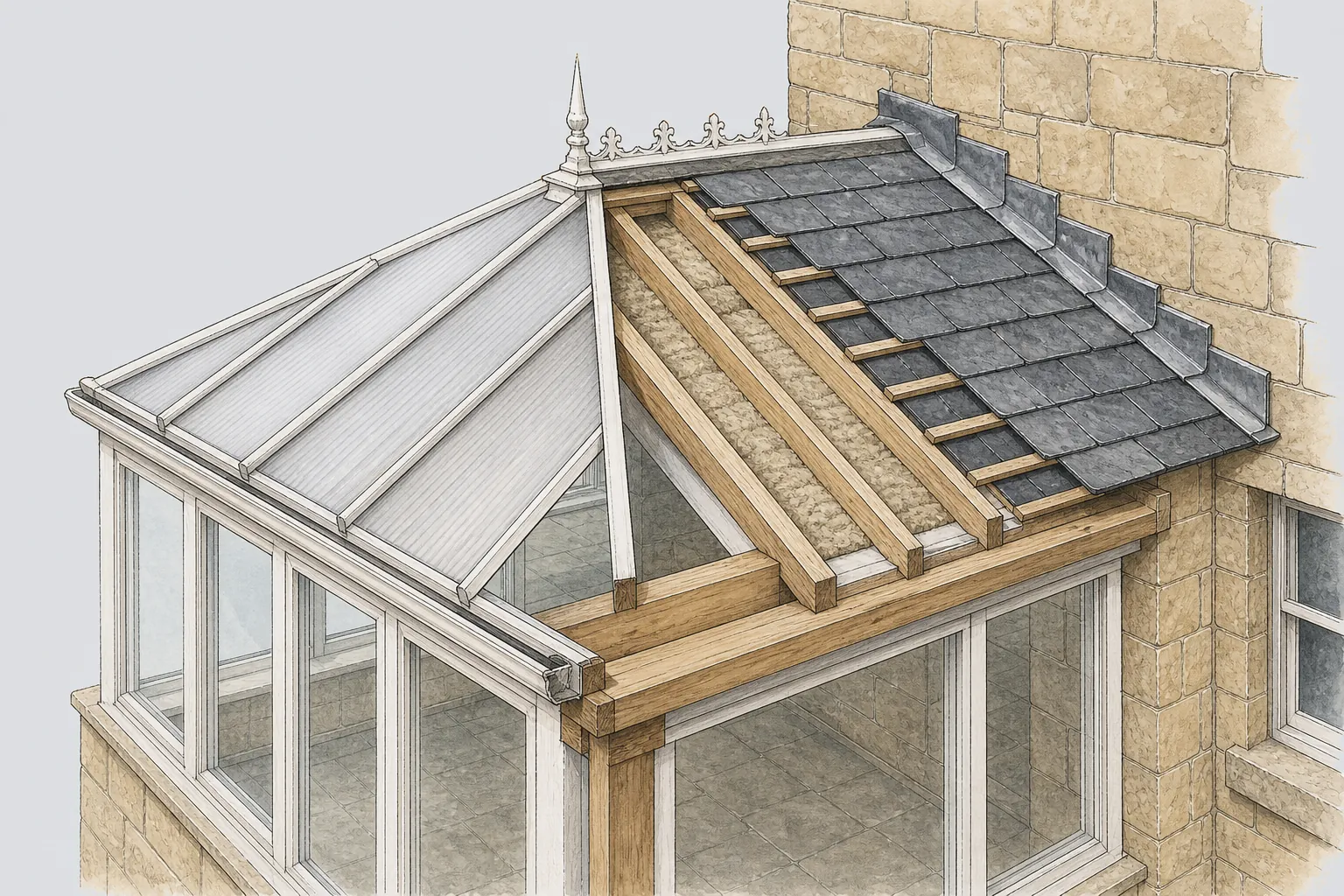
Stand in the road and look up at a Weston Park villa and count the planes of the roof. A main pitch, perhaps two gables, a rear wing, a bay with its own small roof, a dormer. Each time one plane meets another there is a line where water must be turned: a valley where the slopes dip into each other, a hip where they rise, an abutment where a roof runs into a wall. On a house of this scale there can be many such junctions, and the roof is only as good as the weakest of them.

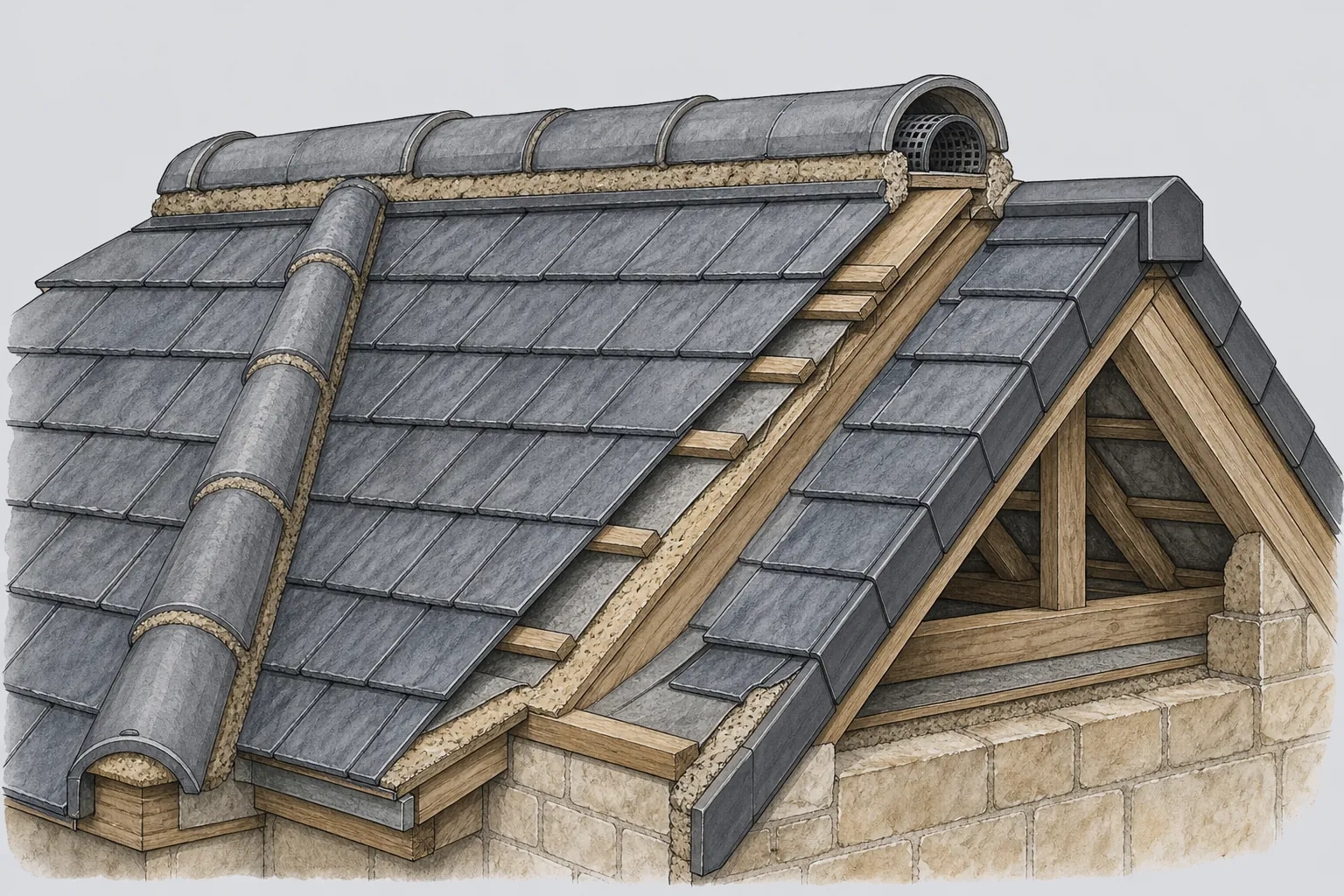
Valleys deserve the closest look. A valley is the trench where two slopes dip into each other, lined with lead or zinc and overlapped at the edges by the slates or tiles. It drains both slopes together, which makes it the busiest water channel on the house. When the lining splits, or the edges of the slates have worn the metal, water goes under the covering and into the roof timbers. The sign is often a stain at a ceiling that is nowhere near a missing slate.

The trees in the grounds add to the work. A villa set in a garden has leaves and seed drifting onto its roof all year, and they settle in the valleys and the gutters. A blocked valley overflows sideways, and a gutter full of silt holds water against the fascia. Clearing these is cheap, and doing it before autumn ends saves the bigger bill. We check what is wrong by lifting rather than guessing.

When a villa roof needs work on several slopes at once, the sensible plan is to deal with them under one scaffold. Our work on slate roofing covers the re-laying of whole slopes in natural slate, with new lead where the old has failed, and the same approach applies to clay.

Junctions on a villa roof and what we check

JunctionWhere it isWhat we check
ValleyWhere two slopes dip togetherLining for splits, edges for wear
HipWhere two slopes rise togetherBedding and fixings on the hip tiles
AbutmentWhere a slope meets a wallFlashing and the joint in the stone
Bay roofOver a projecting windowLead on the flat top and the side cheeks

Natural slate and clay on Bath stone ashlar

Fine stone and a good roof covering belong together, and a repair has to keep the pair intact.

Ashlar is stone cut square and laid with thin joints, so that the wall looks almost like a single surface. On a Weston Park villa it carries a roof of natural slate or clay tile, and the two materials were chosen to go together. A cheap substitute on the roof shows at once against that wall: the colour is flatter, the edges are too regular and the thickness is wrong. If a roof like this is stripped and re-covered, the new material should be of the same kind as the old.

Natural slate is the likely covering on many of these roofs, and a slate roof can last a very long time if its fixings do. The slate is rarely the problem. The nails rust, the battens soften at the nail positions and the underlay beneath dries out. If the slates are sound, we take them off, grade them and lay them again over fresh battens and underlay, discarding only the cracked ones and replacing those with matching slate, new or reclaimed. If they have gone, we match the size, thickness and colour of the original as closely as the supply allows.

Clay tile roofs are repaired in the same spirit. Plain clay tiles are small, so a roof needs very many of them, and each one is held by a nib hooked over a batten and by an occasional nail. Frost damage shows as flaking faces and broken corners. A scatter of failures can be repaired by hand-picking replacements in a matching colour from reclaimed stock. A slope that has failed throughout needs a full re-tile.

Where a whole roof is to be taken off and replaced, the job comes under roof replacement, and that is the point at which Building Regulations come in. Approval applies when the work is large enough, and the roof may need extra insulation as part of it. We tell you before the price is fixed, not after.

Match the roof

On a stone villa the covering stays natural slate or clay, laid to the pattern the house was built with.

Walls, hedges and the problem of reaching the roof

High boundary walls and mature gardens protect a villa, and they make a scaffold a planning job.

One of the things that sets Weston Park apart is how enclosed its best houses are. Tall boundary walls of Bath stone and hedges screen the villas from the road, and the grounds behind them are often generous. That privacy comes with practical consequences when a roof has to be worked on. Materials, scaffold poles, a skip and a delivery lorry must all get through a gate that may be narrower than a modern vehicle.

We plan access when we survey. We note the width of the gate, the route to the house, the condition of the drive and where a skip can sit without damaging a lawn or a root zone. Where the gate is too narrow, materials are carried in by hand or lifted over the wall by hoist, and the plan shows how many days of delivery that adds. We protect paths and borders with boards, and when the job ends the rubbish goes with us.

Trees close to the house are a separate matter. Overhanging branches drop leaves, twigs and sap on the roof, and a branch that rubs on slates wears them over a few seasons. We cannot prune protected trees, and in a conservation area works to trees may need notice to the council, so we point out the problem and leave the decision to you. Bats and nesting birds in a roof void are protected, and if we find either, work waits while we get advice.

The high walls matter in another way. They hide from the street the roof you might never see, so defects can go on for years. A yearly look from a ladder or a photograph from an upstairs window, after the leaves fall, catches slipped slates early. Our chimney repairs work often begins this way, since tall stacks are the first thing a sharp-eyed neighbour notices.

Postwar terraces: concrete tiles, felt and insulation

The simpler roofs of the postwar housing fail in plainer ways, and a thermal upgrade often comes with the work.

West and north of the villas, the housing changes. The postwar terraces here are built of reconstituted Bath stone, a cast imitation of the real thing, and roofed in concrete tiles. They were built for speed and economy, and the roofs show it: a low shape, a uniform covering and not much redundancy in the layers below. These houses are no less deserving of a good repair, but the problems are different from the problems of a stone villa.

Concrete tiles are durable, but they are heavy and their surface wears over time. Moss can hold moisture against the face and the edges, and the underlay beneath them is usually bitumen felt. Felt sags between rafters and, at the eaves, can rot where it dips into the gutter. A tile that rocks, a ridge that has lost its bedding or an edge that is lifting at the verge means the structure around it is ready for attention.

If the tiles are sound but the felt has failed, the usual repair is to lift the tiles, lay new breathable underlay and battens, and put the tiles back. If the roof has weathered throughout, a new covering is the better answer. Whichever it is, replacing a lightweight covering with a heavier one adds load to the rafters, and a covering that weighs 15% more than the old one or beyond calls for a structural check. A re-roof of a large part of the house can also trigger a requirement to improve the insulation, and we advise on that at the survey stage.

Many terrace roofs also suit a dry-fix ridge and verge, which holds the units mechanically and does not depend on mortar. See the notes on heavier roof tiles if you are weighing a change of covering. We repair where repair works, and tell you when a roof has gone past it.

Words you will hear

Reconstituted stone
Cast stone made from crushed natural stone and cement, used as a cheaper stand-in for cut stone.
Breathable underlay
A modern membrane under the battens that lets moisture vapour escape from the loft while turning back rain.
Dry-fix
A set of clips, caps and seals that fix the ridge and verge without mortar.
Valley
The trench between two slopes that dip towards each other.

Map showing the location of Weston Park.

Nearby

Roofers near Weston Park

Roofing services in Weston Park

Local questions

Villa owners behind Weston Park walls ask

My Weston Park villa has natural slate. Should it be replaced like for like or with something cheaper?

Like for like is the right answer on a stone villa. Natural slate on Bath stone ashlar is the pairing the house was built with, and a flatter, thinner or more regular substitute shows from the road. If many of the slates are sound, they can be stripped, sorted and laid again on new battens and underlay, with matching slate for the gaps. We set out both options in the survey so that you can see what each involves.

How do you get a scaffold and materials into a villa behind a tall stone wall?

We look at the gate, the route and the ground on the survey. A narrow gate may mean carrying materials by hand or lifting them over the wall, and a soft lawn means boards under the scaffold feet and the skip. We note the details so the written scope covers the extra time and does not surprise you later. Paths and borders are protected, and when we finish the site is left clear and the rubbish goes with us.

Do postwar concrete-tiled terraces near Weston Park need the same care as the older villas?

They need different care. The covering is simpler and heavier, and the usual faults are cracked ridge bedding, tired verges and underlay that has sagged under the tiles. A repair at the eaves can sometimes bring a roof back, but where the felt has failed throughout, the tiles come off and go back over new underlay. Because concrete tiles are heavy, we check the rafters before anything is relaid.

Is my Weston Park house inside the conservation area, and does that affect the roof?

We cannot tell from here, because the answer depends on the street. About half of Bath lies in the conservation area, and some streets have Article 4 directions as well. The council's policy map shows both, and its planning team can confirm what applies to your house. A repair that matches what is there may need little or nothing, but a new covering, a roof window or a rebuilt chimney should be checked with them first.

Get your free survey

Get your free roof survey

Tell us what's happening and we'll call you back to arrange a visit. Prefer to talk? Call 01225 285181.

  • Photos of your own roof
  • A fixed price in writing
  • 10-year workmanship guarantee
Call Free survey