


Mid-century roofs: felt, tiles and ventilation
Housing from the middle of the 20th century needs the layers under the tiles checked more than the tiles themselves.
In the southern part of Newbridge, mid 20th century housing is the main character of the streets. Roofs from that period are straightforward in shape, typically a simple pitch with a ridge and perhaps a hip, with the covering laid over battens and, as first built, bitumen felt. They were built efficiently, and after several generations of weather the layers beneath the visible surface are often the part that needs attention.
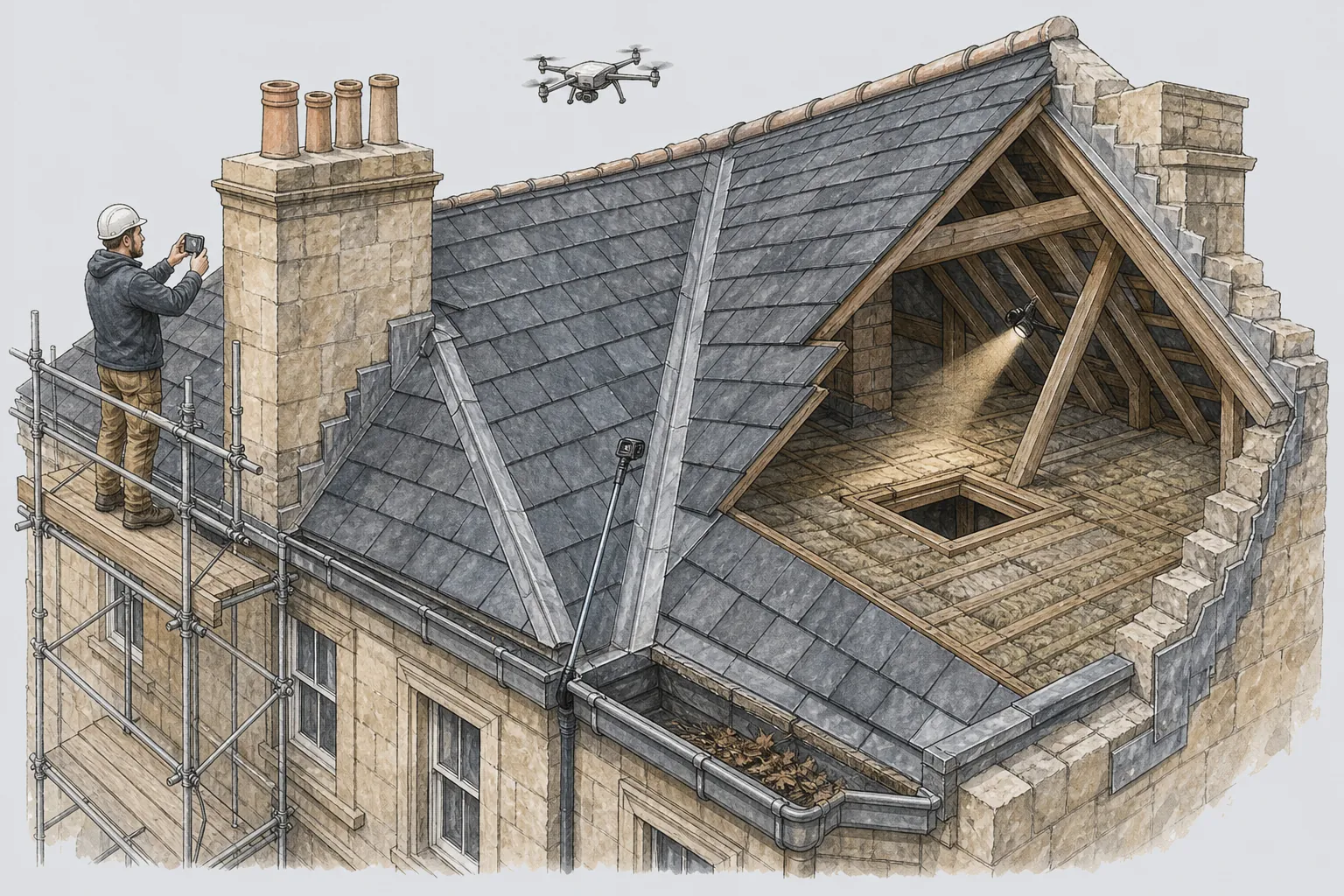
Bitumen felt is the first to go. It sags between the rafters, where it collects water and wears against the battens, and it perishes at the eaves, where it should deliver water into the gutter. Once it has failed, a wind-driven shower can find its way past a single tile and into the loft. The signs are subtle: a faint musty smell, a stained felt seen from the hatch, a slight dip in a slope. Our survey checks all of them, and we pull one tile at the eaves to see for ourselves.
Ventilation is the other recurring issue. A roof needs air moving through the loft to carry moist air out, and if the eaves vents have been blocked by insulation or the ridge is sealed, the moisture condenses on the underside of the felt and drips onto the timbers. Black spotting on rafters or damp insulation is a clue. We can correct it by clearing the eaves, fitting vents or changing to a breathable underlay when the roof is next stripped. See our guide to loft condensation for the signs.
Where the tiles are good and only the felt has gone, the answer is to strip them, lay fresh underlay and battens and refit the same tiles. That is often the best-value route, and it is how our roof replacement work begins when the whole slope is involved. Large re-roofs may bring a Building Regulations application and a thermal upgrade, and we explain that before the price is set.
Myth
If the tiles on a mid-century roof look fine, the roof underneath must be fine.
Fact
The felt and battens under the tiles age separately from the tiles, so the only way to know their condition is to take a few out and look.