



Rendered rubble and the roof edge
When limestone walls were smoothed over with render, the line where wall meets roof became the weakest joint.
The 17th and 18th century houses of Calne were built of stone, mainly limestone rubble, which is rough, irregular masonry that is rarely square. Many were then covered in a smooth coat of render, which gives a neat face and a layer of protection against the weather. The render does its job as long as it stays sound. Once a crack lets water behind it, the damage is out of sight.
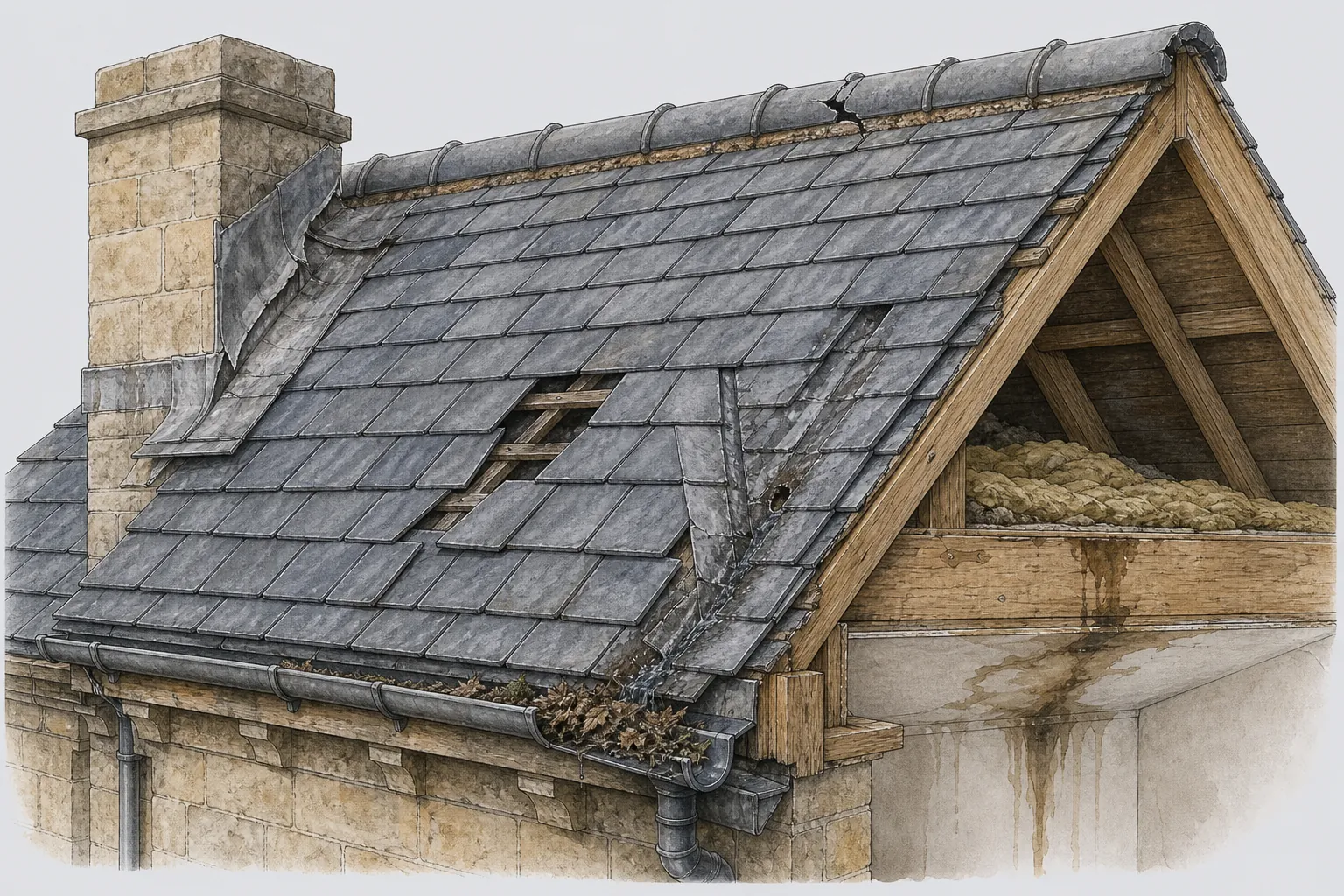
The roof edge is the most likely point of entry. At the eaves, the render ends beneath the gutter, and a gutter that leaks or overflows drips straight down the wall. At a gable, the verge sits over the wall head, and failed pointing lets rain run into the top of the render. Where a roof meets a higher wall, the lead flashing, called an abutment flashing, is tucked into a groove cut into the wall and sealed. If the sealing fails, the water runs behind it.
The signs are easy to miss from the ground. Look for a stain that begins below a gutter joint, a bulge or a hollow sound when you tap the render, a green streak below the verge, and a damp patch on the inside of an upper wall. Each has a cause that can be traced upward to the roof, and it is wiser to find that cause before repairing the render, which will otherwise fail again in the same place.
Our repair begins with the water. We fix the gutter, the verge or the flashing that has been letting it in, and only then comment on the render. Render repairs belong in a mix that suits the wall. Old limestone has to dry out, and a hard coat that will not let water through keeps the moisture in.
Where the fault is a leak at a join or a valley, roof repairs sets out how we make a leak safe first and put it right afterwards.
Myth
A stain on rendered brickwork or stone below the eaves is a cosmetic problem.
Fact
It usually marks a leaking gutter or failed edge detail, and repainting without curing the water only hides the sign.