
A Mendip village of grey limestone cottages with clay tile roofs

Roofers in Pilton

Pilton, 20.5 road miles out from Bath in a south-westerly direction, stands at the edge of the Somerset Levels. A Grade I tithe barn and a medieval church stand in the village, while the scattered hamlets of the parish add longer drives and smaller lanes to any job out there.

Local roofs

An abbey's barn, a medieval church and a parish of hamlets

Pilton sits on the edge of the Somerset Levels, an area now drained that was once a shallow tidal lake. The village is on the A361, and the parish reaches out to the hamlets of West Compton, East Compton, Westholme, Beardly Batch and Cannards Grave. A roof job here can mean a lane off a lane, so the address matters as much as the house.

Three buildings carry the village's history. The village church, St John the Baptist, is medieval and Grade I listed. The manor house is Grade II* listed. And the tithe barn that once belonged to Glastonbury Abbey is Grade I. A tithe barn was built to hold the produce an abbey took from its land, and the scale of it, in timber and roof area, is far beyond a house.

The roofs we are called to are, naturally, nothing like that. They belong to farmhouses, cottages, converted outbuildings and newer homes, and they face the same weather as the great buildings do. What the three landmarks offer is a standard for the village: an old roof documents how people built, and a repair should leave that account legible.

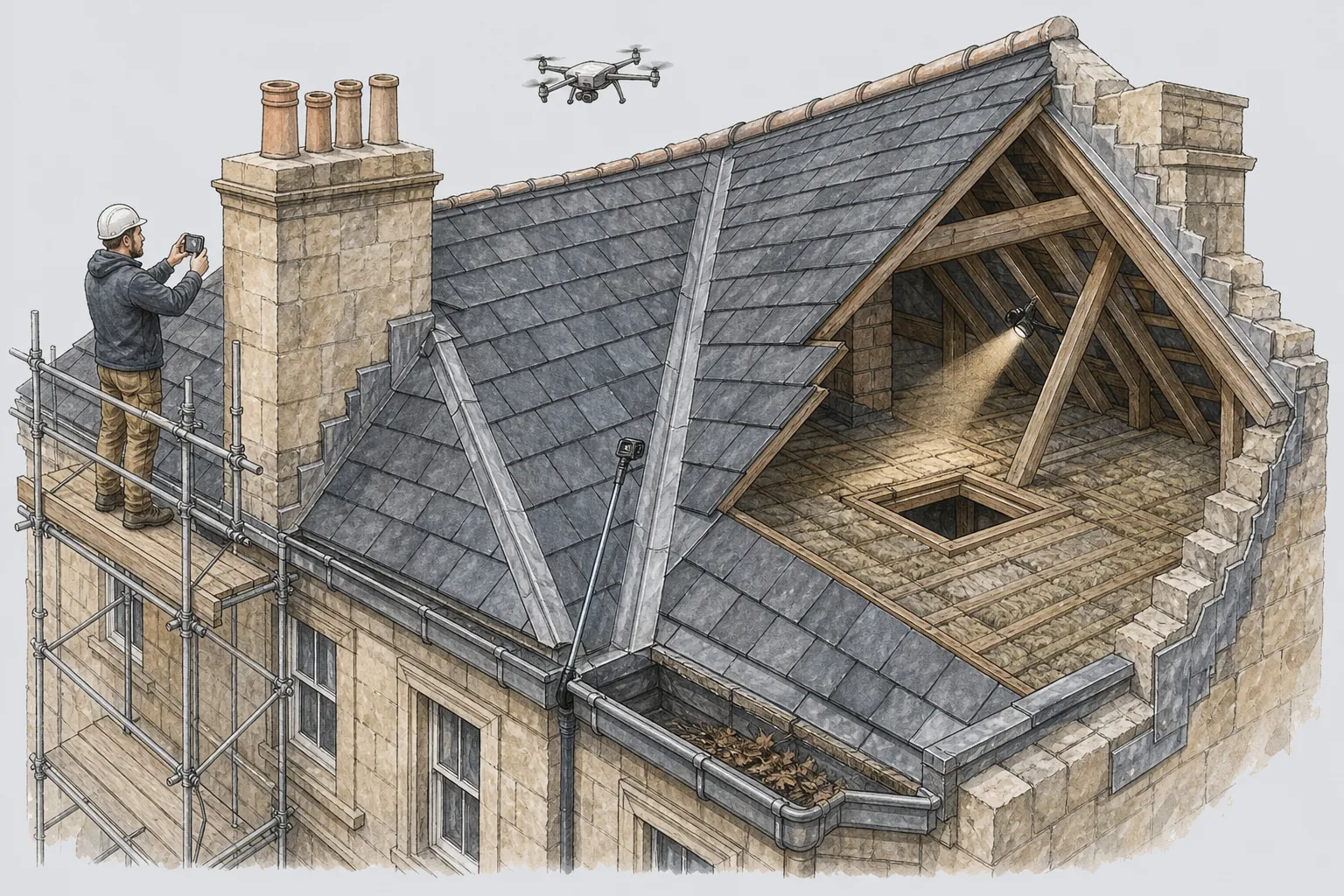
The survey is done on the roof, with pictures of what we find. It ends with the cause of each fault and a fixed written price, and where an older roof is concerned, the repair uses matching material.

Council
Somerset Council
From central Bath
20.5 road miles, south-west
Tithe barn
Grade I listed, once belonging to Glastonbury Abbey
Manor house
Grade II* listed
Hamlets in the parish
West Compton, East Compton, Westholme, Beardly Batch, Cannards Grave

What we find

Shady moss, barn frames and tired fixings

Moss on slopes that stay shadySlopes that stay damp grow moss, which lifts the edges of tiles and holds water. We see how thick it is, whether it has worked under the laps and whether a gentle clean will do or a repair comes first.
Old timber frames in barns and outbuildingsLarge old roofs rely on a few big timbers. We look at the feet of the principal rafters and the wall plate (the timber on the wall top) for rot or insect attack, the first places a roof of this kind shows distress.
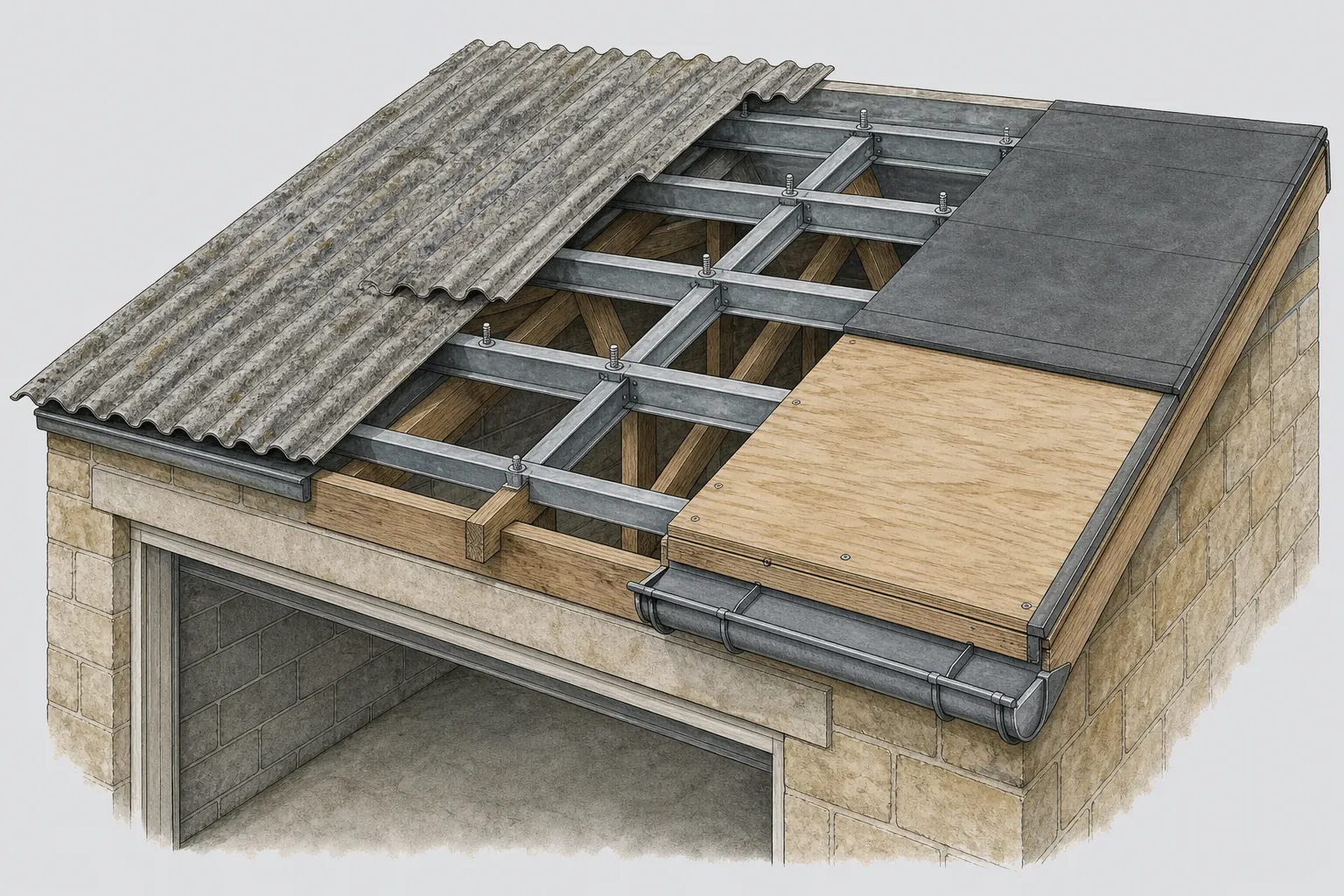
Roof coverings that have outlived their fixingsA roof on an older farmhouse may have been patched many times with whatever came to hand. We lay out what is original, what has been added and whether the patches are holding or hiding a larger fault.

The tithe barn and roofs on a grand scale

A barn the size of a Grade I tithe barn shows what old roof timbers can do, and what happens when water reaches them.

Pilton's tithe barn is Grade I listed and belonged to Glastonbury Abbey. A building like that was made to store a large share of an estate's harvest under one roof, and it did so with a timber frame and a roof area that dwarfs any house. Buildings of this class are rare, and the village's roofs are mostly more modest. Even so, the principles that keep a great barn roof sound apply at every scale.

The main one is that timber survives for centuries if it stays dry and ventilated. Nearly every old roof that fails has been taking in a little water, winter after winter. A slipped slate or a cracked ridge lets in a little rain each winter. The rafter foot or wall plate beneath takes it up, stays damp and begins to decay. The signs are invisible from the field. A probe finds them, and a loft inspection with a torch finds them sooner still.

The same goes for any converted barn in the parish. A big open roof turned into a living space has been insulated, boarded or lit with rooflights, and each of those changes has altered how the timbers breathe. Insulation squeezed hard against the underside of a covering can trap damp. We look at how the conversion was done before deciding what a repair needs, and we ask whether any original timbers were boxed in or cut during it.

If a property is listed, repair work is judged against what is there, and anything that changes its character needs consent from the planning authority before it starts. Bats and nesting birds make use of old roofs, and if signs of either appear, work pauses while proper advice is obtained. Our roof inspections page explains how a survey of a large or old roof is carried out and written up.

Five hamlets and the lanes between them

Pilton parish runs to West Compton, East Compton, Westholme, Beardly Batch and Cannards Grave, and each address has its own access.

A parish spread over several hamlets does not behave like a street. The houses are farther apart, the approach roads vary from main road to farm track, and a lorry that reaches one doorstep may not reach the next. The A361 passes through Pilton itself, but the hamlets of West Compton, East Compton, Westholme, Beardly Batch and Cannards Grave sit on smaller roads, and the last stretch to some houses may be a private track.

Access is not a detail. It decides where scaffold can stand, whether a delivery lorry can reach the property and how far materials must be carried by hand. A skip with nowhere to sit may have to be placed on a verge or a neighbour's land, with their agreement. Rural roofs also tend to be bigger, with long runs of ridge and gutter and outbuildings alongside, so scaffold costs rise with the extent of the work.

We therefore look at the route, the working space and the ground, and say at the survey what will be needed. If the track is soft after rain, if a gate is too narrow for a lorry, or if a tree overhangs the roof and a branch needs to be dealt with first, that is raised before a price is fixed.

The survey also records what the property needs beyond the obvious fault. A farmhouse roof that leaks over one room often turns out to have worn gutters, a loose chimney flashing and a ridge that needs refixing as well. Telling you that in one visit, with photographs, saves a second call-out. Where only a repair is needed, that is what we propose, and the written scope says what is left alone as well as what is done. For repairs after storm or leak, roof repairs explains how urgent work is handled.

Access first

On a rural address the route and the working space decide the method, so the survey settles them before the price.

Moss, damp air and the edge of the Levels

Pilton sits on the edge of the Somerset Levels, and roofs near damp ground and trees tend to hold moss.

The Levels were a shallow tidal lake before they were drained. Wherever the ground is damp and the trees are heavy, slopes that face north or sit in shade stay wet longer, and moss and algae take hold on them.

Moss is more than cosmetic. Its roots grip the surface of a tile or slate and its mat holds water against the covering. In winter the trapped water freezes, and tile edges can flake. Moss can also work its way under the laps and lift the course, and a thick growth can block a gutter when it falls. A clean roof dries faster and lasts longer, so cleaning has a place in maintenance, as long as it is done gently.

The method matters. A soft wash uses low pressure and a treatment applied to the surface, and the moss dies back and is rinsed away. Pressure washing blasts the growth off, but MyBuilder's roof cleaning guide notes that it may damage delicate tiles, and it can drive water under the laps. We use the gentler method on older roofs. For scale, the same 2026 guide gives national figures of about £450 to £850 to clean a pitched roof, £500 to £1,000 for slate and £400 to £750 for tile. A fixed quote for your own roof follows the survey, and it names the method, so you know what you are paying for.

Cleaning is not a cure for a roof that needs repair, and a roof that is cleaned and left with a cracked tile will only show the crack more clearly. We check before cleaning whether any tiles are cracked, whether the ridge is sound and whether the gutters will cope with what washes down. Details on method and aftercare are in our roof cleaning section.

Myth

Pressure washing is the quickest, best way to clear moss from a roof.

Fact

High pressure can damage delicate tiles and force water under the laps, so a soft wash is generally the gentler choice for older coverings.

Church, manor and the question of consent

With a Grade I church and a Grade II* manor house in the village, plenty of roofs here sit beside listed neighbours.

St John the Baptist is a medieval church of the highest grade, while Pilton's manor house sits one rung below at Grade II*. The grading matters because it tells you how seriously a building's fabric is protected. It also colours how the whole village is seen: a house near a Grade I church sits in a setting where visible roof changes draw more attention than they would in an estate of newer homes.

For a listed house, the route is the same whatever the grade, and St John the Baptist, where Anglican worship continues, follows the diocese's faculty route instead. The listing includes the roof. A repair that retains what exists, in matching materials and by the same methods, is least likely to cause difficulty. Changes in the covering, the profile or the chimneys are the ones to raise with the council first, and the local authority here is Somerset Council. Whether a building is listed can be checked on the Historic England list, with the council able to confirm the position at your address.

Heritage repair has its own habits. Lime mortar suits old stone and brick, being softer than the masonry and porous enough to let moisture escape. Repairs are made so that they can be read as repairs and, where possible, undone. Old materials are kept and reused where they are sound. A good repair leaves more of the original in place than a replacement would.

For an unlisted house, the position is simpler, but the same instincts apply. Stripping and re-covering a big part of the building brings Building Regulations into play, with possible insulation improvements, and a new covering that outweighs the old one needs a structural check. Our survey sets these out for your roof specifically, so you can plan with the facts. For the overall picture of a large job, see roof repairs.

Words you will hear

Tithe barn
A large barn built to store the tenth of a farm's produce due to the church.
Lime mortar
Soft, porous mortar for old masonry, used where cement would be too hard.
Wall plate
The timber laid along a wall top on which the rafters stand.
Principal rafter
One of the main sloping timbers of a traditional roof frame.

Map showing the location of Pilton.

Nearby

Roofers near Pilton

Roofing services in Pilton

Local questions

Five hamlets, one parish, plenty to ask in Pilton

What is feeding the moss on the shady side of my Pilton farmhouse roof?

A slope that gets little sun stays wet for longer, and in a parish at the edge of the Levels, with trees close by, moss takes hold quickly. The mat keeps water sitting on the tiles, and the edges can lift. We check whether the moss has worked under the laps before cleaning, and we use a soft wash, which is gentler on older tiles than high pressure.

My home is in Cannards Grave. Can you reach a property that far from the main road?

We cover roofs within 30 road miles of Bath, and Pilton parish lies inside that. The practical question is the access: the track, the gate, the space for scaffold and where a lorry can stand. We check those at the survey, so any extra time or equipment is in the written price from the start.

Is a barn conversion roof in Pilton treated differently from an ordinary house roof?

It often needs more care. The original timbers are large, the roof area is wide, and the conversion may have added insulation or rooflights that changed how the frame dries. We look at the timbers in the loft first, then the covering, and say whether a limited repair is enough or the conversion itself needs putting right.

Do bats or nesting birds affect when a roof near the abbey barn can be repaired?

They can. Bats and nesting birds enjoy legal protection, and old barns and church-age roofs are places they use. If we see signs during the survey or the work, we pause while proper advice is obtained, and Natural England is the body that gives it. Planning around that can mean adjusting the timing of the job.

Get your free survey

Get your free roof survey

Tell us what's happening and we'll call you back to arrange a visit. Prefer to talk? Call 01225 285181.

  • Photos of your own roof
  • A fixed price in writing
  • 10-year workmanship guarantee
Call Free survey