
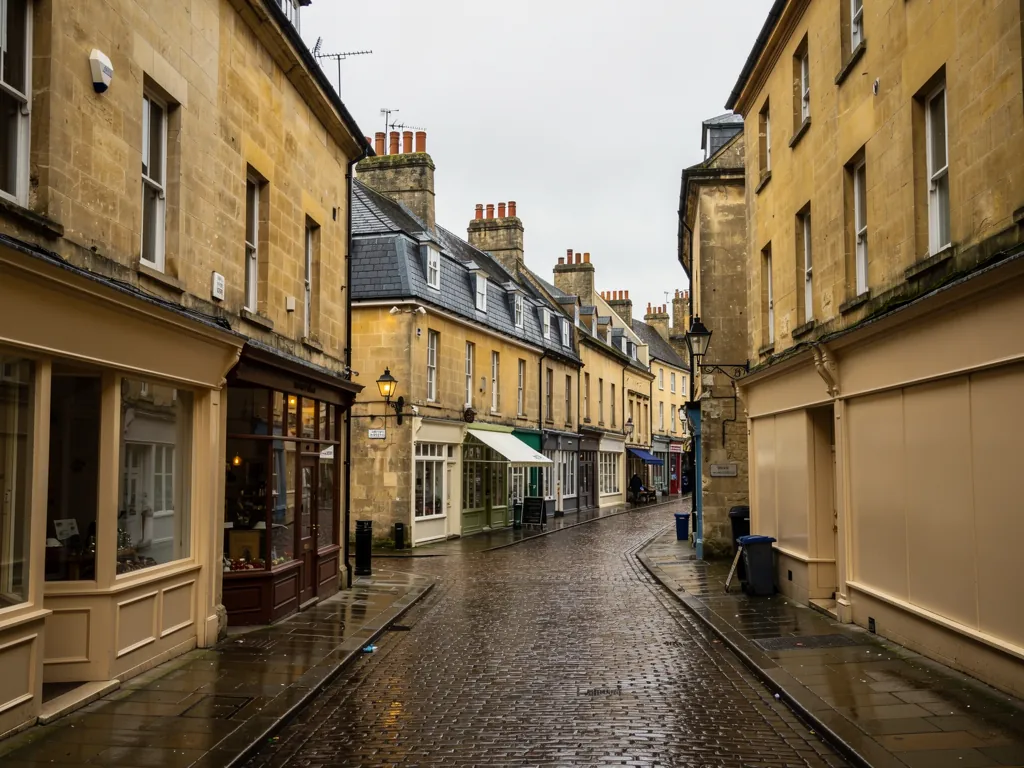
A Mendip village of grey limestone cottages with clay tile roofs

Roofers in Wells

Wells is a small cathedral city 21.3 road miles south-west of Bath, under the Mendip escarpment, with a cathedral carved from warm Doulting stone. Old masonry meets the roof at every edge in the city, so a repair here deals with walls, gutters and gatehouse parapets as much as with the covering on top.

Local roofs

A city at the foot of the hills

Wells lies at the foot of the southern escarpment of the Mendip Hills, where the limestone uplands drop away to the Somerset Levels. The hills behind the city are largely carboniferous limestone, quarried at several sites nearby. Wells Cathedral, Grade I listed, keeps almost 300 of its original medieval statues on the west front, carved from warm, yellow Doulting stone.

The city is compact and old, and much of its character sits within a few streets. Vicars' Close, owned by the cathedral, is described as the oldest residential street in Europe, and it is tapered by 10 ft so that it looks longer from the bottom. The walled Liberty of St Andrew is entered through the Penniless Porch, the Bishop's Eye and Brown's Gatehouse, all built around 1450. In the Market Place the Town Hall of 1778 houses Wells City Council.

Later buildings sit among these. The former Regal cinema in Priory Road, built in 1935 in Flemish bond brickwork with Art Deco features, is Grade II listed. A city of that mix gives a roofer several quite different jobs on a single afternoon: stone-built houses with parapets, terraced rows with shared gutters, and commercial and civic buildings with flat sections behind their walls.

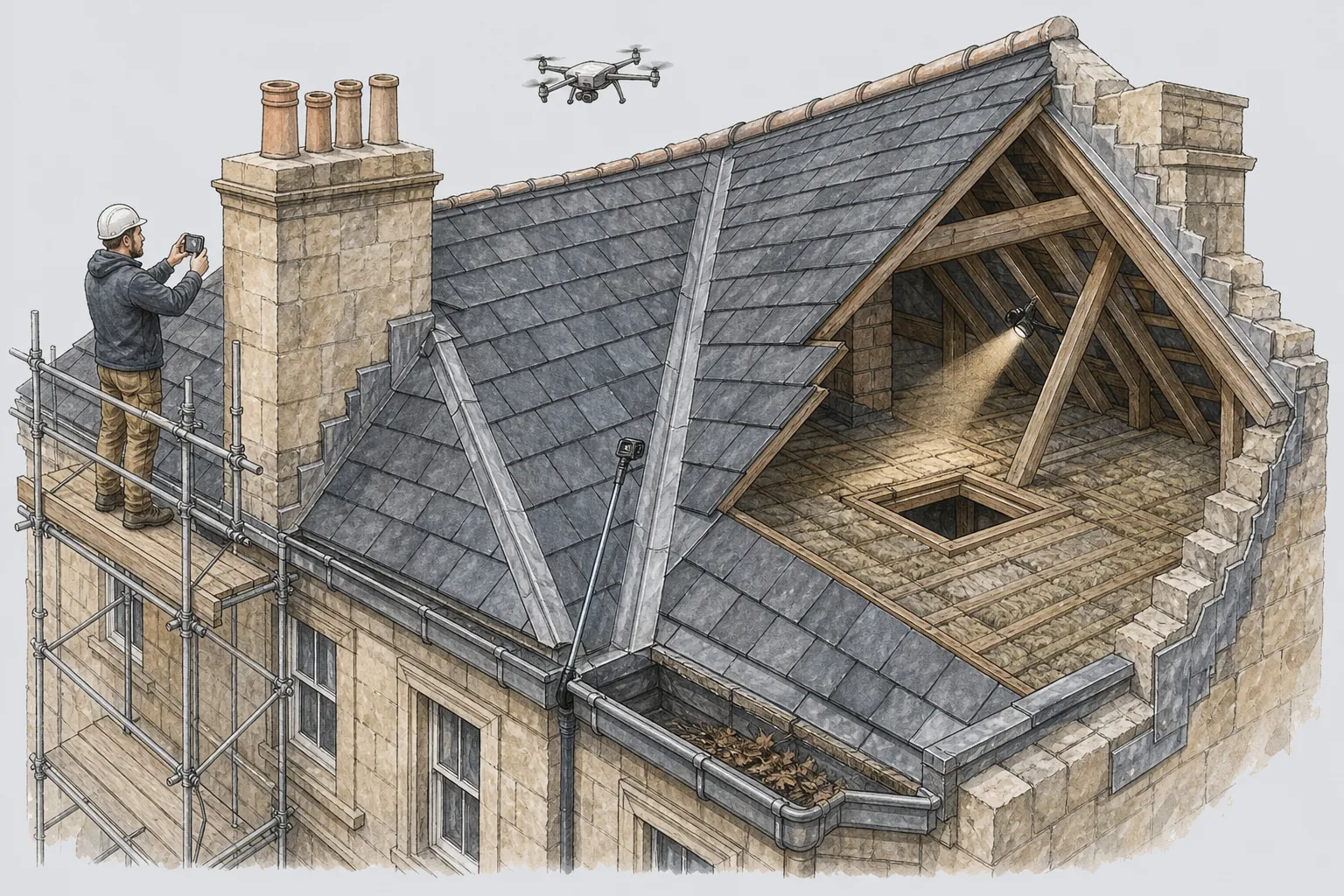
The council here is Somerset Council, and any question of listed building consent goes to its planning team. We will go up, find out what the roof actually needs and put it to you in simple language, and we send you the evidence as pictures of the roof itself, with a price in writing to follow.

Council
Somerset Council
From central Bath
21.3 road miles, south-west
Cathedral
Wells Cathedral, Grade I, Doulting stone
Oldest street
Vicars' Close, tapered by 10 ft
Town Hall
Market Place, built 1778

What we find

Doulting stone copings and gutters between rows

Weathered stone copings and parapetsWhere a roof ends against a stone wall, the coping on top is what keeps rain out of the wall head. We look for open joints, stone that has lost its face, and any place where water has been running down a parapet and into the roof below it.
Blocked or split gutters between rowsA terraced roof often drains through a gutter shared between two properties or hidden behind a parapet. We open it up, clear it, and look at whether the lining has split, ponded or sagged away from the fall.
Aged flat sections behind masonryShops, halls and extensions can have flat areas that no one sees from the street. Cracked or blistered membrane, loose edge trims and failing laps are what we hunt for, and we tell you whether a repair is realistic or the section is due for renewal.

Doulting stone, coping and the stone parapet

A city of old limestone buildings meets the weather at its wall heads.

The cathedral's west front, carved in warm, yellow Doulting stone, shows what weather does to limestone over time. Weather works on it slowly and from the surface. At roof level, though, the stone is asked to do something more difficult than stand in a wall. It forms copings, parapets, gable kneelers and chimney heads, all places where rain lands on a horizontal face and has to be shed without soaking in.

That is where the trouble starts. A coping stone caps a wall and sheds rain from its head. The joints between coping stones are the weak points, because water enters a failed joint and travels down the wall beneath, sometimes to emerge as damp on an internal face months later. Where the wall is also the edge of a roof, the same water can reach the timbers. Called out to a top-floor ceiling stained beside a parapet, we start with the coping.

The right repair uses a mortar that suits the stone, softer and more porous than the masonry, so damp can leave through the mortar joint and not through the stone itself. Hard cement traps water, and the stone beside it decays. Where a block has lost too much of its surface to be saved, replacement in matching stone is a mason's job, and we can arrange it as part of the roofing work so that lead, stone and covering are dealt with together.

A parapet gutter, set along the base of such a wall and usually lined with lead, is often the actual source of a leak that seems to come from the wall itself. Sections that pond or are choked with debris wear out first. The chimney repairs service covers stacks, caps and the lead around them, and the same stone and lime principles apply to every masonry detail on the roof.

Myth

A damp patch beside a stone parapet means the roof covering has failed.

Fact

More often the water comes in at the coping or the gutter behind the wall, and the slates or tiles beside it are perfectly sound.

Vicars' Close and the terraced row

A street laid out as a single composition has roofs that depend on each other.

Vicars' Close is the best-known street in the city, a planned row of houses facing one another across a narrow way, tapered so that the far end seems more distant. The detail is a reminder that terraced and linked buildings are designed as groups. What matters for a roofer is that their roofs are groups too.

In a row, a slope runs between two party walls, and each point where roof meets wall gives water a way in. Where the roofs of two neighbours meet, there may be a valley, a shared gutter or a stepped flashing. A valley is the fold between two slopes that drains both, and a stepped flashing is a staircase of lead pieces sealing the roof against a rising wall. When one owner repairs their half and the other does not, the weak side usually sets the pace of the leak.

We therefore like to look along the whole run when we survey a terraced house. If the gutter beyond your boundary is blocked, it may be what is overflowing into your roof. If the next house has lost a flashing, water can track along the wall. We will tell you what is yours to mend and what to raise with a neighbour, and where shared work makes sense we can price it in one visit.

Cast and extruded gutters, brackets and downpipes along a row also wear in different ways. Corroded joints, failed seals and sagging fall lines all send water to the wrong place. Material and profile choices are covered under gutters, soffits and fascias, and where the gutter is a built-in channel rather than a fixed run, it is a lead or membrane job and we treat it as part of the roof.

On any listed or historic row, the covering must be matched. We do not mix slate with a modern substitute, or reclaimed tile with new in a way that shows from the street, and we explain in writing what will be used.

Words you will hear

Party wall
The wall shared by two adjoining properties, which a terraced roof runs up to.
Stepped flashing
Lead cut and folded into steps so that a sloping roof seals against a rising wall.
Valley
The junction trough between two slopes, taking water from both.
Fall
The gentle slope given to a gutter so that water runs to the outlet.

Gatehouses, the Liberty and consent in a cathedral city

In a place with this much protected stone, many roofs have to be agreed with the council before the work begins.

The Liberty of St Andrew, the walled enclosure around the cathedral, is entered through the Penniless Porch, the Bishop's Eye and Brown's Gatehouse, all built around 1450. That kind of fabric is exactly what the listing system exists to protect, and in a city with a Grade I cathedral, a street of ancient houses and a number of listed civic buildings, you should assume nothing about your own roof until you have checked.

Historic England keeps the National Heritage List for England, an official record of every listed building, and an entry takes a few minutes to look up. A listing protects the whole building, including its roof, and works that affect its character need listed building consent from Somerset Council before they start. Altering a listed building without consent is a criminal offence, so the check is worth making early. If you are in a conservation area, the question for roofs is different but real, and you should confirm with the council whether your street has any added restrictions.

What we can give you is a clear description of the work. For a listed roof, that means saying what covering would be used, how lead flashings would be formed, how the fixings would be done and what would be kept. The council has something specific to react to, and the answer comes back faster. Where an older covering is sound, repair is often the better path both for the building and the budget.

Separately from consent, Building Regulations apply in certain cases. A small re-covering usually needs no approval, while larger work, or a new covering much heavier than the old, does. Where the work is notifiable, the application is ours to make, through Somerset Council's own building control or else a registered building control approver of your choice. For anything involving a stack, the chimney repairs page is a useful starting point.

Birds and bats use old roofs and gatehouse voids. Both are protected, so if we find evidence of either, we stop and talk to you.

The Regal, the Town Hall and the flat roofs behind them

Civic and commercial buildings bring flat roof sections, parapets and larger gutters into the work.

The 1935 Regal cinema in Priory Road, with its Flemish bond brickwork and Art Deco styling, is Grade II listed, and the Town Hall in the Market Place dates from 1778. They come from different centuries, and both are reminders that central Wells includes buildings that are not houses. Shops, halls, offices, church rooms and former industrial space all have roofs of their own, and many combine a pitched section with a flat one behind a front wall.

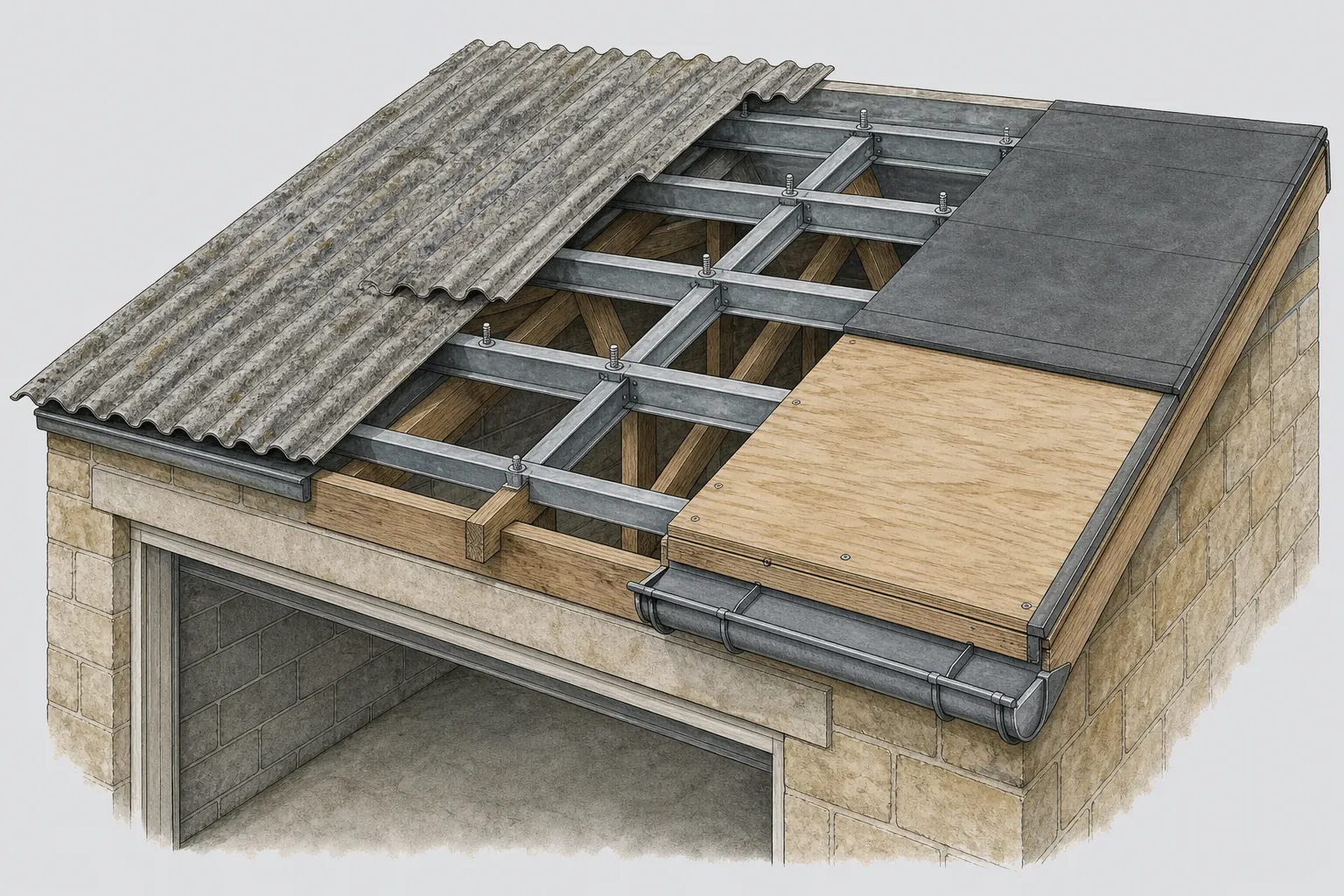
Flat roofs fail in ways that are quite different from pitched ones. The common faults are a membrane that has blistered or cracked, laps that have opened, upstands (the vertical edge of the membrane where it meets a wall) that have pulled away, and outlets that have blocked. The usual materials are lead, bitumen felt, EPDM (one sheet of synthetic rubber), GRP (a glass-fibre and resin coat laid on site) and single-ply membranes. Which suits a given roof depends on its shape, its age and what lies below it.

For commercial work, we survey the whole building and price on what we find. A MyBuilder guide from 2026 reports typical UK costs for a replacement flat roof of about £2,800 to £7,500, with lead at the high end per square metre, but commercial roofs vary too widely for a single figure, so we price them on survey. Your fixed price arrives in writing once we have seen the roof.

Our flat roofing page describes the systems we fit and repair, while larger and non-domestic buildings come under commercial roofing. If your building is listed, the covering and its detailing are part of what the consent has to agree.

Typical flat roof systems

SystemWhat it isTypical UK range per m²
Bitumen feltLayered bituminous sheet, bedded in place£70 to £100
EPDMA single synthetic rubber sheet£90 to £130
GRPGlass-reinforced resin laid in place£95 to £150
LeadRolled sheet with formed joints£150 to £200 and up

Map showing the location of Wells.

Nearby

Roofers near Wells

Roofing services in Wells

Local questions

Questions from the Liberty and Vicars' Close

Can new Doulting-type stone be matched when a coping or chimney head needs replacing in Wells?

Usually a close match can be found, and a mason can cut it to suit. The right stone for a coping or stack is chosen to blend with what surrounds it, and it is bedded in lime so the new block does not trap moisture against the old. On a listed building the choice of stone is something to agree with the council. We will put the repair into words that the council can assess.

My Wells terrace has a gutter running behind the parapet. How do I know whether it has failed?

Look for staining on the wall below, damp at the top-floor ceiling and plants growing in the gutter line. From the inside, a damp patch that appears after heavy rain and fades slowly is typical. We open the gutter, clear it, and look at the lining for splits, ponding and sagging. Then we tell you whether a repair will serve or the run needs relining.

Does a roof in Wells need listed building consent for a like-for-like repair?

That depends on the building and on how like-for-like the repair is. Consent is the council's decision, and Somerset Council's planning team should be asked before work on a listed building starts. A modest patch in matching materials may raise little, whereas altering the covering, forming a new opening or taking a stack down calls for agreement beforehand.

We manage an older shop with a flat section behind the front wall. Can you survey the whole building?

Yes. We go over the pitched and flat sections together, photograph the defects and write up the repair or renewal scope. Flat roofs behind masonry need particular attention at the upstands and the outlets, and a ranked list for each part lets you choose where to begin.

Get your free survey

Get your free roof survey

Tell us what's happening and we'll call you back to arrange a visit. Prefer to talk? Call 01225 285181.

  • Photos of your own roof
  • A fixed price in writing
  • 10-year workmanship guarantee
Call Free survey