
A Mendip village of grey limestone cottages with clay tile roofs

Roofers in Axbridge

Axbridge is a small town whose centre kept its old buildings when the cloth trade faded, and it lies west of Bath by 27.9 road miles. We survey, repair and re-cover roofs there, from Tudor-era houses and stone chimneys to the large 19th-century buildings and outbuildings that have found new uses.

Local roofs

A town the wool trade left standing

Axbridge reached its height as a Tudor cloth-making town, and then its importance declined. The slump was unkind to the economy and kind to the buildings, because a town with no money for rebuilding keeps what it has. The stagnation left many historic buildings standing in the centre, and that is the first thing to know about the roofs here: a good number of them are old, and some are very old.

King John's Hunting Lodge, despite its name, is a Tudor building and now serves as a museum. The Church of St John is Grade I listed and built of limestone decorated with Doulting stone. Its nave roof is Jacobean, dating from 1636, and its crossing tower stands over 100 feet high and holds six bells. In 1837 the Axbridge Union workhouse went up on the south side of West Street to a design by Samuel T Welch, intended to hold 250 inmates.

The Cheddar Valley railway once ran through the district. Its route is now the A371 Axbridge bypass, though the station buildings and goods shed still survive. Those survivors are outbuildings of a type we see in many towns: large, plain and easy to forget until the roof lets go.

A town like this has several kinds of roof work running side by side. Somerset Council decides what listed building consent applies to, and where it does we take care to set out the details of the repair in ordinary language before anything is priced.

Council
Somerset Council
From central Bath
27.9 road miles, west
Church of St John
Grade I listed, nave roof dated 1636
King John's Hunting Lodge
Tudor building, now a museum
Union workhouse
Built 1837, West Street, designed by Samuel T Welch

What we find

Tudor timbers and rain-worn stone in Axbridge

Old timbers under later coveringsIn a town that kept its Tudor and Jacobean fabric, the frame can be older than the tiles by centuries. We look into the loft for movement, rot at the wall plate and the sort of past repair that hides the real fault.
Stone details exposed to rainCopings, gable tops and chimney caps in limestone take the weather first. We check the joints, the lead where it meets the stone and whether earlier repointing used a mortar harder than the stone can tolerate.
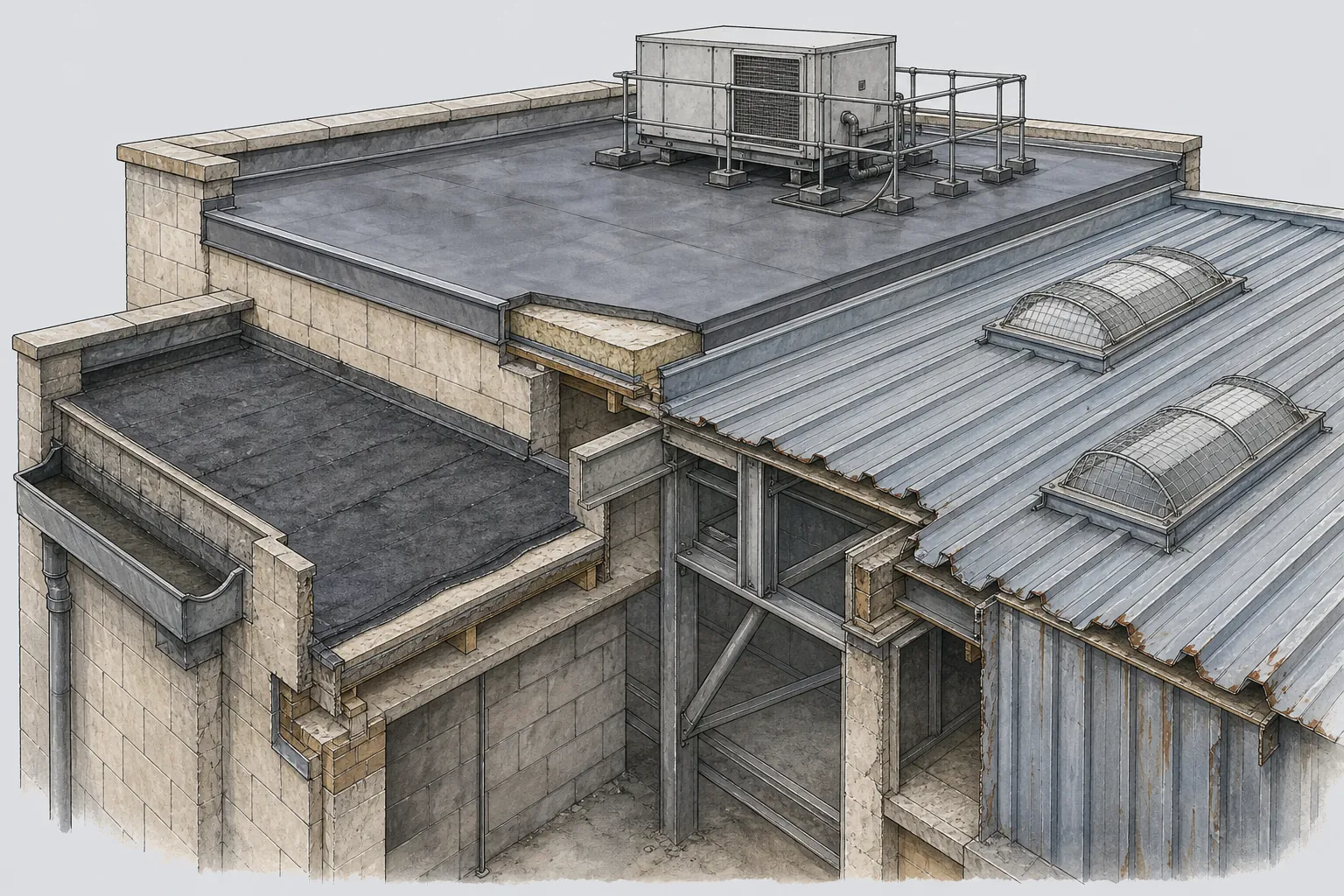
Shared and outbuilding roofsLarge 19th-century buildings and old railway sheds have long valleys, wide spans and few visits from anyone. We check drainage and the condition of the covering before pricing a repair.

A centre that decline preserved

When trade declines, buildings are patched instead of rebuilt, and the patches tell a story.

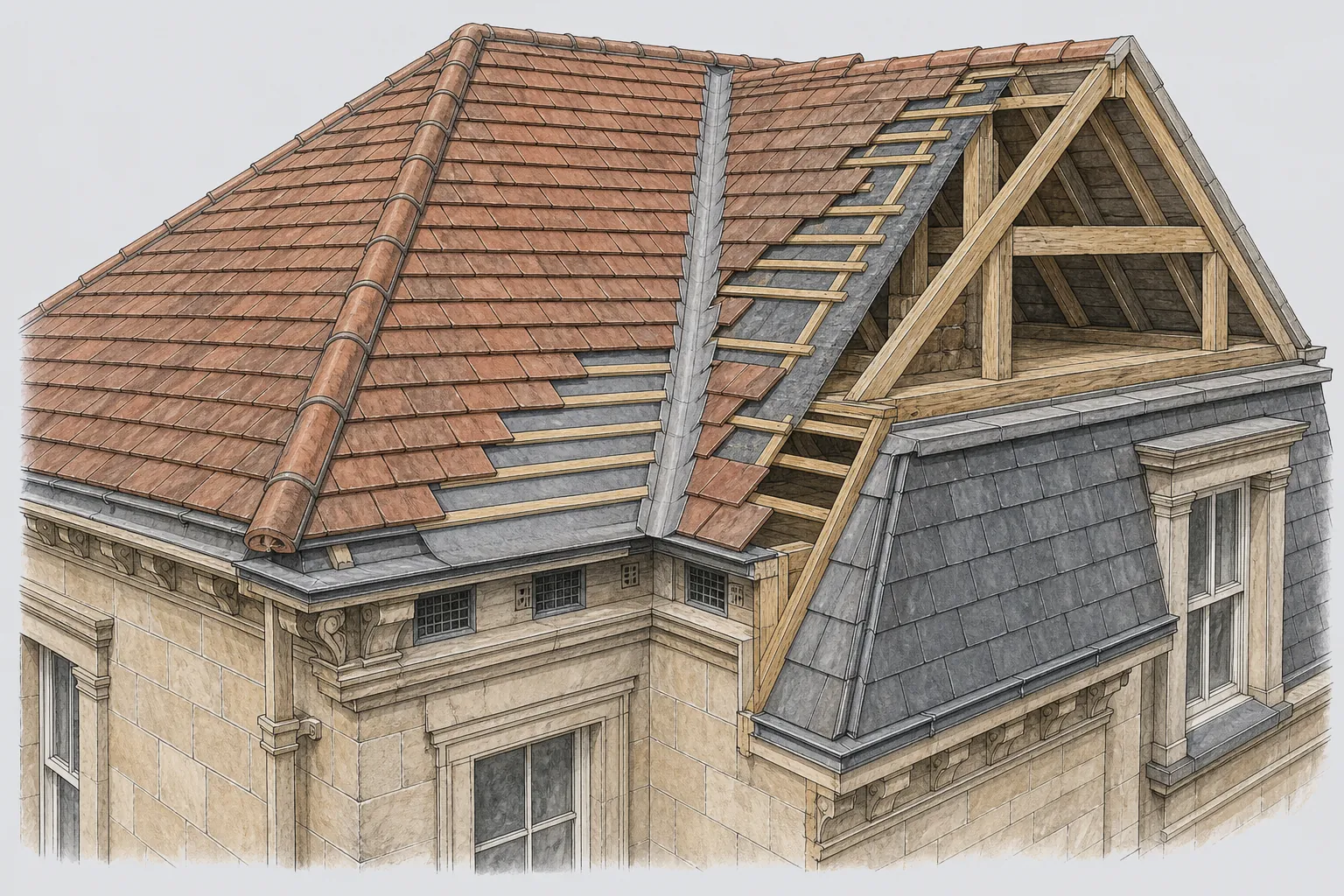
The effect of Axbridge's decline after its Tudor peak was to preserve many historic buildings in its centre. That does not mean every house looks Tudor, but it does mean that the bones of many buildings are old, and the roofs have been repaired in several different ways over several periods. A slope may carry stone slates at the bottom, clay tile in the middle and a sheet patch at the top.

Surveying a roof like that is detective work. We want to know what the original covering was, since the pitch of the roof usually follows from it. We want to know what has been added, because every layer is weight on a frame that may not have been designed for it. And we want to know what the loft shows, since wet timber, old fungal damage and past leaks will not be visible from the street.

Where a building is on the statutory list, any roof work that changes its character calls for consent granted by Somerset Council. Repair in kind, with the same material, size, pitch and details, raises fewer questions than a new covering, though the council makes that call. The list entry on the Historic England website is the first document to read, and we are happy to go through it with you.

For any older roof, the choice between repairing and re-covering is made by the evidence, not by habit. Many roofs here can be repaired successfully because their materials are sound and only the details have failed. When they cannot, our roof inspections report gives you a written record of what we found and why.

Limestone, Doulting stone and a Jacobean nave roof

The church shows the principle: soft stone needs a soft mortar, and a good roof needs sound timber beneath it.

St John's is built of limestone with Doulting stone dressings, and its nave roof, put up in 1636, is Jacobean. A roof that has stood for nearly four centuries has done so partly through the quality of its timber and partly through regular care. We cannot comment on the church's own condition, but it is a good reference for houses nearby: the principles are the same in stone and timber at any scale.

Stone chimney stacks and gable copings take the weather without a roof's shelter. Their weak point is the joint. Lime mortar is softer than the stone around it, and it is meant to wear before the stone does; the joint can be raked out and refilled when it has done its job. Cement mortar is harder than limestone, so it traps moisture behind its face and forces the damage into the stone instead. A Bath Preservation Trust comment on a listed stack in the city made the same point: it asked for lime in the pointing and the flaunching (the mortar bed round the pots), since cement may have made the stone damage worse.

On the roof itself, lead flashing seals the join between stack and covering. It should tuck into a slot sawn in the stone, be wedged tight and pointed, then fold down over the slope. Where earlier repairs relied on a smear of sealant, the seal fails within a few seasons and water runs behind. Our chimney repairs service covers pointing, flashings and rebuilds.

Matching stone is the last question. On a listed stack, a damaged block is replaced in the same stone where the council requires it, and the supplier and finish are agreed in advance.

Myth

A hard, grey cement repair is stronger and so lasts longer on a limestone stack.

Fact

Cement is harder than the stone, so moisture is driven into the limestone around it and the stone, not the joint, decays.

Big 19th-century buildings and their roofs

A workhouse for 250 people was a large roof, and large old roofs have long lives and long lists of faults.

The Axbridge Union workhouse, erected in 1837 on the south side of West Street, was designed to take 250 inmates. A building of that size has a large, complicated roof, and such buildings are often converted, divided and shared. We are not saying anything about the present state of that building. It is simply a useful example of the type: big 19th-century public or institutional buildings whose roofs have outlasted their original purpose.

The things that fail on roofs like that are consistent. Valleys between ranges carry water from several slopes and block easily. Gutters between two buildings, hidden behind parapet walls, are difficult to reach and easily forgotten. Rooflights, added in later conversions, are sealed with sealants that dry out. The long ridges have been repaired many times and may have no mechanical fixings. Chimney stacks are tall and often unused, which means no one checks the flashings.

When a roof is shared by several owners, the survey has to answer a question that does not arise on a single house: where does one party's responsibility end? We photograph every section and give a written scope that a managing agent or neighbours can read and agree on. The price is fixed after the survey, so that costs are divided on a clear basis.

Substantial roof replacement involves scaffolding, a good deal of waste and careful sequencing, and it is covered under roof replacement. We also take the old covering away and leave the site clear when we finish.

Faults on large old roofs

PartUsual faultFirst check
ValleyBlocked or split liningClear the channel and inspect the lead
Hidden gutterLeaks at joints or outletsRun water and watch the joints
RooflightDried-out sealInspect upstand and flashing
RidgeLoose beddingTest each unit by hand

Old railway buildings and outbuildings

Goods sheds, garages and lean-tos have plain roofs, and they are the ones we see ignored the longest.

The Cheddar Valley railway has gone, and the A371 bypass follows its route, but the station buildings and goods shed survive. Axbridge has its share of such utilitarian buildings: sheds, workshops, garages and lean-to stores whose roofs were put on cheaply and have been left alone since. They do not feature in guidebooks, but they keep stock, tools, vehicles and equipment dry, and a failed roof ruins the contents.

The coverings vary. Corrugated sheets may be metal, fibre-cement or plastic, and old corrugated fibre-cement can contain asbestos. We never assume. If the material is suspect, a test comes first. HSE guidance puts careful removal of asbestos cement sheet in the non-licensed category, provided it comes off whole. Heavy breakage moves the job into notifiable work, which has its own precautions.

Flat and low-pitched outbuilding roofs are commonly covered in bitumen felt, which cracks as it ages, or in EPDM or GRP. The seams, the edges and the point where the roof meets a wall are the likely leak points. For a garage or similar building, replacement may cost less than a series of repairs, and the decision depends on the condition of the deck beneath. Our garage roof replacement page explains the options.

For any of these buildings the price is set and written down after the survey, and the waste leaves with us.

Shed roofs

Test any old corrugated sheet for asbestos before it is touched, then decide between repair and replacement on the condition of the structure beneath.

Map showing the location of Axbridge.

Nearby

Roofers near Axbridge

Roofing services in Axbridge

Local questions

Axbridge asks, from the hunting lodge to West Street

My Axbridge house has a roof of mixed old materials. Can it be repaired without stripping it?

Often it can. The question is whether the frame and the lowest, most weathered section are sound. The rafters and wall plate are inspected from inside the loft, and that tells us which stretches of covering can stay. Where new material is needed, it is chosen to suit the existing roof, because the mix of materials is part of what the building looks like.

Does a limestone chimney stack need a different mortar from a brick one?

Yes, generally. Limestone is softer than brick, and lime mortar is meant to be softer than the stone, so the joint wears first and can be renewed. Cement is harder than limestone and drives moisture into the stone. The stack is examined, failed joints are raked out and refilled in lime, and any new lead flashings go into slots cut in the stone.

I own part of a large Victorian building in Axbridge. How do you deal with a shared roof?

We survey the whole roof, photograph each section and write a scope that names the parts. That lets the owners or their managing agent agree who is responsible for what before work starts. The fixed price follows the survey. If any part of the building is listed, we raise consent with Somerset Council early and describe the repair in detail.

Can you replace an old railway-style shed roof, and what if it is asbestos?

Yes. If there is doubt, the sheeting is tested first. HSE guidance treats careful, unbroken removal of asbestos cement as non-licensed, and substantial breakage as notifiable non-licensed work, which changes the method. You will be told which category your roof falls into, and the removal and new covering are priced together.

Get your free survey

Get your free roof survey

Tell us what's happening and we'll call you back to arrange a visit. Prefer to talk? Call 01225 285181.

  • Photos of your own roof
  • A fixed price in writing
  • 10-year workmanship guarantee
Call Free survey