



A roof on the edge of the Mendips
Exposure is the first fact of Blagdon roofing, and it decides what we check before we look at anything else.
A house on the Mendip edge does not get the shelter a town street offers. Wind comes over the hill, rain comes with it, and in winter the freeze and thaw loosen whatever the weather has already worked on. A roof in that position has a harder life than the same roof in a sheltered valley, and it tells you so in a predictable order.
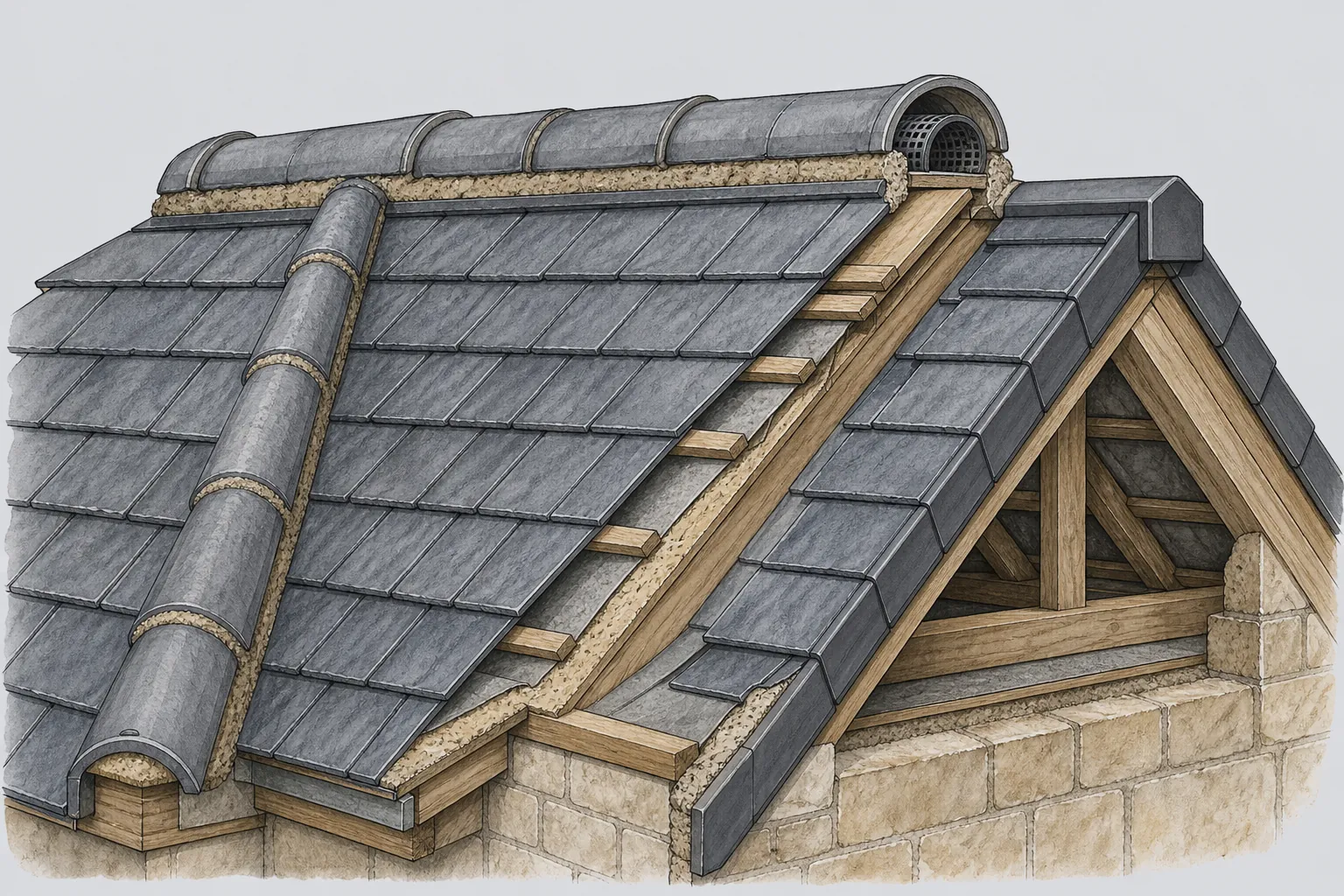
The edges go first. The ridge runs along the top and takes the wind from both sides. The verge is the sloping edge where the roof stops at a gable wall, its last tiles pointed in with a thin mortar bed. Hips are the sloping ridges on hipped roofs. All three are traditionally bedded in mortar, and mortar cracks when a roof flexes in the wind. A modern standard, BS 5534, expects a mechanical fixing on these tiles in addition to any bedding, which is why a repair now generally includes a clip, screw or dry-fix system. Dry-fix means the ridge or verge is held by manufactured fittings and not mortar, and BS 8612 is the test specification for such systems.
Next come the fixings in the field of the roof. Slates are nailed, and old nails rust. Tiles are held by their weight and by a nib on the batten, and in a strong gust they can chatter, lift and slip. Look from the road for a line of slightly crooked tiles, or for gaps in the courses at the top of a slope, and you are looking at fixings that are giving out.
The questions that matter are how widespread the movement is and what sits underneath. A local patch on a sound roof can be repaired with matching tiles and new fixings, and our roof repairs page covers that work. If the movement is across every slope, the case for a full re-cover builds quickly. We give you both options in writing, with photographs, and let you compare.
Patch or re-cover
Repair when loose tiles are confined to one edge or slope of an otherwise sound roof, and re-cover when the same failure shows on every slope.