
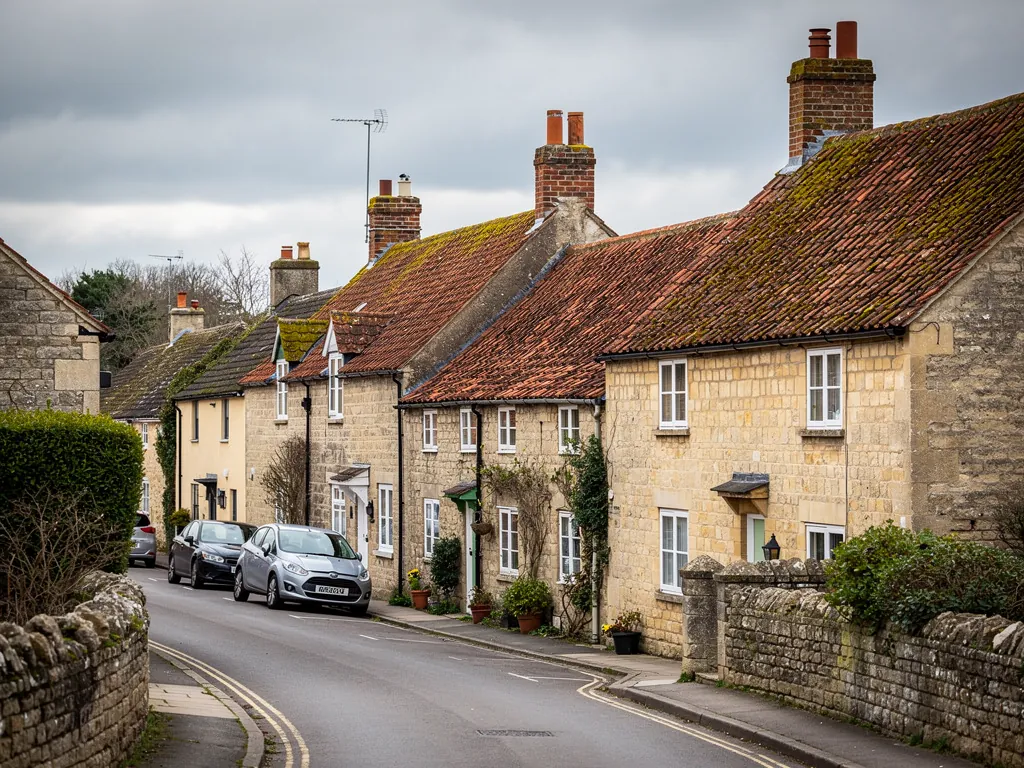



Gournay Court and roofs on a country-house scale
A Grade II* house of about 1600 shows what a large roof asks for, both in skill and in access.
Gournay Court is a Grade II* listed country house from about 1600, and houses of that rank tend to carry roofs more complex than anything on a village street. A typical example has several ridges, valleys where wings meet, stacks at intervals and a range of roof pitches added at different periods. Every junction between them is a place where water can enter.
The first challenge is simply seeing it all. A roof this size cannot be judged from a ladder, so we survey from a safe platform and use photography to record every slope. A drone is occasionally useful for the highest parts, but we prefer to touch the covering where we can, because a sound-looking slate can be loose beneath the surface.
The second is the valleys. A valley, the inward fold between two slopes, is lined with lead on an older house. Lead in a valley takes the full flow of two roofs and, over time, suffers from the weight of debris and moss as well as simple fatigue. We lift the covering on each side, check the lining for splits and replace it where the lead has reached the end of its life.
The third is the stacks. A tall stack on an old house is a long way above the roof it serves, and takes the wind on all sides. The pointing and flaunching need attention, and the lead flashing round its base needs to be sound.
None of this is exotic. It is the ordinary roofing trade applied at a larger scale, and the key is a survey that records every part. Where a roof of this type needs re-covering, our roof replacement page describes the planning, from scaffolding to final inspection.