
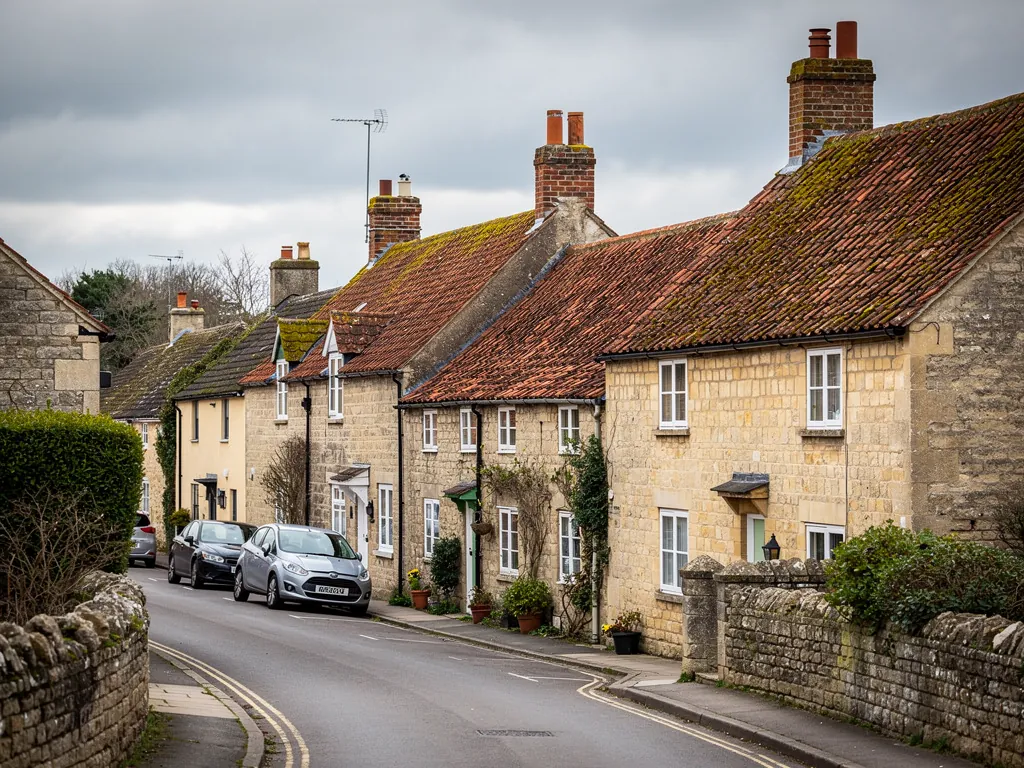
A Somerset village street of stone cottages with clay pantile roofs

Roofers in Chew Magna

Chew Magna is 13.9 road miles west of Bath, a Chew Valley village whose conservation area was designated in 1978. Its High Street houses, Harford Square and the listed buildings behind them call for roof repairs that match what was built, with the gutters and lead that carry the water away.

Local roofs

A conservation village with a long memory for water

Chew Magna was designated a conservation area in 1978 and has many listed buildings reflecting its history. The conservation area takes in the church, the High Street and Harford Square, each with buildings of real age. St Andrew's Church dates from the 12th century, is Grade I listed, and has a pinnacled sandstone tower about one hundred feet tall, probably built about 1440. Chew Court, originally a bishop's palace and largely rebuilt in 1656, is Grade II* listed, as is the neighbouring Church House.

The domestic buildings are later. The High Street holds many old buildings, including The Beeches, built in 1762, while Harford Square is dominated by Harford House, built in 1817. South of the village the medieval Tun Bridge, with its three pointed arches, is listed Grade II and also scheduled as an ancient monument. Taken together, that is a village where a change to a roof is seen by a lot of people and judged against a lot of surviving history.

Chew Magna also remembers a bad night. The storm of 10 to 11 July 1968 flooded 88 properties in the village, many with about two metres of water. That was a river flood, not a roof failure, but it is a reminder of how much rain this valley can receive in a short time, and why roof drainage here deserves attention.

We work on the roofs and the water-carrying parts of the buildings: slate, tile and stone coverings, lead flashings and valleys, parapet gutters, and the guttering and downpipes that take rain away. After a survey you receive a fixed written price.

Council
Bath and North East Somerset Council
From central Bath
13.9 road miles, west
Conservation area
Designated 1978
Grade I
St Andrew's Church, 12th century with a tower of about 1440
Grade II*
Chew Court, rebuilt 1656, and Church House

What we find

Downpours, split lead and conservation rules

Gutters that cannot cope with a downpourIn a valley that has flooded within living memory, we check that gutters are the right size, that joints are sealed and that downpipes reach a working drain. A gutter sagging on its brackets is often the first sign.
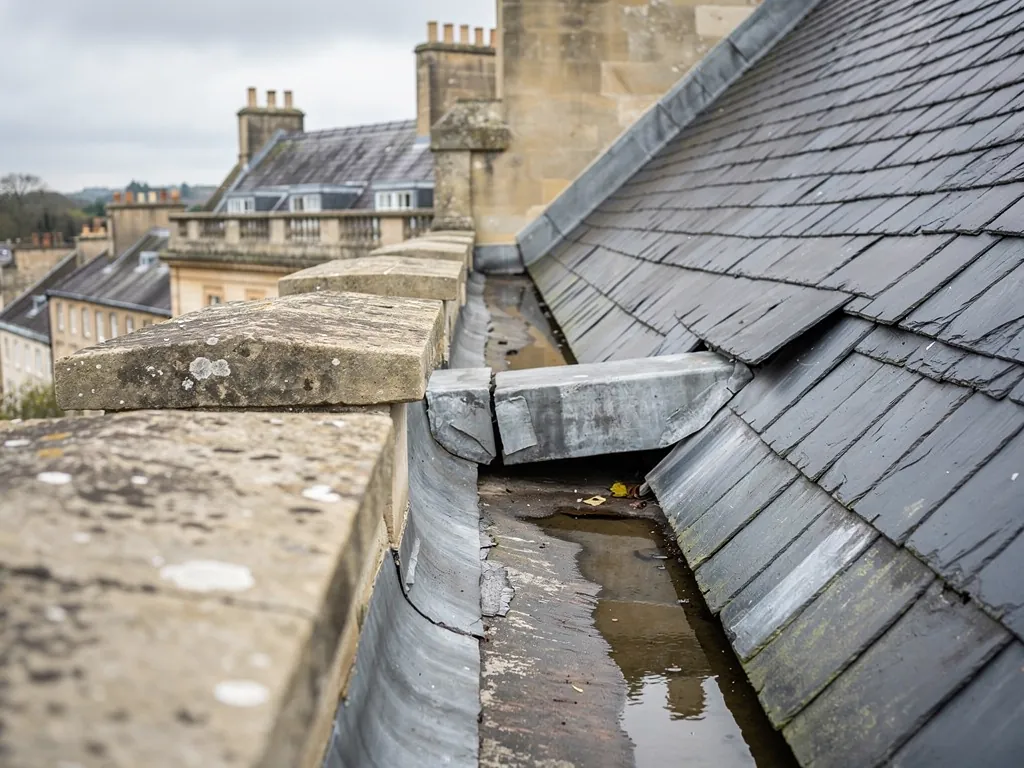
Lead that has split at the lapsOn the older houses, lead sits in the valleys, behind chimneys and along parapets. We look for cracking where sheets overlap, because lead expands and contracts with the weather and fatigues at those joints.
Visible changes in a conservation areaStreets here are read as a whole, so we pay attention to the colour, size and laying of any covering we touch. A repair that blends in is easier to agree with the council and easier to live with.

Living inside a conservation area

Designation in 1978 means roof choices in the village are judged as part of the street.

A conservation area exists to protect the character of a place, and in Chew Magna that character is built from roofs, walls and chimneys read together. Designation does not stop you maintaining a roof. It does mean some changes that would be routine elsewhere become questions for the council, and the roofs facing the road are the ones most likely to be scrutinised.

Two different permissions can be in play here. If your house is listed, B&NES must grant listed building consent for works that touch its character, and it asks owners to get in touch before any work begins. If your house is not listed but stands in the conservation area, some permitted development rights may be limited, and some streets carry Article 4 directions that withdraw more. The council keeps a policy map, and a few minutes with your address on it will answer the question.

None of this makes a repair complicated. The simplest repairs keep the same covering, the same lead and the same details, and they leave the roofline exactly as it was. A bay of slipped slates refixed in the same pattern, a rotten fascia replaced like for like, or a damaged ridge rebedded on the same line rarely raise a flag.

Where a change is wanted, such as a different covering or a new roof window, we describe what is proposed in terms the planning officer can use: the material, the dimensions, the position on the slope. For the rules on roof windows themselves we point you to our roof windows page rather than repeating them here. And when a roof has failed in more than one place, our roof repairs page explains how we separate what needs doing now from what can wait.

Before you book

Check your address against the B&NES policy map first, because it decides whether a plain repair or a formal application is the right route.

Georgian houses on the High Street and Harford Square

The Beeches of 1762 and Harford House of 1817 sit in a village that kept building well into the Georgian period.

Houses of the later 18th and early 19th centuries have a recognisable roof. The walls rise to an eaves or a parapet, the pitch is moderate, and the covering sits on a frame of sawn timber that is more regular than anything medieval. The Beeches, built in 1762, and Harford House, built in 1817, stand fifty-five years apart, but they share the same demands: gutters that drain cleanly, flashings that are tight, and chimneys whose masonry is sound.

The parts that fail first are rarely the broad slopes. Behind a parapet there is often a gutter lined with lead (a parapet gutter), and a blockage or a split in that lining lets water into the wall below. We lift the nearest courses, trace the fall of the lead towards its outlet and clear any silt. A valley, where two slopes meet at an internal angle, carries the water of both and needs the same attention.

The chimney is the other weak point, and it deserves a close look by going up into the loft and by looking at it from the roof, because the damp it lets in often shows first on a bedroom wall or a ceiling beside the breast. Flaunching, the cap of mortar at the stack head, cracks and lets water into the flue and the brickwork below. Soakers, the small lead tabs interleaved with the courses beside a stack, can corrode out of sight. Repointing in a soft lime mortar instead of cement keeps the masonry breathing, and we discuss those choices on our chimney repairs page.

The loft will tell you what the roof has been through. Look for daylight at the joints, for stained battens beneath the stack and for lead that has been patched with sealant. Where a house of this period needs the covering renewed, the replacement should match the original in material, texture and size. A like-for-like re-cover keeps the street consistent, and it makes the consent conversation, where one is needed, short.

Words you will hear

Parapet gutter
Lead-lined gutter that sits behind the wall at the roof edge.
Valley
The inward fold where two slopes join, lined so it can carry both slopes' rain.
Flaunching
The mortar cap sloped across a stack's top, bedding the pots in place.
Soaker
A lead tab slipped in between the courses at the side of a wall or stack.

Guttering, drainage and the memory of July 1968

The valley floods at the river. The roof's job is to make sure nothing worse arrives from above.

The 1968 storm that put 88 Chew Magna properties under water was a flood of the river, not of the roofs. The roofs still did a great deal of work that night, and they do it every time it rains. Every square metre of roof sends its water to a gutter, the gutter sends it to a downpipe, and the downpipe sends it to a drain or soakaway. If any link in that chain is slow, the water finds another way: over the back of the gutter, down the wall face, or into the roof space.

The signs are easy to read once you know them. Green staining down a wall below the eaves shows where a gutter has been overflowing. A damp patch high on a ceiling beside an external wall points to water tracking behind a defective gutter or flashing. A rotten fascia board is often the result, not the cause, of a long-running leak at a joint.

Gutters come in several materials: uPVC, aluminium and cast iron are the common choices, and the right one depends on the house. On an older listed building, cast iron or a close match to it is usually the sensible choice for the front. A modern rear extension can use uPVC without anyone noticing. Our gutters, soffits and fascias page lays out the choices of material and what moves the price.

Maintenance is dull but effective. Leaves from the village trees fill gutters every autumn, and a gutter that is clear in November takes a storm far better than one that has silted up. For a high roof, we clear from a safe working platform rather than a ladder, because an overloaded gutter bracket gives way without warning.

Myth

A gutter that is not dripping is a gutter that is working.

Fact

A blocked gutter can overflow behind the fascia or into the wall without a drop reaching the ground, so the staining and damp usually show before any visible drip.

St Andrew's, Chew Court and roofs of this rank

A Grade I tower and a Grade II* palace set the standard for the older buildings around them.

St Andrew's Church, with its Grade I listing, is the grandest roof in the village. Grade I buildings are the highest category of listing, and Chew Court and Church House, both Grade II*, sit one step below. You will not be asked to re-cover a Grade I church by a householder, but the principle behind their treatment spreads to the rest of the village: repair first, use the original material, and do as little as the fault demands.

The same principle governs the Grade II listed buildings and the unlisted houses that fall within the conservation area. Lead is the material that makes the work possible. It is used at the hidden junctions where slate or stone meets a wall, tower or chimney, and it can outlast several coverings if detailed correctly, with laps of the right depth and clips that allow for movement. Poorly fixed lead splits; well fixed lead keeps going.

Where a stone tower or parapet meets a roof, the junction has to cope with different rates of movement. Stone expands slightly in sun, lead more, and the covering beneath moves with the timbers. A flashing that is chased into the stone with a lime-based mortar and dressed over the covering accommodates it. A flashing sealed with a bead of mastic does not, and the mastic fails within a few seasons.

If the building you look after is a listed hall, school or house, ask for a written scope before any work starts. Our lead roofing page explains lead in more detail, from the way sheets are laid to the common causes of failure, and the survey we give you describes each junction we have inspected and what we propose to do about it.

Map showing the location of Chew Magna.

Nearby

Roofers near Chew Magna

Roofing services in Chew Magna

Local questions

Harford Square and High Street questions in Chew Magna

I live on the High Street in Chew Magna in an unlisted Georgian house. Can I replace slates without asking anyone?

Replacing like with like is generally straightforward, but the conservation area means you should check the policy map and speak to B&NES if you want to change the material or the appearance of the roof. Matching the existing slate in size, colour and laying pattern is the simplest route, and we can write the specification so you have it to show the council before you commit.

Harford Square has big rooflines. Is scaffold always needed for repairs there?

Not always. A few slipped slates on a low eaves can be reached from a ladder or a platform, but a high roof, a chimney or a parapet gutter normally needs a scaffold for safe working. We tell you at survey which case yours is, and the written price shows what is included, so there is no surprise when the access goes up.

After heavy rain I see damp on a wall under the gutter of my Chew Magna cottage. Is it the gutter or the roof?

Often it is the gutter, but not always. We look for a blocked outlet, a joint that has opened, brackets that have dropped and a fascia that is rotting behind. If the gutter is sound we check the roof edge, the flashing against any adjoining wall and the position of the downpipe. Fixing the wrong one wastes money, so we trace the water before we price.

Can you repair the lead on a Grade II* property like Church House?

We can carry out lead repair and replacement on older buildings, but a Grade II* listing means consent from B&NES comes first. We describe the extent of the failure, the sheet layout, the laps and the fixing method in writing so the council can assess it. A like-for-like repair done to a clear specification is the kind of work that is easiest to agree.

Get your free survey

Get your free roof survey

Tell us what's happening and we'll call you back to arrange a visit. Prefer to talk? Call 01225 285181.

  • Photos of your own roof
  • A fixed price in writing
  • 10-year workmanship guarantee
Call Free survey