
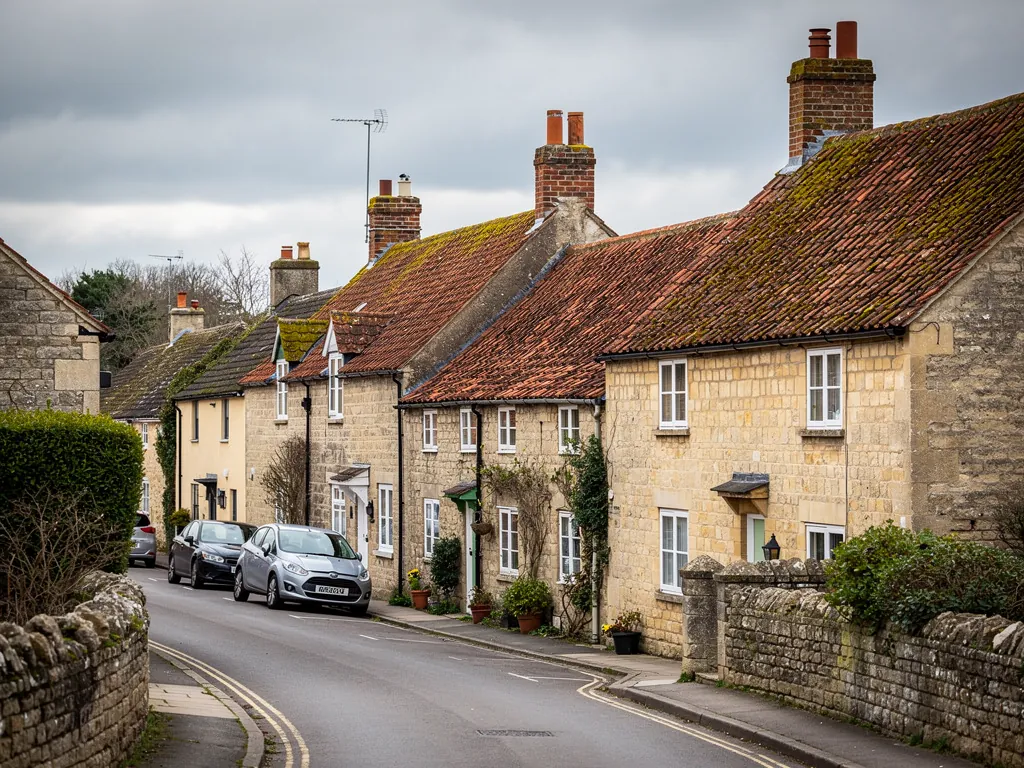

A Somerset village street of stone cottages with clay pantile roofs

Roofers in Stanton Drew

Stanton Drew is a Chew Valley village 12.5 road miles west of Bath, with listed farmhouses, a thatched toll house and one of the largest stone circles in Britain. We look after its roofs one building at a time, from barns and dovecotes to larger occupied properties.

Local roofs

Farmhouses, a toll house and a stone circle

Stanton Drew is best known for the Great Circle, which measures 113 metres across and is the second largest stone circle in Britain after Avebury. The village beside it has a long history of its own, much of it recorded in the list of protected buildings. The Round House, at the northern entrance, is a white, thatched, late 18th-century former toll house, and it is Grade II listed. Rectory Farmhouse, a 15th century building with a Grade II* listing, keeps a barn and dovecote of the same period. The Court, in Bromley Road, was built in 1753, is Grade II* listed and is now a nursing home.

The parish also contains a group of listed 17th-century buildings: Byemills Farmhouse, Codrington Cottage, Stanton Wick Farmhouse and Parson's Farmhouse. A narrow limestone bridge crosses the River Chew, possibly dating from the 13th or 14th century, and it was damaged in the 1968 Chew Stoke flood.

To a roofer this reads as a village of working buildings: farmhouses, barns, a dovecote, a toll house, a large house now used as a care home. Each has a different kind of roof and a different set of demands. A farmhouse roof wants careful like-for-like repair. A barn wants an eye for long runs and wide spans. A care home wants work arranged around the people who live in it.

Stanton Drew belongs to the Chew Valley ward, and Bath and North East Somerset is the council. Should your building be on the list, the council decides what consent is needed, and a precise written account of the work from us lets it reply without delay.

Council
Bath and North East Somerset Council
From central Bath
12.5 road miles, west
Great Circle
113 m across, second largest stone circle in Britain
Rectory Farmhouse
15th century, Grade II* listed, with barn and dovecote
The Court
Built 1753, Grade II* listed, now a nursing home

What we find

Old frames, long barns and riverside damp

Old structure under an old coveringA 15th or 17th century roof has been reworked many times. We go into the roof space, read the timbers and the repairs, and decide what is original, what is later and what is failing before proposing a plan.
Long spans and large outbuildingsBarns and outbuildings put big surfaces under a few gutters. We look at sag along the ridge, gaps at the eaves, the condition of the gutter runs and the junctions with the house, because water on a large roof collects fast.
Wet ground that mimics a roof faultBeside a river, damp in the walls can come from the ground, from a blocked drain or from a roof. We rule out the roof first and then say where the evidence points next.

Listed farmhouses from the 15th and 17th centuries

Rectory Farmhouse, Byemills, Parson's and Stanton Wick are reminders that a roof can outlast its first builders by many generations.

Rectory Farmhouse dates from the 15th century. Byemills Farmhouse, Codrington Cottage, Stanton Wick Farmhouse and Parson's Farmhouse are listed 17th-century buildings in the parish. A roof on a house of that age is not the roof it started with. It has been patched, retiled or reslated as fashions and budgets changed, and the frame beneath it has settled to suit. Our job is to mend the roof as it now exists without making it a new roof.

The listing matters. On a listed farmhouse, any change to the building's character requires B&NES consent, and the roof with its chimneys carries much of that character. Owners are told to approach the council before starting, and it warns that carrying out unauthorised work is an offence. We would add one piece of practical advice: ask early. A short written description of a repair, with photographs, often settles the question in days, whereas a job started on the wrong assumption can take months to put right.

Inside the roof we look for several things. Rafter feet and wall plates are the first, because they sit where water from above meets damp from the walls. Purlins come next, the long horizontal timbers that hold the rafters part-way up the slope, followed by any sign of old insect attack and any new timber that has been spliced in. Where timber needs a specialist joiner's repair, we pass on what we found and work alongside whoever you choose. For the roof covering and its details, the roof repairs service shows how that is done.

One caution applies near thatch. The Round House has a thatched roof, and thatch and hot work do not mix. On any roof close to thatch we avoid naked flames and plan lead work, flashing and chimney repairs so that nothing is lit near it. If a neighbour's roof is thatched, we ask about it at the survey and agree how we will work.

Barns, dovecotes and the long roofs of outbuildings

Rectory Farmhouse keeps its barn and dovecote from the 15th century, and outbuildings carry their own repair needs.

The barn and dovecote at Rectory Farmhouse date from the same period as the house. We know nothing of their roofs beyond that, and make no assumption. But barns and dovecotes in general share features worth understanding. A barn roof is long, with few interruptions: no chimneys, few valleys, and a ridge that may run for the full length of the building. A dovecote is small, tall and exposed, with a roof that is often steep or conical and open to the weather from every side.

Long roofs reveal their faults along the ridge. If a ridge sags, we check the purlins, the rafter feet and the wall tops, since a spreading wall or a failing joint can pull the frame down. If a gutter runs the full length of the barn, we check the fall and the number of outlets. One outlet serving a long run is a common weakness. On a roof that size, a small blockage backs up a lot of water.

Many barns and outbuildings are now put to new uses, from workshops to garages to storage to homes. The roof may need to do more than it did. Adding insulation changes how air moves through the roof space, and a covering that was happy when the building was open to the air can start to trap moisture once the building is closed up. Where a roof is renewed, the new build-up needs ventilation. Your building control body can confirm what applies, whether that is the council or a private approver.

Small buildings are a good place to see the principle of repairing before replacing. A garage or store with a few cracked sheets or a worn felt can often be put right without a full re-roof. Where a roof truly has reached the end, our garage and outbuilding roofing service describes the options, including what to do about coverings that may contain asbestos cement: they are checked before anything is moved, and handled with care.

Long roofs: faults along the line

WhereCommon faultOur check
RidgeSag between supportsPurlins, wall tops, rafter feet
Eaves gutterOne outlet serving a long runFall, joints, outlet capacity
CoveringSlipped or cracked units in rowsFixings across the whole slope
Junction with houseFlashing lifts or splitsLead, mortar, wall condition

The Court of 1753 and roofing an occupied building

A Grade II* house now used as a nursing home shows the difference between roofing a house and roofing a place where people live and work.

The Court, in Bromley Road, was put up in 1753. It is Grade II* listed and now serves as a nursing home. We have not worked on it and do not describe its roof. It stands here as an example of a type: a large, historic building in daily use by people who cannot easily move out.

Roofing an occupied building starts with a different set of questions. Who is on the floors below the work, and what do they need to be undisturbed? Which rooms are sleeping rooms, and when is quiet needed? Where do visitors and staff enter, and how do we keep them clear of the scaffold? What happens to the roof overnight, and will the roof be weathertight when the crew leaves? None of those are roofing questions. All of them decide whether the job goes well.

We plan around them in advance. The work is phased in sections, so that only one part of the roof is open at a time and the rest stays covered. Noisy tasks are scheduled for agreed hours. Scaffold is set up with clear protected routes for access. Materials are lifted in ways that keep deliveries away from entrances. Waste is bagged and removed, not left to build up. We discuss these arrangements with the person responsible for the building, and write them into the plan.

On a large historic building the covering and the lead need the same attention they would on a house, but at greater scale. Valleys, parapet gutters and stacks may all be involved, and each is checked and recorded. A parapet gutter runs behind a low wall at the edge of the roof, lined in lead, and it has to stay clear, sound and properly sloped. For larger or institutional properties, our commercial roofing service covers the approach in more detail.

Occupied buildings

Phase the work in sections, so the roof is never open over rooms in use and every working day ends watertight.

The River Chew, an ancient bridge and damp that is not the roof

A limestone bridge damaged in the 1968 Chew Stoke flood is a reminder that water in this valley arrives from many directions.

A narrow limestone bridge crosses the River Chew at Stanton Drew. It is possibly 13th or 14th century in origin, and it was damaged in the 1968 Chew Stoke flood. Villages beside a river like this one know what water can do, and they also know that not every wet wall means a bad roof.

When a customer in a valley village reports damp, we treat the roof as one suspect among several. Penetrating damp comes from outside through a wall or roof fault. Rising damp comes from the ground through a wall with a failed or missing barrier. Condensation comes from inside, when warm air meets a cold surface. Blocked drains and splashback from a hard surface beside the wall can all add to the picture. The signs overlap, and the repair follows from which of them you have.

For the roof side, we look at the places where water is likely to enter: the gutters and outlets, the flashings and the valleys, the chimney stack and the condition of the covering. Then we look at whether the pattern of damp fits. A stain high on a wall below an eaves gutter fits a roof or gutter fault. A tide mark low on a ground-floor wall does not. A musty bedroom ceiling with no stain on the outside points to condensation. We explain which we think it is and why, with photographs.

If the evidence says the roof is sound, we tell you, and we suggest who should look at the rest. It is better to spend nothing on the roof than to spend a lot and still have a damp wall. If it says the roof is the problem, we repair that and no more. After wet weather, a quick look at the gutters and downpipes is the cheapest step you can take. The route from first look to finished repair is described on the roof repairs service page.

Myth

Damp in an old stone house beside a river always means the roof is leaking.

Fact

Damp can rise from the ground, enter at a blocked drain or form as condensation, so the roof has to be ruled in or out before any repair is priced.

Map showing the location of Stanton Drew.

Nearby

Roofers near Stanton Drew

Roofing services in Stanton Drew

Local questions

Barn, farmhouse and Court queries at Stanton Drew

Our farmhouse near Stanton Drew is listed. Can the roof be repaired without consent?

A repair using matching material laid as before may need little more than a conversation, though B&NES has the final say. Anything that alters the look or structure of the roof, such as a new covering or a rebuilt chimney, is more likely to need consent. Ask the council first, and use our written description of the work to make the enquiry specific.

Can you repair the roof on a barn or dovecote that is no longer used?

Yes. An unused building still needs a sound roof, and a small repair now is cheaper than a rebuild later. We check the frame, the covering and the gutters, and we sort the work into what is urgent and what can be planned. If the building may be converted, we advise on ventilation and insulation as part of the roof plan.

How do you work on a roof close to thatch?

With care and with agreement. We find out about the neighbouring roof at the survey and plan the job so that no hot work, naked flame or sparking tool is used near it. Lead work and chimney repairs are scheduled and carried out with that in mind, and we keep any debris well clear of the thatch.

Is there a way to tell if damp in my wall comes from the roof or the ground?

There are clues. Damp high on a wall under the eaves, or stains on the ceiling beneath the roof, point to the roof or gutters. Damp low on a ground-floor wall, with a tide mark, points to the ground or drainage. Musty air and spotting without a stain point to condensation. We check the roof side and say what we find.

Get your free survey

Get your free roof survey

Tell us what's happening and we'll call you back to arrange a visit. Prefer to talk? Call 01225 285181.

  • Photos of your own roof
  • A fixed price in writing
  • 10-year workmanship guarantee
Call Free survey