
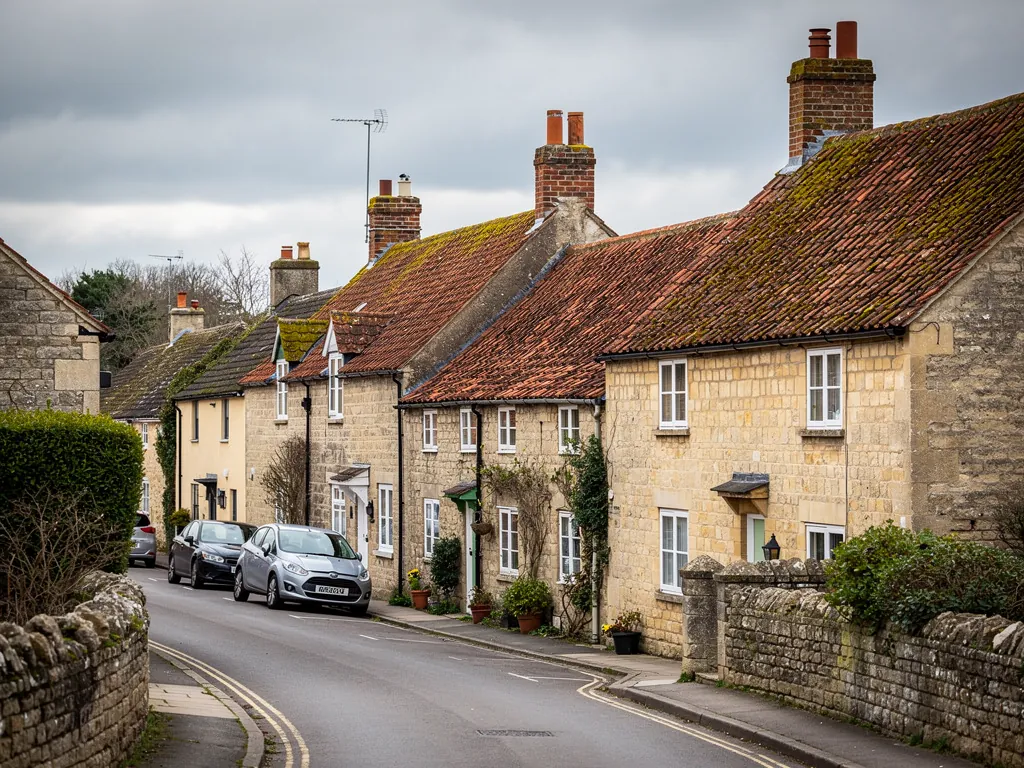
A Somerset village street of stone cottages with clay pantile roofs

Roofers in Temple Cloud

Temple Cloud, a former mining village with a listed Victorian court house, lies to the south-west, 12.4 road miles from central Bath. Lead on parapets, chimney stacks, a church dedicated in 1926 and the roofs of pubs that stay open are the details that matter here, and each is repaired or renewed with that in mind.

Local roofs

A court house, a Templar name and a coalfield past

Temple Cloud's name may come from an old holding. The Temple in the name possibly relates to the Knights Templar, who held the manors of Cameley and Cloud around 1200, though that link is not confirmed. Centuries later the village sat inside the Somerset coalfield, and several coal mines worked in and around it before they all closed.

The best-known building today is The Old Court, a Grade II listed former magistrates' court house with police cells, built in 1857 in baronial style. Baronial architecture borrows from castles, so a building in that manner tends to have stone parapets, projecting features and roofs that meet walls in awkward places. The village also has a number of other listed buildings, including the Temple Inn. The church in the centre of the village is much younger: it was built in the 1920s and dedicated to St Barnabas in 1926.

That is an unusual spread for one small village. A baronial public building of the 1850s, a listed inn and a church of the 1920s each ask for a different approach. A parapet and its lead gutter call for lead work. A working inn calls for a plan that keeps it trading. A church close to its hundredth year calls for a close look at the fixings and the timbers.

The village forms part of the civil parish of Temple Cloud with Cameley. We survey the roof you have, write up what we find with photographs, and quote the work it needs.

Council
Bath and North East Somerset Council
From central Bath
12.4 road miles, south-west
The Old Court
Grade II, built 1857 in baronial style
Village church
St Barnabas, built in the 1920s, dedicated 1926
Parish
Temple Cloud with Cameley

What we find

Parapet lead and working stacks in Temple Cloud

Splits in the lead behind parapetsBehind a parapet wall, rainwater collects in a lined trough and leaves by a single outlet. We look for splits at the laps, a loose or blocked outlet, and cracked coping stones above, since all three let water through to the room below.
Open chimney joints on stacks still in useA stack that serves a fire or a kitchen flue is heated and cooled again and again. We check the pointing, the cap and the flashings where it meets the slope, and we look inside the loft for staining on the brickwork.
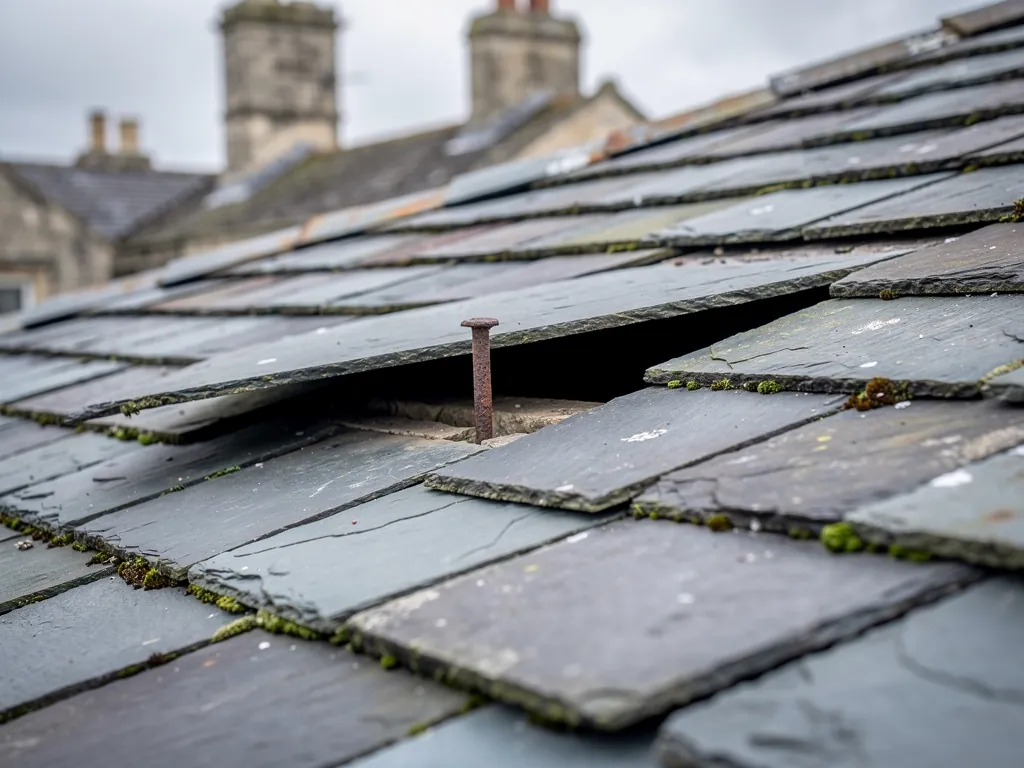
Fixings on roofs approaching a centuryA roof laid in the 1920s may still have its original battens and nails. We check for corroded fixings, softened timber and slipped courses, then tell you whether the covering can be saved or has reached the end of its working life.

The Old Court: baronial parapets and the lead behind them

A building designed to look like a small castle has the weather details of one.

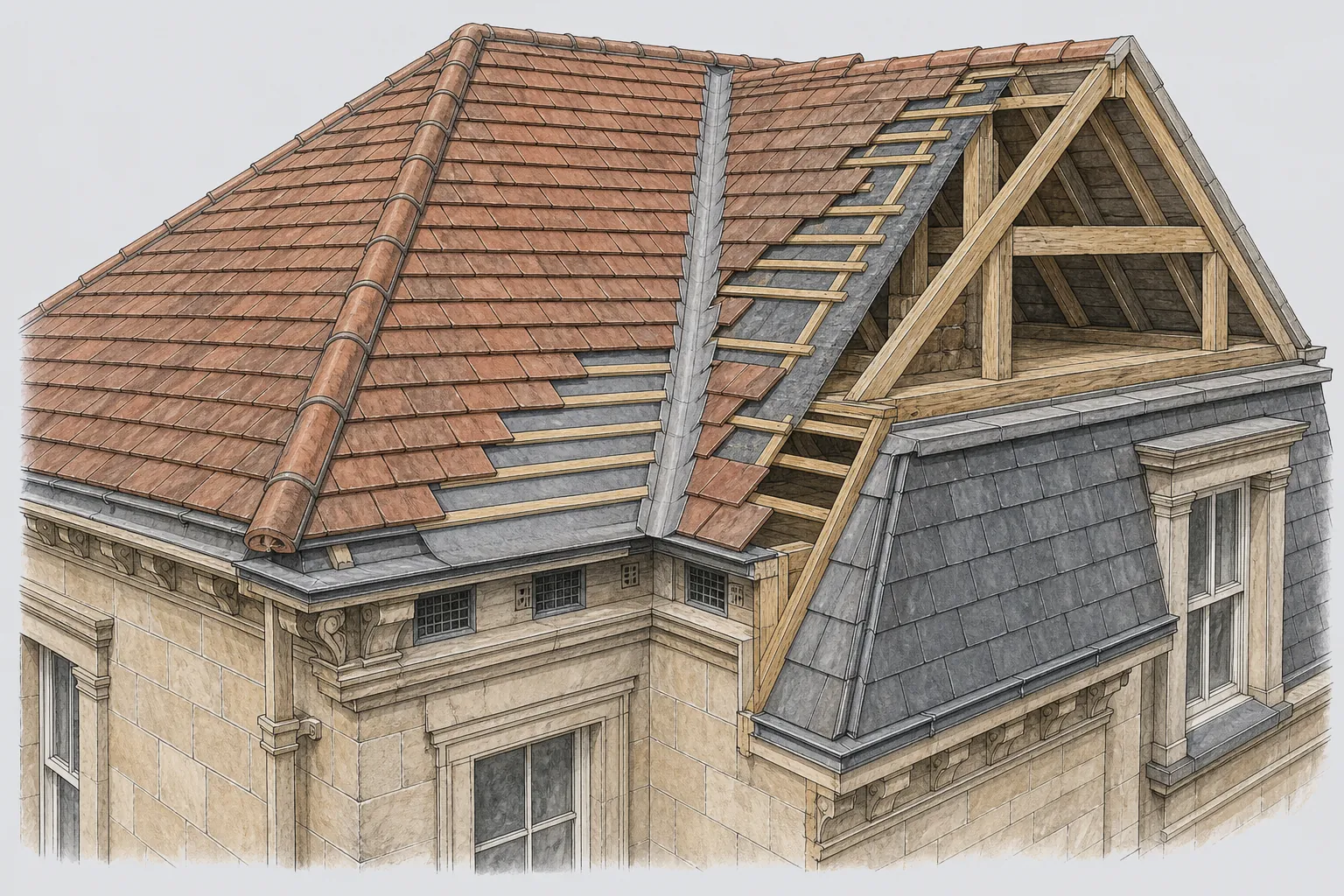
When the Old Court was built in 1857, baronial style gave public buildings a solid, stern appearance. For a roofer that style brings a recognisable set of details: stone parapets round the roof edge, projecting corners and slopes that stop short of the walls. Each of those details needs a waterproof junction.

The lead gutter behind a parapet is the clearest example. A parapet gutter is a lead-lined trough set behind the wall that rises above the eaves; it collects the run-off from the slope and passes it to an outlet. Lead is the traditional lining. It moves with temperature, expanding when warm and shrinking when cold, and a sheet fixed too tightly will crack along its folds over time. The cracks usually appear at the laps (where one sheet overlaps the next) and at the steps where the gutter changes level.

The coping, the stone cap on top of the parapet, matters as much as the lead. Joints between coping stones open as the mortar weathers, and water enters the wall below the lead, where it is hard to see. A stained wall inside the building is often the first sign. We check the coping joints, the pointing under them and the lead flashing that turns up the back of the parapet.

Repair depends on the extent of the damage. A single split can be cut out and welded or patched with a new section of lead, properly dressed. A gutter with many splits, or one that has lost its fall, is better re-laid, with new rolls and drips to carry the water cleanly. The lead roofing page describes the options in more detail.

The Old Court is listed, so any work to a roof of its kind begins with the council. We write the scope in specific terms for that conversation, naming the lead, the stone and the method, and we do not start until the consent position is clear.

Typical UK lead and chimney leadwork costs (MyJobQuote and MyBuilder, 2026)

WorkTypical range
Patching lead round a chimney£150 to £250
Renewing all the lead round a chimneyAbout £570 on average
Lead flat roof, price per m²£150 to £200 and above

Stacks that still work: chimneys on inns and older houses

A chimney in daily use ages differently from one that has been capped for years.

Temple Cloud has a number of listed buildings, including the Temple Inn, and the older ones have chimney stacks that often still carry flues. A stack in use is heated, cooled and wetted on a regular cycle. That cycle is hard on mortar and stone, and the joints at the top of the stack are the first to give way.

Start at the cap. The flaunching is the angled mortar fillet bedding the pots, which also sheds rain; when it cracks, water runs into the stack and down the flue lining. Below it, the pointing between the stones or bricks loses its face, and the open joints take in more water. The flue itself may be damp-stained inside, a sign that water is entering from above.

Next, the junction with the roof. Lead flashings dress up the sides of the stack and tuck into the joints, and soakers, small pieces of lead set between the slates or tiles along the side, carry water over the flashing onto the roof. If either has lifted, the water reaches the timbers around the stack. A damp brown patch on a loft or bedroom ceiling next to a chimney breast often starts here.

On a stack that is in use, we also look at the pots and the cowls. A cracked pot may drop pieces down the flue, and a blocked flue is dangerous. If a stack holds an active bird's nest, we hold off until the young have flown, since nests in use are protected.

The repair we propose depends on how far the damage has gone. Repointing and a new flaunching can restore a sound stack. A stack that leans or has loose courses may need partial or full rebuilding. For a listed building, talk to B&NES before the stack is rebuilt or altered. The chimney repairs page shows how each of these jobs is done.

Myth

If the chimney is not leaking into the room, the stack must be fine.

Fact

Water can sit in a stack for years, softening the mortar and staining the flue before any mark appears on a ceiling, so the cap and joints are worth checking on a schedule.

A church close to its hundredth year

St Barnabas was dedicated in 1926, and a roof of that age tells you about its fixings before it tells you about its covering.

The village church in the centre of Temple Cloud was built in the 1920s and dedicated to St Barnabas in 1926. That makes it a much younger building than the Old Court, but a roof of nearly a century has its own concerns. Whatever the covering, the things that hold it on were fitted when the building was new.

Nails corrode, battens soften and mortar fillets crack. We check these first because they decide whether the covering can stay. A tile or slate that is sound on its face but held by a rusting nail can be reused on a new set of battens; a covering that has itself decayed cannot. The two outcomes cost differently, and a survey that tells them apart saves money.

Underneath, the question is the lining. Older roofs may have no underlay, or an early bitumen felt that has hardened and cracked, especially along the eaves. Where the lining has failed, the roof can look fine from the ground and still admit damp air and wind-blown rain. We look for light and stains from inside the roof space, and we note where the felt has failed.

The gutters of an older church carry a lot of water and are often hard to reach. A box gutter, a lined channel set into the roof between slopes or behind a wall, is difficult to inspect from below, so we survey it from a safe working platform. If a church committee needs to decide whether to repair or renew, the written report sets the two out side by side.

That choice is rarely about age alone. A well-built roof of a century can have many more years of service in it if the fixings and timbers are sound, while a poorly fixed one needs attention early. Our commercial roofing work covers surveys and repairs on community buildings of this kind.

Repair or re-cover

Repair a roof of this age when the covering and timbers are sound and only the fixings or lining have failed, and re-cover it when the failure runs through every slope.

Keeping a pub or village hall open while the roof is worked on

A roof over a trading building has to be repaired around the people using it.

Not every roof job is on a house. A pub, a hall or a shop has customers, staff and a calendar, and the roofer has to work around them. Temple Cloud has the Temple Inn among its listed buildings, and a trading building of that kind raises questions a house does not.

The first is timing. Some work is noisy, some is dusty and some needs part of the building closed off. Before we price a job we ask when the building is busy and when it is quiet, and we plan the work to suit. Where a delivery bay or an entrance is below the roof, we agree how it will be kept clear and protected.

The second is safety below. Scaffolding goes up beside doors and over footpaths, and anything falling from a roof could land on a customer. We plan the protection with you in advance and keep the site tidy as we work, clearing waste each evening.

The third is what is on the roof. A kitchen extract, a flue terminal or a plant unit passes through the covering, and each opening in the covering is a way in for water. We check the flashing round each one and note where the sealant has done the job that metal should have done. A flat section over a kitchen or store may be a different covering from the main pitched roof, and it needs its own inspection.

Finally, the report. A landlord, a tenant and a brewery or committee may all need to see it, so we describe each finding clearly, mark it with a photograph, and say what each repair involves and how urgent it is. Where a quote is needed for approval, the written price follows the survey and does not change without a conversation.

Work like this falls under commercial roofing, which also covers larger flat roofs and the access they need.

Map showing the location of Temple Cloud.

Nearby

Roofers near Temple Cloud

Roofing services in Temple Cloud

Local questions

Questions about the Old Court and village roofs

Why would a parapet gutter on a Victorian building like the Old Court leak when the roof above looks sound?

Because the leak is usually in the lining, not the covering. Lead splits at laps and steps as it moves with the temperature, the outlet can silt up, and coping joints can open above. The water then enters the wall behind the gutter and shows inside as a stain. We open the gutter, trace the path of the water and describe the repair.

We run a pub in Temple Cloud and need a chimney stack repaired. How can that be arranged while we keep trading?

We agree the timetable first, working around your busy periods, and we plan scaffold and protection so entrances stay safe. The survey covers the stack, the flashings and the pots, and the written price follows it. If the building is listed, B&NES should hear about a rebuild or alteration before you book the work.

St Barnabas church was dedicated in 1926. At what point does a roof of that age need re-covering?

Age alone does not decide it. What counts is the condition of the fixings, the battens, the lining and the timbers. A covering that is sound but held by rusting nails can be lifted and relaid, while one that has itself decayed cannot. The survey separates the two, and the written report lets a committee compare repair with renewal.

My Temple Cloud house is listed. Who decides whether a chimney rebuild needs consent?

B&NES decides, and its conservation team is the place to ask. Listed building consent is a process of its own, apart from planning permission, and it is a criminal offence to alter a listed building without it. For a ruling on your own house, ask the council; what we supply is a precise description of the stack and the repair, with photographs.

Get your free survey

Get your free roof survey

Tell us what's happening and we'll call you back to arrange a visit. Prefer to talk? Call 01225 285181.

  • Photos of your own roof
  • A fixed price in writing
  • 10-year workmanship guarantee
Call Free survey