
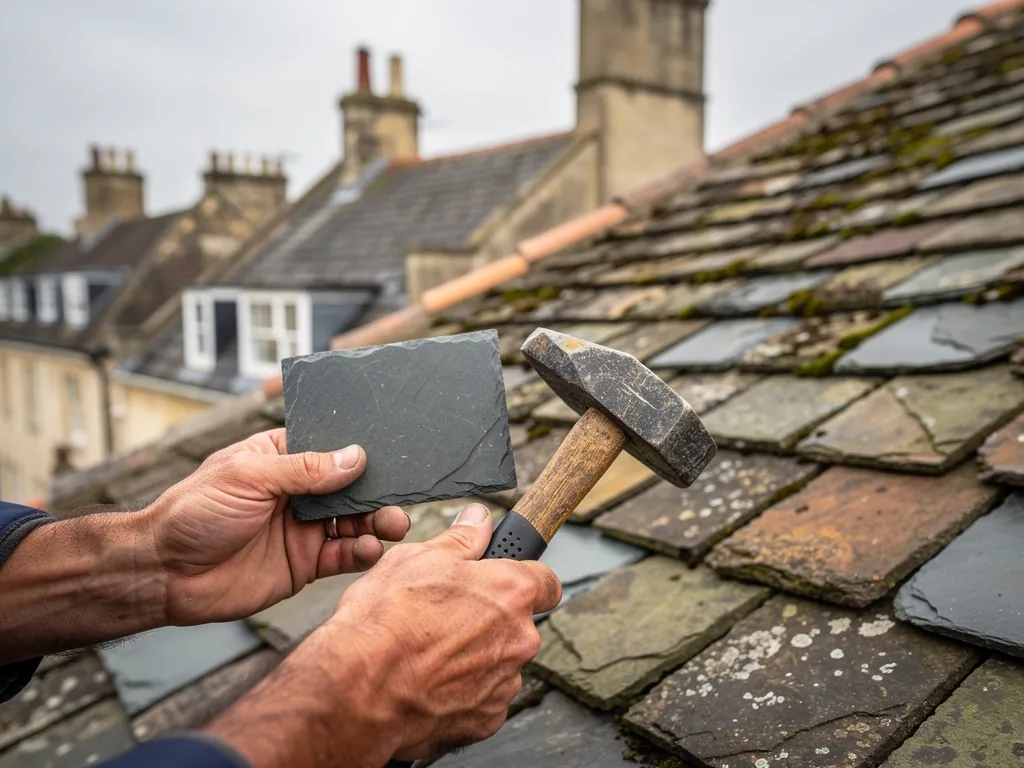
Georgian terrace of honey Bath stone with natural slate roofs and chimney stacks

Roofers in Bathwick

Bathwick is 1.1 road miles north-east of Bath, across the river from the centre, and its roofs are the Georgian ones people picture: Bath stone terraces under natural slate on the Pulteney estate, with tiled streets beyond. On those Pulteney estate terraces the slate is relaid like for like, and the lead that carries water off each roof is kept in good order.

Local roofs

The Pulteney estate and the streets it left behind

Bathwick became part of the Bath urban area with the 18th century development of the Pulteney estate and the building of Pulteney Bridge. Georgian streets followed, among them Great Pulteney Street, Laura Place and Sydney Place. Bathwick is bounded by the River Avon on its western edge and the Kennet and Avon Canal on its eastern edge, on ground that is flat for the most part.

Bath's city-wide character appraisal records most of Bathwick's buildings as natural Bath stone ashlar under natural slate roofs. The exceptions are Powlett Road and Rockliffe Avenue, where the roofs are clay or concrete tile and some houses are red brick. The terraces range from late 18th century two-storey rows to early and mid 19th century three-storey terraces, with an enclave of early 20th century two-storey terraces around those same two roads. St Mary the Virgin was built in the early 19th century by John Pinch the Elder, and Henrietta Park was given to the city in 1897 on land first intended for more Pulteney development.

Bathwick lies inside the Bath World Heritage Site, as the whole city does, and listed buildings are many. That makes consent the first question on many jobs here, along with the matching of slate and the care of the lead. The conservation area reaches only about half of that site, so ask B&NES which side of the line your street sits.

We survey with photographs of your own roof, then write a fixed price for what it needs.

Council
Bath and North East Somerset Council
From central Bath
1.1 road miles, north-east
Planned estate
Pulteney, 18th century, with Great Pulteney Street
Boundaries
River Avon to the west, Kennet and Avon Canal to the east
Tiled streets
Powlett Road and Rockliffe Avenue

What we find

Hidden gutters and mismatched slate across Bathwick

Parapet gutters behind the stoneOn a Georgian terrace the roof edge is often hidden behind a parapet, with a lead-lined gutter behind it. We trace the fall of the lead, check the outlets and look for splits where sheets overlap, since a blocked outlet here puts water straight into the wall.
Slates that no longer matchYears of mixed repairs leave a roof patched in three or four slates of different colour and thickness. We look for the original slate, count what is sound and plan the match before anything is ordered.
Ridge and verge on tiled roofsIn the tiled streets the ridge, hip and verge are the first parts to loosen, as old mortar cracks. We check each for movement and for a fixing that holds without relying on the mortar.

Georgian terraces: slate, stone and the hidden gutter

On the Pulteney terraces the roof you see from the street is only half of it.

A Georgian terrace in Bathwick is a stone front with a roof set back behind it. Many Georgian terraces have a parapet, a low wall of stone that rises above the roof line and hides the slope from the street. Behind the parapet runs a gutter, usually lined with lead and sloping gently towards an outlet at one end. That gutter does the work of the eaves, collecting all the water that falls on the roof behind, and it is the part of the roof most likely to fail without anyone noticing.

The causes are familiar. Leaves and debris collect in the lining and block the outlet. Standing water finds a split in the lead, most often at a drip or an overlap, and tracks into the wall. A stone coping on the parapet cracks and lets water into the joints below. The first sign is often a damp patch high on an upper-floor wall, which is easily mistaken for a condensation problem.

The slope behind the gutter is typically natural slate laid on battens, with lead at the valleys and chimneys. The City-wide Character Appraisal describes most of Bathwick's buildings as having natural slate roofs, and the roofs behind the parapets follow suit. When we repair or renew, slate is replaced with slate, in matching size and colour, and we reuse sound originals where we can.

For an owner, the practical advice is to have the parapet gutter inspected on a regular cycle, because the cost of a clear outlet is small beside the cost of a rotted wall plate. Our lead roofing page explains lead details and failures in depth, and our slate roofing page covers the covering itself.

Words you will hear

Parapet
A stone wall that stands above the line of the roof, screening the slope from the street.
Parapet gutter
The lead-lined channel hidden behind that wall, draining the roof towards an outlet.
Coping
The stone capping laid along the top of a parapet to shed water.
Lap
The overlap where one sheet of lead is laid over the next.

Great Pulteney Street and working at three storeys

Late 18th century two-storey rows and 19th century three-storey terraces ask different things of access.

Great Pulteney Street, Laura Place and Sydney Place belong to the estate laid out after Pulteney Bridge. The terraces in Bathwick range from two-storey rows of the late 18th century to three-storey terraces of the early and mid 19th century. That difference matters to a roofer before anything else, because it decides how the roof is reached.

Two storeys may be reached from a tower scaffold or a ladder platform. Three storeys call for a full scaffold standing from pavement to eaves. That scaffold must leave room for people to pass, be tied back to the building without damaging the stone and sit safely at the corners. On a street with a continuous frontage there is nowhere else for the scaffold to go but the front, so the work has to be planned with neighbours and, where needed, with the council. We discuss this at survey and include the scaffold in the written price.

Height also changes how a repair is made. A single slipped slate on a high roof is not a quick fix if the scaffold has to be erected for it, so we usually recommend gathering several small repairs into one visit: slates, the ridge, a lifted flashing and a cleared gutter together. Whether the work is on a listed house is checked at the start; a like-for-like repair is easier to agree than a change, and the council's conservation officers are who to ask.

Where a full re-cover is needed, the scale of the terrace becomes clear. The best result comes from planning the stripping in sections so the house is never left open overnight, and from having the lead dressed before the slate is laid back. The planning of that sequence is described under roof replacement.

Combine the repairs

Where a scaffold has to go up for one fault, repair everything else on that elevation while it stands.

Powlett Road, Rockliffe Avenue and the tiled roofs

Early 20th century terraces use clay or concrete tile, and they fail in quite different places from the slate ones.

Around Powlett Road and Rockliffe Avenue the roofs change. The Character Appraisal records clay or concrete tile roofs here, with some red brick houses, in an enclave of two-storey terraces from the early 20th century. These roofs have no parapet gutters and no stone coping. Instead they have eaves gutters, ridge and hip tiles, and verges at the gable ends.

The ridge is the most common point of trouble. Ridges of this date were bedded in mortar, and the bedding cracks and drops out as the tiles heat, cool and shift beneath it. A cracked ridge lets rain into the loft along its length. The right repair puts a clip or screw into every ridge tile, since BS 5534:2014 treats mortar on its own as an unreliable fixing. Dry-fix to BS 8612:2018 is the other route and dispenses with the bedding.

Underlay is the second concern. Houses of this age were built with a bitumen felt, if any, and it has typically sagged, torn at the battens or perished at the eaves. When the felt has gone only along the lowest courses, a repair there may be all the roof needs. When it has gone right up the slope, we lift the tiles, renew battens and underlay and relay the good tiles, adding matching ones as needed.

Valleys and chimneys complete the list. A valley gutter, the angle where two slopes meet, can be lined in lead or in a modern material, and the tiles along it should be cut cleanly and bedded firmly. The details are in our ridge and verge repairs service pages, and in pitched roofing for the covering as a whole.

Tiled terrace roofs: what to inspect

PartSign of troubleUsual repair
RidgeCracked or missing beddingRebed and fix mechanically, or dry-fix
VergeLoose end tiles, pointing lostRebed with mechanical fixing
EavesPerished felt, damp fasciaNew underlay to the bottom courses
ValleyStaining, moss, split liningReline and recut the tiles

Between the river and the canal

Flat ground bounded by water and old trees puts leaves and damp onto the roofs.

Bathwick is bounded by the River Avon on one side and the Kennet and Avon Canal on the other, on ground that is flat for the most part. A district between two waterways collects the things that grow near them: mature trees in gardens and along the water, ivy on walls, and damp air that suits moss. For roofs, those translate into practical maintenance rather than mystery.

Leaves are the first. Gutters in tree-lined streets fill every autumn, and a gutter that sits full of wet leaves holds water against the fascia and brackets for weeks. In a parapet gutter the problem is worse, because the outlet is small and blocks easily. A clear-out in late autumn, and again after the leaves finish falling, costs very little set against what a wet wall costs to dry out.

Moss and lichen are the second. They gather on the shadier slopes of slate and tile, and a thin layer does little harm. A deep carpet of it keeps the slate or tile damp and can push up edges, which is a reason to take it off. The method matters: pressure washing can damage delicate coverings, and on old slate it can strip the surface or force water under the laps. A soft wash, using low pressure and a biocide, is gentler, and our roof cleaning page explains the options.

Henrietta Park, given to the city in 1897, is one of the green spaces that keep trees close to the housing. Branches that overhang a roof drop leaves and twigs, and in wind they can scrape the covering. Where overhang is heavy we advise pruning the tree, since the cost of taking back a branch is small compared with the cost of repairing a damaged slope.

Map showing the location of Bathwick.

Nearby

Roofers near Bathwick

Roofing services in Bathwick

Local questions

What Bathwick owners ask about Pulteney slate

Our Great Pulteney Street flat has damp high on an upper wall. Could it be the parapet gutter?

It is one of the first things we check. A parapet gutter that is blocked or split lets water into the wall below, and the stain shows up on an upper wall or ceiling rather than near the gutter itself. We trace the lead from end to end, clear the outlet and look at the coping. If the lead has failed we replace the affected bay, so the repair is local rather than the whole roof.

Can slates on a Sydney Place terrace be replaced with a cheaper manufactured slate?

We would not recommend it. Natural slate stays natural slate on older buildings, and a manufactured substitute is visibly different in colour, edge and weathering. On a listed house it may also need consent from B&NES. Where a roof has lost slates, we reclaim what is sound, source a matching natural slate for the rest, and keep the appearance of the terrace consistent.

My Powlett Road house has a tiled roof and the ridge is cracking. Do I need a full re-roof?

Not on that evidence alone. A cracked ridge is usually a local fault in the bedding, and the cure is to remove the failed mortar, put clips or screws in the tiles and bed them again, or fit dry-fix. We look at the tiles and the underlay beneath to see whether anything else is wrong. If they are sound, you pay for the ridge only.

Scaffold on a three-storey Bathwick terrace seems a large part of the cost. How can it be reduced?

Plan the work so that one scaffold serves every job on that elevation. Gutters, slates, chimney flashings, fascias and the ridge can all be done while it stands. We include scaffold in the written price and suggest which repairs can wait, so you can choose what to do in a single visit and avoid paying for access twice.

Get your free survey

Get your free roof survey

Tell us what's happening and we'll call you back to arrange a visit. Prefer to talk? Call 01225 285181.

  • Photos of your own roof
  • A fixed price in writing
  • 10-year workmanship guarantee
Call Free survey