
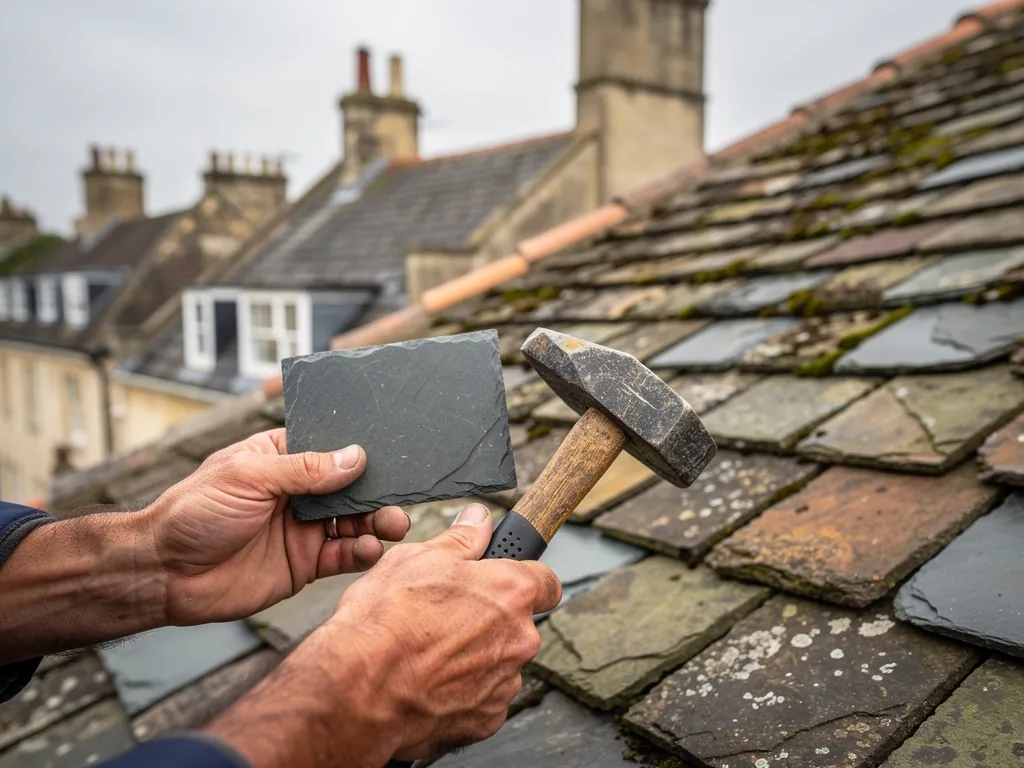
Georgian terrace of honey Bath stone with natural slate roofs and chimney stacks

Roofers in Walcot

Walcot runs north from the middle of Bath, 1.3 road miles by road, along a line believed to follow a Roman road, long before the Georgians built beside it. Its terraces on London Road and The Paragon have parapets, stacks and gutters that need care from the right side, and some of them stand above a raised pavement.

Local roofs

A Roman road, a Georgian parish church and the terraces between

Walcot is old. Walcot Street and London Road are believed to follow a Roman road leading north from Aquae Sulis to join the Fosse Way, and the area first grew as a residential settlement, a vicus, in the 1st to 3rd centuries. What most people see now is later: the parish church of St Swithin on The Paragon, built between 1779 and 1790 by John Palmer, and the terraces that grew up beside the road after it.

In the council's character appraisal for the Grosvenor and Lambridge area, the main terraces along London Road are late 18th century, and Bath stone is the dominant building material. Walcot Parade is three storeys high and is emphasised by the highest raised pavement in Bath. Cleveland Place, built in 1830 in the Greek Revival style, gave access to Cleveland Bridge over the Avon to Bathwick.

Those details matter to a roofer. A three-storey stone terrace is a tall building, and a roof at that height takes the wind and has to be reached with care. The stone gives the street its colour and also its maintenance: parapets, copings and stacks are all cut stone that shed water onto the lead and slate below. The roof is the part that keeps the weather out of the whole building, and in a street of terraces, it is shared by a long run of owners.

We survey a Walcot roof from the pavement, the loft and the roof itself, and report the faults with photographs and a fixed price in writing. Most repairs on these buildings are small, specific and done in matching materials.

Council
Bath and North East Somerset Council
From central Bath
1.3 road miles, north
St Swithin's church
On The Paragon, built 1779 to 1790 by John Palmer
Walcot Parade
Three storeys, with the highest raised pavement in Bath
Cleveland Place
Greek Revival, built 1830 for access to Cleveland Bridge

What we find

Parapet lead and cemented stacks in Walcot

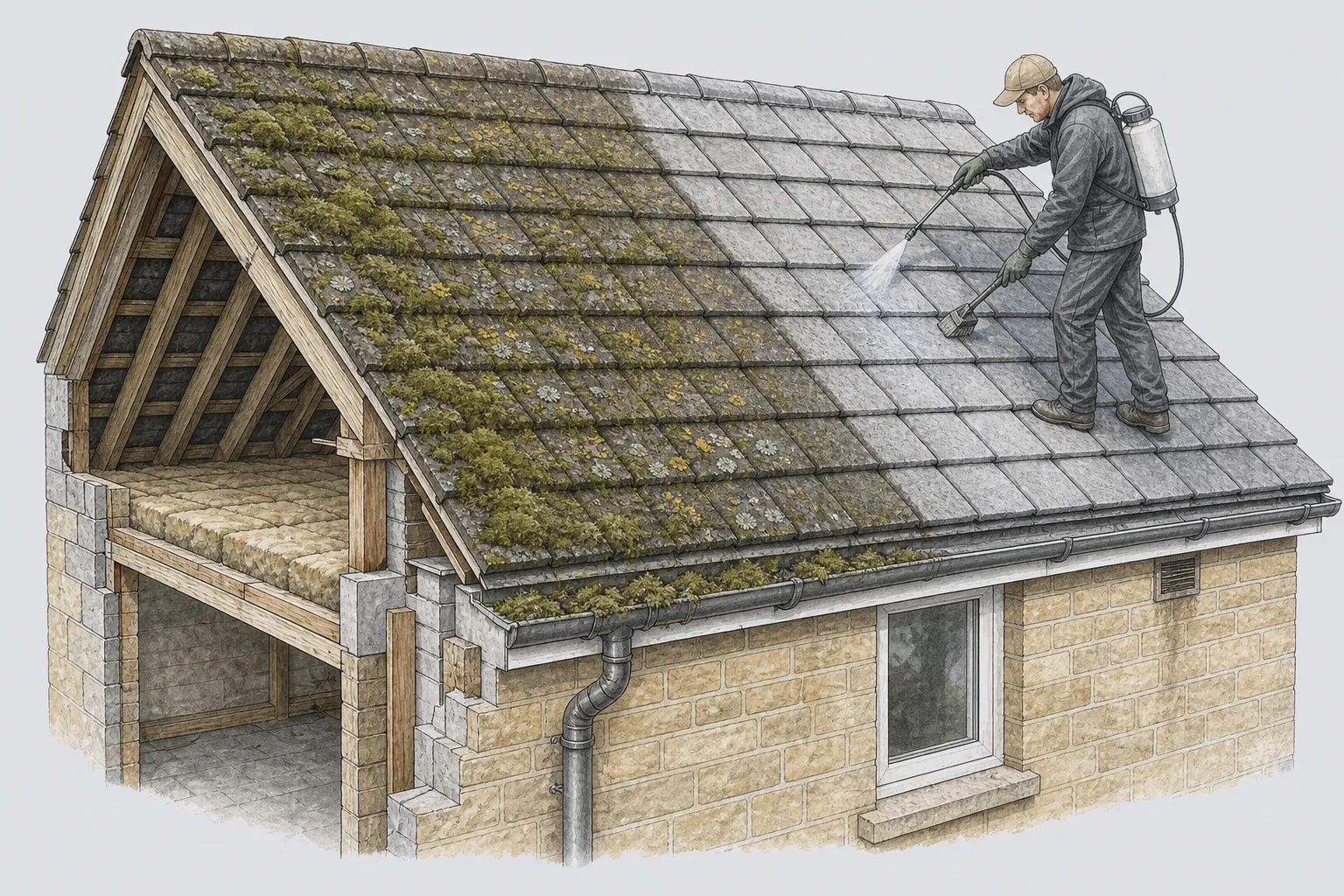
Failed lead behind the parapetA parapet is the wall that stands above the eaves, and the gutter behind it is lined in lead. We look for cracks along the folds, open joints at the outlets and slates that have slid into the channel from the slope above.
Cement on old stone stacksChimneys on Walcot terraces are stone, and many have been repointed in a hard grey mortar at some point. We check the joints, the cap and the pots, and look for stone that has crumbled around a cement patch.
Leaks that show a floor below the roofOn a three-storey terrace a roof leak often appears on a lower ceiling, far from the fault. We follow stains up through the building and check the likely line, from stack to gutter to valley.

Parapet and box gutters on the Georgian terraces

The channel behind the stone wall carries the weather of a whole roof, and no one sees it.

Many Georgian terraces were built with the roof set back behind a parapet, a wall that stands above the front eaves and hides the slopes from the street. Behind the parapet there is usually a parapet gutter, a long lead-lined channel that collects the rain from the roof and carries it to the downpipes. Where two roof planes meet in the middle, or the roof drops between two walls, a similar channel runs between them. People call it a box gutter.

Both are lined with lead. When the lead fails, the water is hidden, since it runs down the inside of the wall, not out into the street. The first sign may be damp in the plaster on a lower floor or a tidemark on a chimney breast. By then the timbers under the gutter may have been wet for some time, and the stone beneath the lead can be stained.

Typical causes are simple. A sheet that was laid too long has cracked at a joint. A drip, the small step that carries water down to the next sheet, has too little fall. Leaves, moss or a slipped slate have blocked the outlet and the water has backed up past its flashings. We find the cause before we recommend a repair, and we show you the photograph.

A gutter that needs one section re-lead is repaired in that section, with new lead joined to the old by a properly made lap or roll. A gutter that has failed along most of its length is relaid in new lead, laid in short sheets so it can move with the weather. Our guttering, soffits and fascias page deals with rainwater goods in general, while our lead roofing page covers sheet work, and the two together describe most of what lies behind a parapet.

Stacks, flaunching and the lesson of Walcot Buildings

Bath Preservation Trust has already said what happens when cement meets old stone in this very parish.

A chimney stack takes the weather on four faces and stands clear of the roof, which makes it the most exposed piece of masonry on the building. The stone is cut Bath stone on most older terraces here, and the mortar that holds it matters at least as much as the stone.

The Trust's comments on a proposal at 7 Walcot Buildings are worth quoting in spirit. It urged repointing in a lime mortar so that the historic stonework could breathe. It said a lime-based mortar would suit the proposed flaunching better, and observed that cement used on a listed building could have made the decay in the stack's stone worse. We see the same thing on site. A hard patch holds the water in, and the stone behind it decays.

The three parts of a stack to watch are the pointing between the stones, the flaunching (the sloping mortar bed that holds the pots and throws off the rain) and the lead flashing where the stack rises out of the slope. Soakers are little lead sheets tucked under the slates beside the stack, one for each course, and they can rot while the stack still looks fine. Once a flashing gives up, water finds its way down the flue and stains the chimney breast.

If the stack is leaning or has lost courses, it may need rebuilding, and on a listed building that requires consent from B&NES before it starts. We can describe the work for the planning team, including the stone, the mortar and the lead. See our chimney repairs page for the full range, including what a typical repair costs.

Myth

A stack that looks sound from the street has no problems.

Fact

Faults at the flashing, flaunching and soakers sit above the line of sight and often go unseen until a damp patch shows on a floor below.

Raised pavements, tall terraces and getting to the roof

A three-storey frontage on a raised pavement changes how scaffold goes up and how work is planned.

Walcot Parade is three storeys high, and its raised pavement is the highest in Bath. A building like that is a tall job for a roofer. The pavement edge is above the road, the eaves are high above the pavement and a ladder that works on a bungalow is no use at all. Scaffold is nearly always needed, and the width and strength of the pavement decide where it can stand.

The scaffold is the biggest single cost on a terrace roof, so we plan to make it earn its place. Where several neighbours need work, one scaffold across the frontage serves them all. Where only one house needs attention, we look at whether a tower or access from the rear will do. Permission to put scaffold on a public pavement may be needed from the council, and we advise you to check with B&NES about licensing before a date is fixed.

The roof shape also affects access. A mansard, with its steep lower slope, is a different climb from a gentle pitch. A roof behind a parapet is safer to work on than an open edge, but the parapet gutter is narrow, and a person kneeling in it needs boards to spread the load and protect the lead.

The table below sets out the usual parts of a Walcot terrace roof and the questions we ask about each. It is a guide to the survey, not a price list. Our price follows the survey, after we see the roof.

Parts of a terrace roof and what we check

PartWhat we checkUsual fault
Parapet gutterFalls, outlets, laps and board beneathSplit lead or a blocked outlet
Chimney stackPointing, flaunching, flashing and soakersHard cement and failed lead
SlopeFixings, courses and underlaySlipped slates or perished felt
ValleyLining, edges and debrisWorn lead or trapped leaves
CopingJoints, bedding and stone faceOpen joints letting water in

Keeping a long terrace dry: inspection, consent and what comes next

A roof on a street of listed buildings does best with a regular look, and a clear idea of who needs to agree.

Many of the buildings on London Road, The Paragon and the streets around them are listed or stand in the Bath conservation area. UNESCO's World Heritage listing spans the entire city, and the conservation area covers roughly half of it. Which of those apply to your house is something to confirm with B&NES, because we cannot rule on it for you, and the rules differ between a listed building and one that is simply in a conservation area.

On a listed house the roof is covered by the listing. The council's advice is to consult its planners ahead of any work, and it says openly that unauthorised work breaks the law. Replacing like with like, in the same slate, lead and stone, generally fits that advice easily. Swapping the covering, adding a roof window or rebuilding a stack needs the council to agree first.

Between those poles sits the ordinary job: a small repair to a roof that is otherwise sound. We keep these cheap by keeping them small. Replacing one slipped slate now is a short job at the roof. Leave it for a winter and it turns into a sodden batten and then a stained ceiling. A regular look at the roof, once a year and after a bad storm, catches most of these early. What a survey records is set out under roof inspections and surveys.

If a larger job is needed, a re-covering of a big section or a new gutter, Building Regulations may apply. Where we must notify, we do it for you. The survey ends with a fixed written price, and when the work is finished we leave the site clear and carry the waste off.

Terrace roofs

Plan one scaffold for the whole frontage when neighbours share a fault, and have the gutter behind the parapet looked at before the lead splits.

Map showing the location of Walcot.

Nearby

Roofers near Walcot

Roofing services in Walcot

Local questions

What owners on the Walcot terraces tend to ask

What does a roofer do about cement pointing on a Walcot chimney stack?

We rake the cement out carefully so the stone edges are not chipped, then repoint in a lime mortar with a gentler set than the stone. Bath Preservation Trust asked for exactly this on a Walcot Buildings stack, because hard cement holds water in the stone. The flaunching and the lead flashing are renewed at the same visit if they have failed, so the scaffold is used once.

Is a scaffold needed for a roof repair on a raised pavement terrace?

Usually, yes, because the eaves are high and the pavement is narrow. We look at whether one frontage scaffold can serve neighbours as well, which spreads the cost. Putting scaffold on a public pavement can need permission, so we advise checking with B&NES before the date is set. For a small job, access from the rear or a tower may work.

How can I tell whether the leak is from the parapet gutter or the stack?

Position and timing give clues. A stain beside a chimney breast points to the stack, flashing or soakers. A stain that follows the line of the front wall, especially after heavy rain, points to the gutter behind the parapet. We do not rely on guesswork; we check both, clear any debris and test the likely line before recommending a repair.

Does a Greek Revival terrace like Cleveland Place need anything special on its roof?

It needs the same care as any listed stone building: a covering that matches, lead dressed properly and masonry repaired in lime. Cleveland Place was built in 1830 in the Greek Revival style, and like-for-like repair keeps its look. Anything that changes the appearance from the street, such as a new covering or window, should be discussed with the B&NES conservation team first.

Get your free survey

Get your free roof survey

Tell us what's happening and we'll call you back to arrange a visit. Prefer to talk? Call 01225 285181.

  • Photos of your own roof
  • A fixed price in writing
  • 10-year workmanship guarantee
Call Free survey