

A Wiltshire market town street with stone and brick houses and clay tile roofs

Roofers in Calne

Calne is a Wiltshire town 20.3 road miles east of Bath, with a triangular green beside its 12th-century church, and extended in recent years by Lansdowne Park. Rendered limestone walls, listed clothiers' houses and new estates all call for different roof work. We survey each on its own terms and bring the right repair to each.

Local roofs

Limestone, render and a green full of listed houses

Calne grew from a core of stone houses, and the stone tells the story. The houses of the 17th and 18th centuries have external walls of stone, mainly limestone rubble, and the walls of many were rendered smooth. Until the 19th century, quarries beside the London road, north-west and south-east of the town, supplied building stone. A house here may well be limestone rubble under render, and the line where its roof meets that wall deserves close study.

Around the triangular green by the parish church, 24 listed buildings remain, five of them Grade II*. They include the Tounson almshouses and Georgian clothiers' houses. The church itself, St Mary's, dates from the 12th century, had its tower rebuilt in the 17th, and is the only Grade I listed structure in Calne. A roof on any of these streets sits in a setting where Wiltshire Council will expect care.

Newer Calne has its own character. Lansdowne Park, completed in early 2007, created a new north-western suburb of the town. In the town centre, the C&T Harris pork factory closed in 1982, and its site was later redeveloped as housing and the public library. These are buildings of a very different kind from the clothiers' houses, with different roofs, different faults and different ways of being mended.

The survey costs nothing and the pictures are of your roof. After it you receive one written price that holds.

Council
Wiltshire Council
From central Bath
20.3 road miles, east
Green and church
24 listed buildings, five Grade II*
Grade I
St Mary's Church, the only one in Calne
Lansdowne Park
North-western suburb, completed early 2007

What we find

Render junctions and gutters over old walls

Where render meets the roofOn a rendered house, the render stops at the roof edge and the lead or mortar takes over. Hairline cracks in that line let water behind the render, so we look at the abutments and the eaves for staining, bulging and hollow-sounding patches.
Gutters over old wallsA gutter that overflows onto rendered rubble wets the wall for years. We trace stains from the eaves down, and check brackets, joints and falls before looking anywhere else.
Small faults on newer roofsOn the suburban roofs of the last twenty years, trouble starts at ridge ends, valleys and cut tiles, so those are the places we examine first.

Rendered rubble and the roof edge

When limestone walls were smoothed over with render, the line where wall meets roof became the weakest joint.

The 17th and 18th century houses of Calne were built of stone, mainly limestone rubble, which is rough, irregular masonry that is rarely square. Many were then covered in a smooth coat of render, which gives a neat face and a layer of protection against the weather. The render does its job as long as it stays sound. Once a crack lets water behind it, the damage is out of sight.

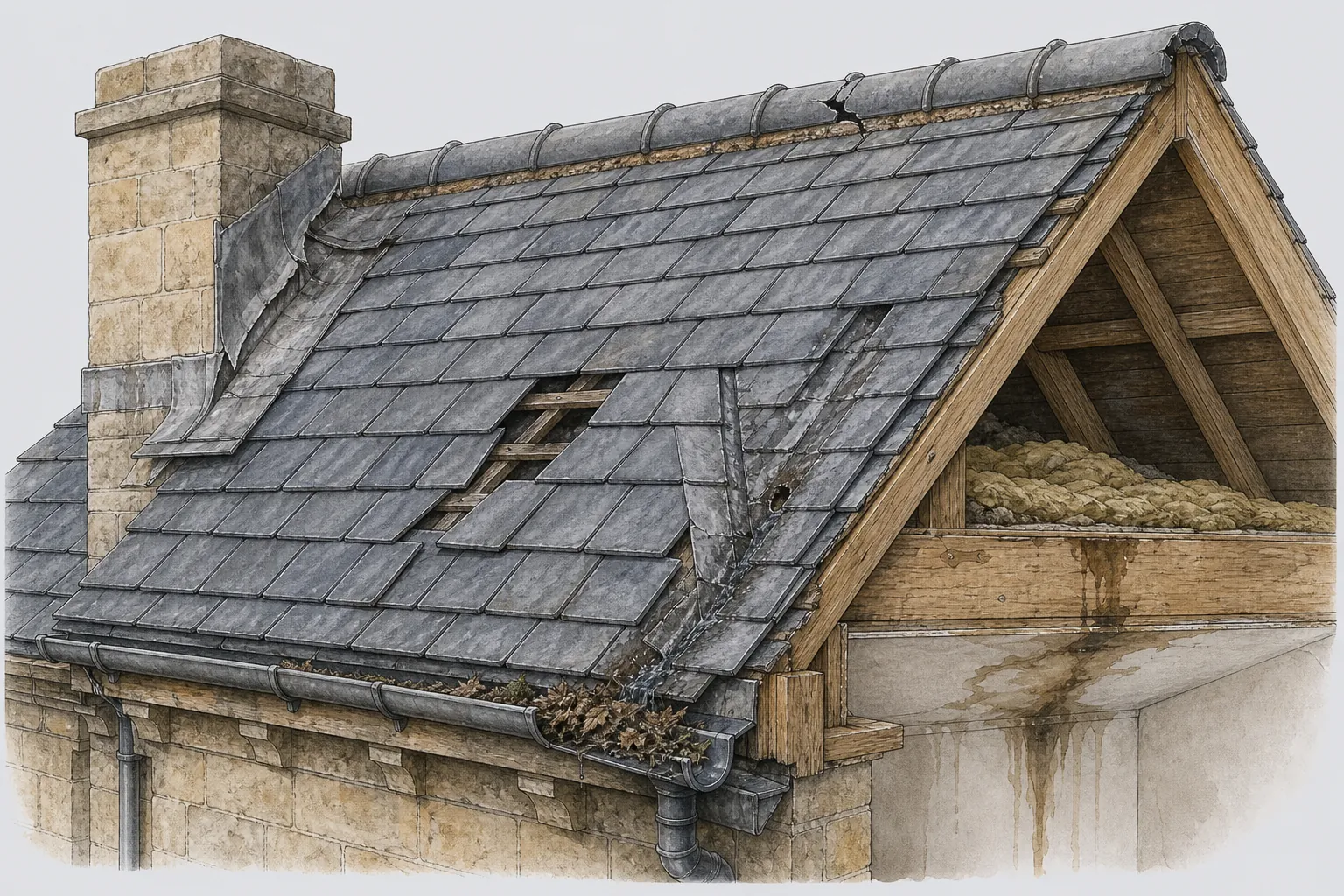
The roof edge is the most likely point of entry. At the eaves, the render ends beneath the gutter, and a gutter that leaks or overflows drips straight down the wall. At a gable, the verge sits over the wall head, and failed pointing lets rain run into the top of the render. Where a roof meets a higher wall, the lead flashing, called an abutment flashing, is tucked into a groove cut into the wall and sealed. If the sealing fails, the water runs behind it.

The signs are easy to miss from the ground. Look for a stain that begins below a gutter joint, a bulge or a hollow sound when you tap the render, a green streak below the verge, and a damp patch on the inside of an upper wall. Each has a cause that can be traced upward to the roof, and it is wiser to find that cause before repairing the render, which will otherwise fail again in the same place.

Our repair begins with the water. We fix the gutter, the verge or the flashing that has been letting it in, and only then comment on the render. Render repairs belong in a mix that suits the wall. Old limestone has to dry out, and a hard coat that will not let water through keeps the moisture in.

Where the fault is a leak at a join or a valley, roof repairs sets out how we make a leak safe first and put it right afterwards.

Myth

A stain on rendered brickwork or stone below the eaves is a cosmetic problem.

Fact

It usually marks a leaking gutter or failed edge detail, and repainting without curing the water only hides the sign.

The green, the almshouses and the clothiers' houses

Twenty-four listed buildings around one green make this the part of Calne where consent matters most.

The triangular green beside St Mary's is ringed by listed buildings. Twenty-four listed buildings survive around it, and five are Grade II*, among them the Tounson almshouses and Georgian clothiers' houses from the century when Calne had a significant woollen broadcloth industry. The church is Grade I, with 12th-century origins and a tower rebuilt in the 17th century.

For a house in this group the roof is inside the listing, and the working principles are simple. Keep what is sound. Mend in the same material. Record what you find. Where a slate or tile has failed, we replace it like for like, and where the whole covering has gone we reuse as much of it as can be saved, supplementing with a match in size and colour. The aim is that someone standing on the green cannot see where the work has been done.

The consent side is Wiltshire Council's responsibility. Officers would sooner be asked than told afterwards, and listed building consent is a different route from planning permission. Whether your repair needs consent is the council's decision. We can describe the job in enough detail for them to give a clear answer.

Almshouses and terraces share roof structures, so a problem in one part may be a problem in the next. Before a repair, we check the party walls where one house's slope meets the next, because a gap there lets water run into the neighbouring house. If the roof is shared, a joint approach with your neighbours is usually cheaper and tidier than two separate repairs.

For stacks, which are the usual feature of a terraced roof, the chimney repairs page explains how they are repointed and, where necessary, rebuilt.

24

Listed buildings round the green by St Mary's

5

Of those listed at Grade II*

1

Grade I structure in Calne, St Mary's Church

Figures: Calne entry, Wikipedia, checked October 2026

Lansdowne Park and the old factory site

Estates of the last twenty years and redeveloped industrial land bring their own kind of roof work.

Lansdowne Park was completed in early 2007 and created a new suburb on the north-west side of Calne. In the centre, the C&T Harris pork factory closed in 1982, and its site was later redeveloped as housing and the public library. Roofs on both are modern, built to standards that did not exist when the green was laid out, and what goes wrong with them is of a different order.

On a roof less than twenty years old, the covering is rarely the problem. The tiles are sound, the battens are sound, and the faults are in the details: a ridge end that was bedded badly, a valley whose lining has creased, a flashing around a rooflight that was never dressed down properly, a cut tile that has cracked with the movement of the house. These faults let water in slowly, and the signs, a faint brown ring on a ceiling or a damp patch in a corner, can take a winter to appear.

It is worth knowing what cover you already have. New homes usually come with some form of builder's cover for early defects, and if a fault falls within it, the first call should be to whoever gave it. We will inspect, photograph the fault and report what we see, and if the cause lies in the original build you will hear that clearly, with photographs for whoever owes the remedy.

Beyond the early years, regular attention keeps small faults small. A check once a year, in autumn after the leaves have fallen, a glance at the ridge from the street, and a clear-out of gutters and downpipes cover most of what needs doing. If a tile has moved, a quick repair stops it from becoming a leak.

The parts of a newer roof most likely to need attention include the eaves, and the gutters, soffits and fascias service deals with them.

Calne stone and what it means for repairs

A town that quarried beside its own roads can still be repaired in kind.

Until the 19th century, quarries beside the London road, north-west and south-east of Calne, supplied stone for the town's buildings. The legacy is visible in the walls, and it matters to anyone repairing a chimney, a parapet or a coping. Stone from one quarry weathers differently from stone from another, and the match in colour and grain is a matter of looking, not of ordering from a catalogue.

Four parts of a roof meet the masonry, and each has its terms. A coping is the stone or tile cap on the top of a wall that sheds water outward. Pointing is the mortar between stones, which should be gentler than the stone so damp can pass out through it. An abutment is where a roof slope butts into a taller wall. Rubble is the rough, irregular stone of the wall itself. Of these, pointing is the repair most often done badly, because hard cement mortar traps water behind it and splits the stone face.

Chimneys are where the issue is clearest. The stack rises clear of the slope and meets weather on all four faces, which is why its mortar joints go first. We examine the pots, the flaunching, the stone and the flashing around the base. A repair uses lime mortar that matches the original in colour and texture, and, where a stone must be replaced, a stone that agrees with its neighbours.

Gutter and fascia work on a stone house needs the same eye. A cast or aluminium gutter fixed to the wall with long brackets leaves holes that must be filled in a mortar the wall can live with. We plan the fixings so that nothing is drilled into a carved or decorative course if there is an alternative.

When a stack is beyond repair, rebuilding is the answer, and in the case of a stone stack this is a job for matching stone and lime. We set out both repair and rebuild on the chimney repairs page.

Words you will hear

Coping
A stone or tile cap on a wall top, shaped to throw rain clear of the face.
Pointing
The mortar packed into the gaps between stones or bricks.
Abutment
Where a roof slope butts into a taller wall.
Rubble
Rough, irregular stone laid in a wall without being cut to square blocks.

Map showing the location of Calne.

Nearby

Roofers near Calne

Roofing services in Calne

Local questions

From the green to Lansdowne Park, Calne asks

My rendered limestone house has a damp patch under the eaves. Is the render or the roof at fault?

Often the roof edge. A leaking gutter, failed pointing at a verge or a cracked abutment lets water behind the render, and the damp appears lower down. We trace the water upward before anyone patches the render, because a repair that ignores the source will crack again in the same place.

Can the Georgian clothiers' houses by St Mary's be re-covered in a different material?

Only with consent, and the council is unlikely to welcome a change of material on a listed roof. The natural course is to reuse the sound covering and supplement it with a match in size and colour. Wiltshire Council decides listed building consent, and we write the proposed material and method down for your application.

Does a newer Lansdowne Park roof still need an annual check?

It is sensible, because faults on young roofs sit at ridge ends, valleys and flashings, and they stay hidden for a winter. A look from the ground and a gutter clear-out each autumn catches most of them. If the fault falls under a builder's cover for early defects, claim there first.

How do I find stone that matches my Calne chimney?

By looking at the stack, not a catalogue. Quarries beside the London road supplied the town's stone until the 19th century, and stone varies from one quarry to the next. We compare colour and grain against samples, and set any new stone in lime mortar so it behaves like its neighbours.

Get your free survey

Get your free roof survey

Tell us what's happening and we'll call you back to arrange a visit. Prefer to talk? Call 01225 285181.

  • Photos of your own roof
  • A fixed price in writing
  • 10-year workmanship guarantee
Call Free survey