
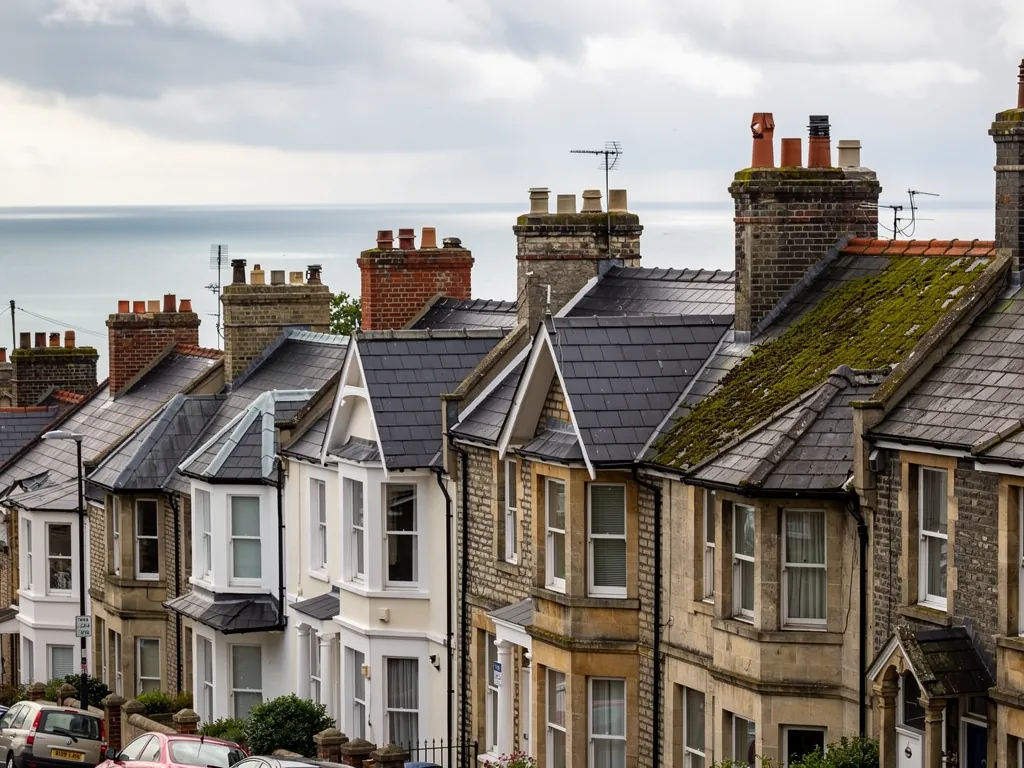

Victorian villas with slate roofs in a North Somerset town near the coast

Roofers in Congresbury

Congresbury lies 24 road miles west of central Bath, on the northwestern slopes of the Mendip Hills with the Congresbury Yeo running through it. Our work here runs from the old village core out to the newer streets, and on every roof we keep to the covering the building already wears.

Local roofs

A river village with a listed centre

Congresbury sits where the Mendip slope runs down to the Yeo, and the village has grown around that meeting of hill and water. Its centre is old. The Anglican Church of St Andrew dates from the 13th century and was altered extensively in the 15th, and it carries a Grade I listing. The Vicarage, which takes in an early 19th-century house and a former Priest's House of around 1446, is also Grade I. Urchinwood Manor, part of it built around 1620, is Grade II* listed, and the 15th-century village cross, 2.5 metres high on an octagonal plinth, is both a Grade II* listed building and a scheduled monument.

A village of this age puts two kinds of job side by side. There are the protected buildings, where every decision about covering, lead and chimney work has to respect what was listed. And there are the ordinary houses and chapels of the Victorian and later village, such as the Methodist chapel on Brinsea Road, built in 1878 to seat 150 people, where the questions are practical: what is on the roof now, what has failed, and what will last.

The setting matters as well. A roof on the lower, river side of the village lives in damper air than one on the slope, and it collects whatever the trees along the water drop into its gutters. A roof higher up takes the weather as it comes off the hill. We look at where the building stands before we look at what is on it, because the two usually explain each other.

The survey costs you nothing. We climb up, photograph your own slopes, and the written price that follows is fixed.

Council
North Somerset Council
From central Bath
24 road miles, west
Parish church
St Andrew, 13th century, Grade I listed
Village cross
15th century, Grade II* and scheduled monument
River
The Congresbury Yeo runs through the village

What we find

Riverside gutters, stack lead and shaded moss

Blocked gutters near the waterLeaves, seeds and moss wash into gutters and hoppers faster where trees line a river. Clearing it is step one. Then we check the falls (the gentle tilt towards the outlet) and the brackets, since a gutter that sits full soaks the fascia and eaves timber behind it.
Worn lead at old stacks and abutmentsWhere a chimney or a wall meets the slope, lead has to be dressed tight and sound. On older houses we find flashings that have lifted, cracked at the folds or been smeared over with sealant, and we cut out the bad length and renew it.
Moss and softened edges on shaded slopesRoofs under trees stay damp, and moss holds that water against the covering. We note where it has lifted tiles or choked a valley, and we say up front whether cleaning will do or the covering underneath has gone.

Roofs around the listed centre

St Andrew's, the Vicarage and Urchinwood Manor set the standard for what a sensible repair looks like here.

The oldest buildings in Congresbury were listed for good reason, and the roof is part of what the listing protects. If your home is one of them, or stands next door to one, the first conversation is not about price. It is about consent. Listed building consent is granted by North Somerset Council for properties here, and it should not be confused with ordinary planning permission. Altering a protected roof without that consent risks prosecution, so ask the council before anything is ordered. We will set the proposed work down in writing so your question has detail behind it.

A repair that keeps the existing slates or tiles, lead and chimney untouched is the simplest to put to a council. A slipped slate or tile is put back or replaced with one that matches in size, colour and thickness. A failed section of lead is cut out and renewed in the same detail. Anything that alters the roof's appearance, say a new covering material or a rebuilt stack, should be agreed before the scaffold arrives. Roof windows have their own rules, set out on our roof windows page.

Older roofs also hide their construction. Timbers on a building of the 1400s or 1600s may be oak, hand cut and uneven, and the covering sits on them in ways a modern roof does not. Before recommending anything we lift a few courses and inspect the battens, the rafters under them, and whatever sits between, if anything does. Sometimes the right answer is a small repair that leaves the old fabric alone.

Not every older house is listed, and not every street is in a conservation area. We would rather you checked with North Somerset Council than took our word, and we will say which parts of the work are likely to raise the question. The day-to-day side of this is laid out under roof repairs.

Living beside the Yeo

Valley damp is slow, quiet and hard on gutters, fascias and the timber under the eaves.

A river does not flood a roof, but it shapes the air around it. In a village where the Congresbury Yeo runs through the middle, many roofs sit in damp, still conditions for much of the year, and the signs show up in predictable places. Moss builds up on the north-facing slopes. Algae darkens the covering. Gutters fill with the debris of the nearby trees and hold water against the eaves.

Gutters take most of our attention in a place like this. A blocked gutter overflows over the back, not the front, so the water slips down the wall or in behind the fascia, the timber fixed along the bottom edge of the roof, and nobody sees it happen. Indoors, the first clue is usually a brown stain high on an outside wall or a damp corner by a window. By that point the fascia and the rafter feet have often been soaked repeatedly. We clear the gutters, check every joint and bracket, and tell you whether the run needs patching or replacing. Where replacement is the answer, we match the material and the profile to the house, so cast iron stays cast iron on an older frontage, and plastic goes in where plastic was.

Moss needs a measured response. Removing a thin layer can help a sound roof dry out, but scraping or pressure washing a tired covering can strip its surface and shorten its life. If tiles are already crumbling or the nibs (the small lugs that hang a tile from its batten) are failing, cleaning is the wrong spend, and we would tell you that. Where the covering is sound, a gentle clean and a clear gutter run is often all a damp site needs.

Valleys take double the water of a plain slope. If a valley lining is split or full of silt, it will leak long before the main covering fails. The whole eaves line, from gutter to soffit, is covered by our gutters, soffits and fascias work.

Myth

Moss on a roof is only cosmetic, so it can be left alone.

Fact

Moss holds water against the covering and can lift tiles and clog gutters and valleys, although scraping a worn roof hard can do more harm than the moss.

Chapel, church and larger-building roofs

Brinsea Road's Methodist chapel is the kind of building where scale changes the job.

Congresbury has buildings that are not ordinary houses. The Methodist chapel on Brinsea Road, built in 1878 to seat 150 people, is one. The parish church is another. Roofs like these have a large span, a steep or long slope, and a lot of junctions: where the nave meets a porch or vestry, where a gable meets a side wall, where a roof drains into a gutter hidden behind a parapet or into a long valley.

Every one of those meeting points is a possible way in for rain. On buildings of this age the usual culprits are the parapet gutter, which runs behind a low wall along the roof edge, and the box gutter, a channel sunk between two slopes or tucked against a wall, both lined in lead. They are out of sight from the ground, they fill with leaves, and they fail at their laps and drips (the steps in the lead that let water fall to the next level). When they do, the first sign is often damp plaster inside, well below the roof.

Access shapes the cost. A building of this height is not repaired from a ladder. Scaffold or a tower may be needed, and sometimes a mobile platform, and that goes into the fixed price we give you in writing after the survey. We will show the scaffold line separately so that you can see what the roof work costs and what the access costs.

Trustees, chapel committees and owners of commercial or community premises get a survey of the whole roof, with the findings written up and illustrated so they can be passed to a committee or a funder. A roof that is actively leaking is made safe first, and the longer programme comes after. Our lead roofing page explains how we detail gutters, flashings and rolls on buildings like these.

Words you will hear

Parapet gutter
The lead channel running behind a wall rising above the roof edge.
Box gutter
A lined trough sitting where two slopes meet or where a slope ends at a wall.
Drip
A raised step across a lead run so that water drops to the lower sheet.
Flashing
Strip metal, usually lead, bent over a joint where roof meets wall or stack.

Hillside exposure and the chimneys that feel it

On the Mendip slope the stack takes the wind first, and the mortar is the first thing to go.

Congresbury lies on the northwestern slopes of the Mendip Hills, and houses that stand higher up take wind and rain with little to stop them. That is a general truth of hillside villages, and it shows up in the same places on every roof: the chimney stack, the ridge and the verge.

Of everything on a house, the stack stands tallest into the wind. Water finds three weak points. First, the flaunching, which is the angled mortar cap that seats the pots, cracks and lets rain run inside. Second, the pointing between the bricks or stones erodes. Third, the lead flashing where stack and slope meet works loose. Together these can let damp into a loft or a bedroom wall with no obvious hole in the roof. We inspect all three, and we match the repair to the stack. Old stone gets a lime mortar that is gentler than the stone itself, so damp escapes through the joint and not the face. A brick stack of a later date is treated as brick.

Next in line are the ridge and the verge, which is where the roof finishes over a gable end. Under BS 5534:2014, the British Standard for slating and tiling, mortar by itself no longer counts as a safe way to hold ridge, hip and verge tiles. We add a mechanical fixing to every one we re-bed or replace. Dry-fix systems, covered by BS 8612:2018, hold those tiles with clips and caps where a mortar bed would crack and drop away. On a roof that has been re-bedded more than once, they are frequently the tidier answer.

If a stack no longer serves a fire, we talk through whether to rebuild, cap or take it down, and what that involves in terms of consent and structure. Our chimney repairs page covers each option.

1446

Date of the Priest's House attached to the Vicarage, Grade I listed

1620

Approximate date of the oldest part of Urchinwood Manor, Grade II* listed

1878

Year the Methodist chapel on Brinsea Road was built, seating 150

Figures: Congresbury entry, Wikipedia, checked October 2026

Map showing the location of Congresbury.

Nearby

Roofers near Congresbury

Roofing services in Congresbury

Local questions

Asked around the cross and beside the Yeo

My house is near St Andrew's church. How do I find out whether the roof is listed or protected?

Put the question to North Somerset Council, and the Historic England list shows whether a given address carries a listing. Living beside a listed building does not list your own house, though it may shape what the council expects of you. We can write the work up, covering, lead and stack included, so that conversation has real detail in it.

Does being next to the Yeo mean my roof needs more maintenance?

It can. Roofs in damp, tree-lined spots collect moss and debris faster, and gutters are the part that suffers. Clearing the gutters and checking valleys, hoppers and fascia boards after leaf fall is a sensible habit. What the roof needs beyond that depends on its covering, and after the survey we say whether cleaning, patching or a full new covering earns its money.

Can you repair the roof of a village hall or chapel like the one on Brinsea Road?

Yes. Larger community buildings need a survey that covers access, the gutters and the junctions between roof levels, and a written report with photographs that a committee can read. Where consent applies we flag it early. The written price after the survey is fixed, and scaffold or platform access appears as its own line so a committee can see what each part buys.

Our Congresbury chimney has a lean and open joints. Is it a repair or a rebuild?

The answer turns on how far things have moved. Open joints on a stack that still stands true usually mean raking out, repointing and a new cap. A visible lean, or stone loose deep in the shaft, leans towards a rebuild, and a listed house needs consent for that first. We look at the stack from inside the loft too, since the back of it tells you more than the face.

Get your free survey

Get your free roof survey

Tell us what's happening and we'll call you back to arrange a visit. Prefer to talk? Call 01225 285181.

  • Photos of your own roof
  • A fixed price in writing
  • 10-year workmanship guarantee
Call Free survey