

A Wiltshire market town street with stone and brick houses and clay tile roofs

Roofers in Market Lavington

Market Lavington lies on the northern edge of Salisbury Plain, 23.7 road miles east of Bath. Its roofs take wind that sheltered Bath streets never see. We mend them with the covering they were built with, from the brick and stone of the Victorian manor to the newer houses laid out beyond the church.

Local roofs

A village under the escarpment

Market Lavington sits at the foot of the chalk, on the northern edge of Salisbury Plain, about five miles south of Devizes. The Wessex Ridgeway runs along the top of the escarpment above the houses, so open high ground overlooks the village on its south side. That position decides a lot about how a roof behaves here. Wind crosses the plain with little to slow it, and the first rows of roofs are where it lands.

The village is not one age. The Old House is a Grade I listed manor of the 14th century, built of roughcast stone with some brick, and Historic England records it as holding the only early medieval double-aisled open hall in Wiltshire. A newer manor house followed in 1865, designed by Ewan Christian in red brick with blue brick patterning and stone dressings; Dauntsey's School has owned it from 1926. St Mary's, the parish church, is late 13th century in origin, and Christian restored it in 1864.

Beyond those, the village has spread outwards. Housing went up to the north-west of the parish church, and the ground was assessed for archaeology first. A single street can therefore hold a listed building beside a house built within living memory, and each asks for a different conversation about materials, consent and fixings.

We work out of Bath, and Market Lavington falls within our radius. The distance is real, so we plan each trip to look at everything at once, then send you photographs and notes on your own roof before you commit to anything.

Council
Wiltshire Council
From central Bath
23.7 road miles, east
Old House
Grade I listed, 14th century, roughcast stone with some brick
St Mary's church
Late 13th century, restored 1864, Grade I listed 1962
Setting
Northern edge of Salisbury Plain, below the Wessex Ridgeway

What we find

Wind off the Plain at edges and ridges

Wind lifting at edges and ridgesGable-end tiles and the ridge line are where a gust gets underneath first. We look for cracked bedding, end tiles that have started to rock and ridge pieces that move under a gloved hand. Where they need refixing, we add a mechanical fixing so the mortar is not doing the job alone.
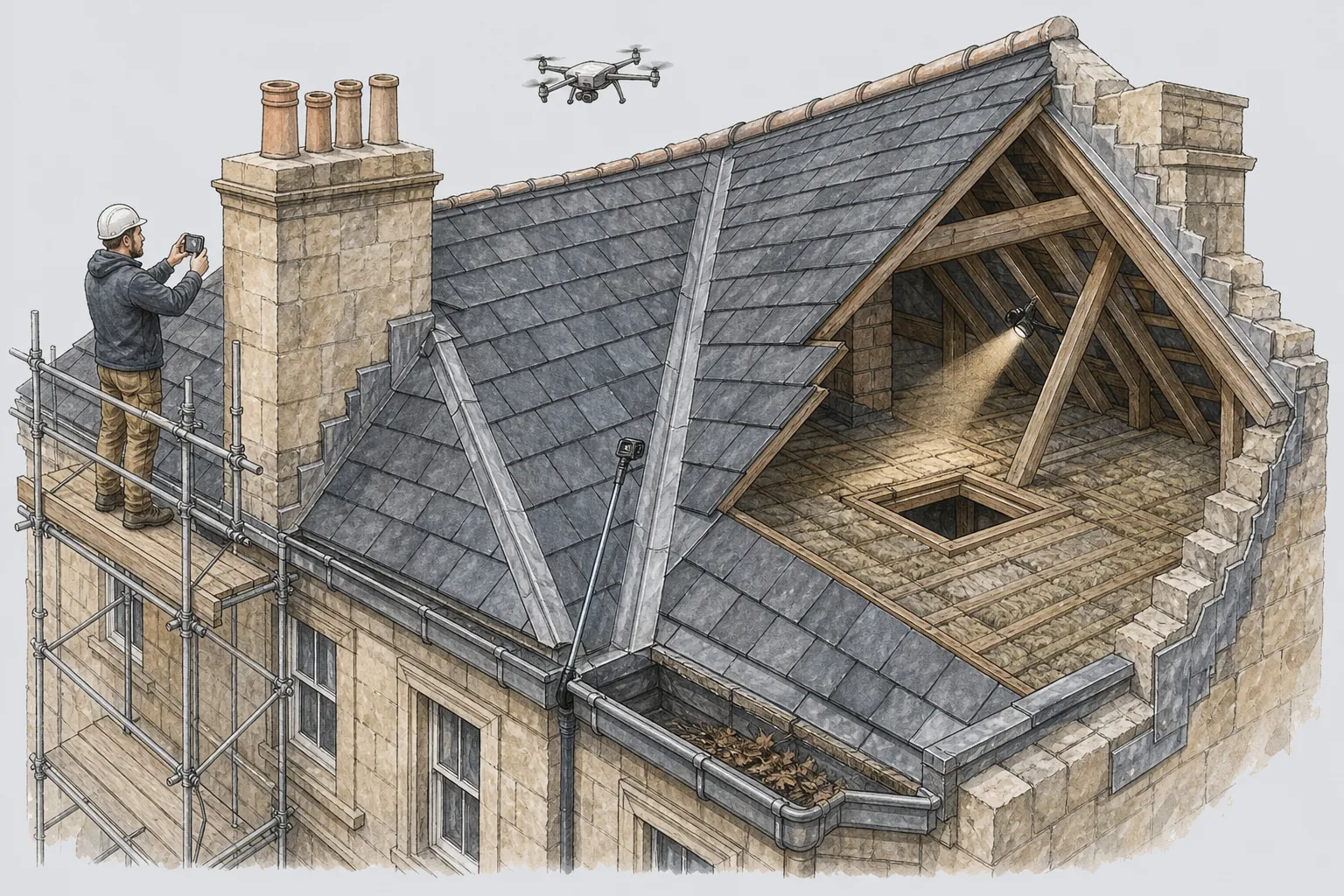
Junctions on brick and stone housesA roof meeting a chimney, a coping or a stone surround depends on lead and pointing to turn water away. We check the lead for lifted edges and the mortar around it for soft joints that let rain behind the flashing (the strip of lead dressed over a joint).
Old timbers under newer coveringsVillage roofs get new coverings over old carpentry that nobody has looked at since. We go into the loft and check rafters, purlins and battens for damp, rot and insect damage before any covering is priced.

Roofing in the wind off Salisbury Plain

With open ground to the south, the fixings rather than the covering decide how long a Lavington roof lasts.

A covering is only as secure as the way it is held down. Market Lavington stands under an escarpment, with open chalk above it, and the wind that comes down that slope does not behave like the wind in a built-up street. It arrives in gusts, lifts at the eaves and edges, and works on anything that has begun to loosen. Tiles themselves are seldom the problem. The nails, clips and mortar holding them are.

Start at the top. Ridge tiles on older roofs sit in a mortar bed, and mortar cracks as the roof flexes through the seasons. Under BS 5534:2014, the standard for slating and tiling, you may not allow ridge, hip and verge pieces to depend on mortar alone, so each should be mechanically fixed as well. Any ridge we re-bed in the village gets that fixing. On a longer run we often suggest dry-fix: ridge pieces held by clips and sealed caps, a method covered by BS 8612:2018, needing no wet bedding.

The verge needs the same care. This is the sloping end of the roof alongside a gable end, with its final tiles pointed in. The pointing falls away over the years, and a gust then finds the end tile. We look at the whole verge from the ladder and again from inside the loft, because a damp stain on the gable wall often tells the story before the tiles do.

Beneath the covering, the underlay is a membrane stretched across the rafters, below the battens (narrow timber laths that carry the tiles). It catches rain driven past the tiles. In an exposed spot it can flap against the battens until it tears, and then the roof looks sound from outside while water reaches the loft.

Our rule is to repair where repair works. A scatter of slipped tiles on an otherwise healthy roof is a small job. Fixings failing across a whole slope make a re-cover, and then we keep the good tiles, renew battens and underlay and refix the lot. How that work is done is set out under pitched roofing, and the ridge and edge work under ridge and verge repairs.

Red brick, blue patterning and stone dressings

A Victorian house built like the 1865 manor has a roof with many junctions, and each one is a place for water to get in.

The manor house Ewan Christian designed in 1865 is a useful picture of a good Victorian house in the village. It is red brick with blue brick patterning and stone dressings. Houses in that manner, large or small, carry plenty of detail at the roofline, and detail means joints.

Take the chimney first. A brick stack is held by its mortar, and the mortar on the weather face wears away. Water then enters the brick, freezes in a cold snap and pushes the surface off. The cure is repointing in a mortar suited to the brick, and where individual bricks have spalled, replacing them with a match. At the top, the flaunching is an angled mortar crown that beds the pots and sheds rain. Once it cracks, water runs down inside the stack. The choices run from repointing to a partial rebuild, and our chimney repairs page covers them.

Stone dressings are the pale surrounds, quoins and copings set into a brick wall. A coping is the cap on top of a gable wall, and under each coping stone sits a joint that should be sealed with lead or fresh mortar. If a coping has shifted, water gets into the wall head, and indoors you may first notice a brown patch up by the ceiling of the party wall.

Valleys are the third place to look. A valley is the sunken channel formed where two slopes meet. On a house with gables and bays it carries a great deal of water. The lead lining can split along a fold, and leaves and moss can fill the channel until the water backs up beneath the tiles. Clearing a valley and relining it where needed is some of the most useful maintenance on a house like this.

The patterned brick and the stone are fixed features of the wall, so beside them we protect the faces and keep hard cement-based repairs off old brick. If the building belongs to a school or other institution, we can price the work in phases that leave the site running.

Words you will hear

Flaunching
The sloping mortar cap on a chimney stack that seats the pots and throws rain clear.
Coping
The stone or tile capping along the top of a gable or parapet wall.
Valley
The sunken gutter-like channel at the meeting of two slopes, lined with lead or special tiles.
Quoin
A dressed corner stone at the angle of a wall, often paler than the brick beside it.

Grade I buildings and what consent means

The Old House and St Mary's church set the tone: in this village, work to an older roof starts with a question to the council.

Market Lavington has two Grade I listed buildings that most residents will know: the Old House and the parish church of St Mary. Grade I is the top tier of listing. Historic England describes the Old House as a 14th-century manor of roughcast stone with some brick, and the church was recorded as Grade I in 1962. Few houses in the village sit at that rank, but those two show how seriously older buildings are treated.

If your own house is listed at any grade, its roof forms part of what is protected. Consent for work comes from Wiltshire Council as the local planning authority, and it is a different permission from planning permission. Doing unconsented work on a listed building can be prosecuted, so the sensible first step is a call to the council's conservation officers before anyone puts up a ladder. We will not pretend to rule on your house, but we can describe the repair precisely enough to make that call short.

Matching what is there draws fewer questions than changing it. Slates or tiles of the same size and pattern, with lead in the same places, is a different proposal from altering the pitch, swapping the material or cutting in a roof window. On an unlisted house, ask the council whether your street lies in a conservation area or under an Article 4 direction, which withdraws some of the usual permitted development rights.

Building Regulations run alongside. A modest re-cover, affecting under a quarter of the envelope of the building and under half the roof, generally sits outside approval. Larger jobs fall inside it, as does any switch to a covering weighing 15% or more extra. Where approval applies, we deal with it through the Wiltshire building control team, or a private registered approver.

For slate and stone roofs on older houses, see our slate roofing page.

1864

Year Ewan Christian restored St Mary's church

1865

Year the new manor house was built in red brick

1962

Year St Mary's was recorded as Grade I listed

Figures: Market Lavington entry, Wikipedia, checked October 2026

Newer streets, longer journeys, planned visits

Houses built beyond the church need less ceremony than the old centre, and a 23.7 mile trip rewards a proper plan.

Away from the old centre the village looks different. Housing went up to the north-west of the parish church, and the roofs there are younger and plainer. They have faults too, but of a different kind: a roof built within living memory tends to fail at its edges and fixings, not in its carpentry.

On a roof of that age we begin with simple questions. Are tiles cracked or slipped? Has the ridge bedding opened? Is the felt under the covering still whole at the eaves, where it has to guide water into the gutter? The gutters deserve a look as well, because one that overflows soaks the fascia and soffit behind it and can rot the timber long before anyone notices. Our gutters, soffits and fascias page shows how those parts fit together.

Since Market Lavington is 23.7 road miles east of Bath, a visit here is never a casual drop-in. Beforehand we agree what you want checked, then inspect from the ground, from a ladder where that is safe, and from the loft, taking photographs as we go so you hold a record. Afterwards comes a written price, fixed, for the work that is needed, with anything that can wait marked as waiting. An active leak is the exception: we put it first and make the roof safe.

Bigger jobs may need scaffolding, and on a village street it matters where the poles stand, whether a neighbour's drive is blocked and how long the access has to stay. We raise those points at the survey, not on the morning the lorry turns up.

At the close of a job we sweep up and carry the waste off. If rain halts a job midway, the roof is made watertight before we go, so a delayed day does not leave the house open to the weather. Work on a school or a shared building can be fitted around its working day.

Repair or re-cover

Sound battens and underlay with a handful of failed tiles mean repair; fixings failing across a whole slope mean re-cover.

Map showing the location of Market Lavington.

Nearby

Roofers near Market Lavington

Roofing services in Market Lavington

Local questions

Wind off the Plain and other Market Lavington queries

Do roofs below the Salisbury Plain escarpment need different fixings from roofs in Bath?

They benefit from extra care. Open high ground overlooks the village, so wind reaches the roofs with little to slow it. We give ridge, hip and verge pieces a mechanical fixing rather than trusting mortar, nail slates and tiles to the correct pattern, and renew torn underlay. That is good practice anywhere, but it counts for more on an exposed slope.

My house is near the church. Will I need listed building consent for a roof repair?

Only if the house is itself listed, or stands within the grounds of a listed building. Standing close to St Mary's does not make a house listed. Check the Historic England list or ask Wiltshire Council. If it is listed, speak to the council before work starts. Like-for-like repair draws fewer questions than a new covering, and we can write the work up so you have something concrete to bring to that call.

Is a Victorian brick roof with stone dressings repairable without rebuilding it?

Yes. We repoint brick stacks in a mortar suited to the brick, replace spalled bricks with a match, and renew lead flashings where a stack or coping meets the roof. Stone copings that have shifted can be reset on a fresh bed. We would look at the valleys and gutters on the same visit, since on a house with gables those often fail first.

You travel from Bath. Does a repair in Market Lavington cost more?

The price follows the work, and we set it out in writing after the survey. The trip of 23.7 road miles shapes how we plan the visit, and for smaller repairs we suggest grouping jobs so one journey covers them. Your written price lists what is included, so the final bill holds no surprises.

Get your free survey

Get your free roof survey

Tell us what's happening and we'll call you back to arrange a visit. Prefer to talk? Call 01225 285181.

  • Photos of your own roof
  • A fixed price in writing
  • 10-year workmanship guarantee
Call Free survey