

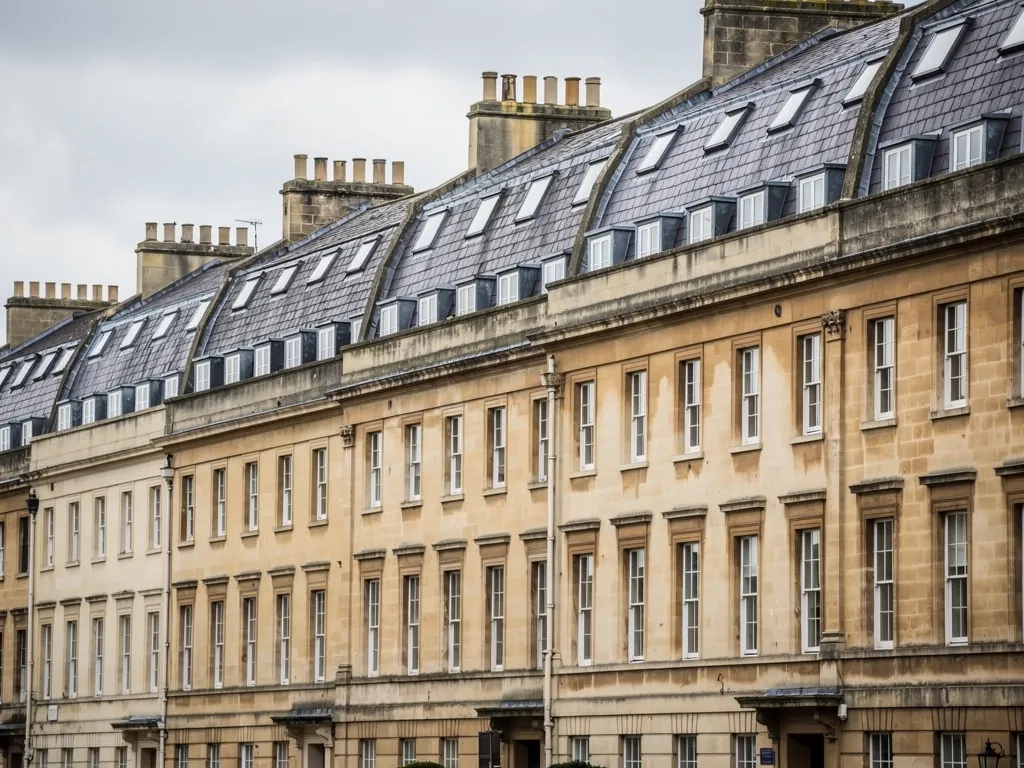
Bristol Victorian terraced houses with slate roofs and bay windows on a hill

Roofers in Winterbourne

Winterbourne is a hill village, 17.1 road miles from central Bath towards the north-west, with the River Frome in the valley below. A twelfth-century church spire, a Grade II* listed tithe barn and the houses around them set the work here: lead, flashings, gutters and the care that old and exposed roofs need.

Local roofs

A hilltop village above the Frome

The modern village of Winterbourne stands on top of a hill, with the River Frome flowing through a valley between it and Frampton Cotterell. That shape is the first thing a roofer notices. A village on a hill has roofs that stand up into the weather and a valley below that collects the water the hill sheds.

The oldest part is by the church. St Michael's Church dates from the 12th century and has a prominent spire visible for miles around. Next to it stands Winterbourne Court Farm Barn, a Grade II* listed 14th-century tithe barn. At that grade the roof forms part of the protected fabric, so a job beyond plain like-for-like repair calls for South Gloucestershire Council's consent first.

The village has the railway and the motorway close by. The Huckford Viaduct carries the Great Western Railway over the River Frome here, and since the 1960s the M4 has bypassed the village to the southwest.

For roofs, the combination matters. An exposed hilltop wants fixings that hold, the historic core wants materials matched and consent considered, and the valley side wants good drainage. We look at all three on every survey, and we tell you which of them your roof raises.

Council
South Gloucestershire Council
From central Bath
17.1 road miles, north-west
Church
St Michael's, 12th century, with a prominent spire
Listed barn
Winterbourne Court Farm Barn, Grade II*, 14th century
Valley
River Frome between Winterbourne and Frampton Cotterell

What we find

Hilltop fixings, old-core lead and hillside drainage

Fixings on exposed hilltop slopesOn a hill the wind reaches the roof from several directions. We check that tiles and slates are held by sound nails or clips, that ridge and hip tiles are mechanically fixed and that verges are not relying on old mortar alone.
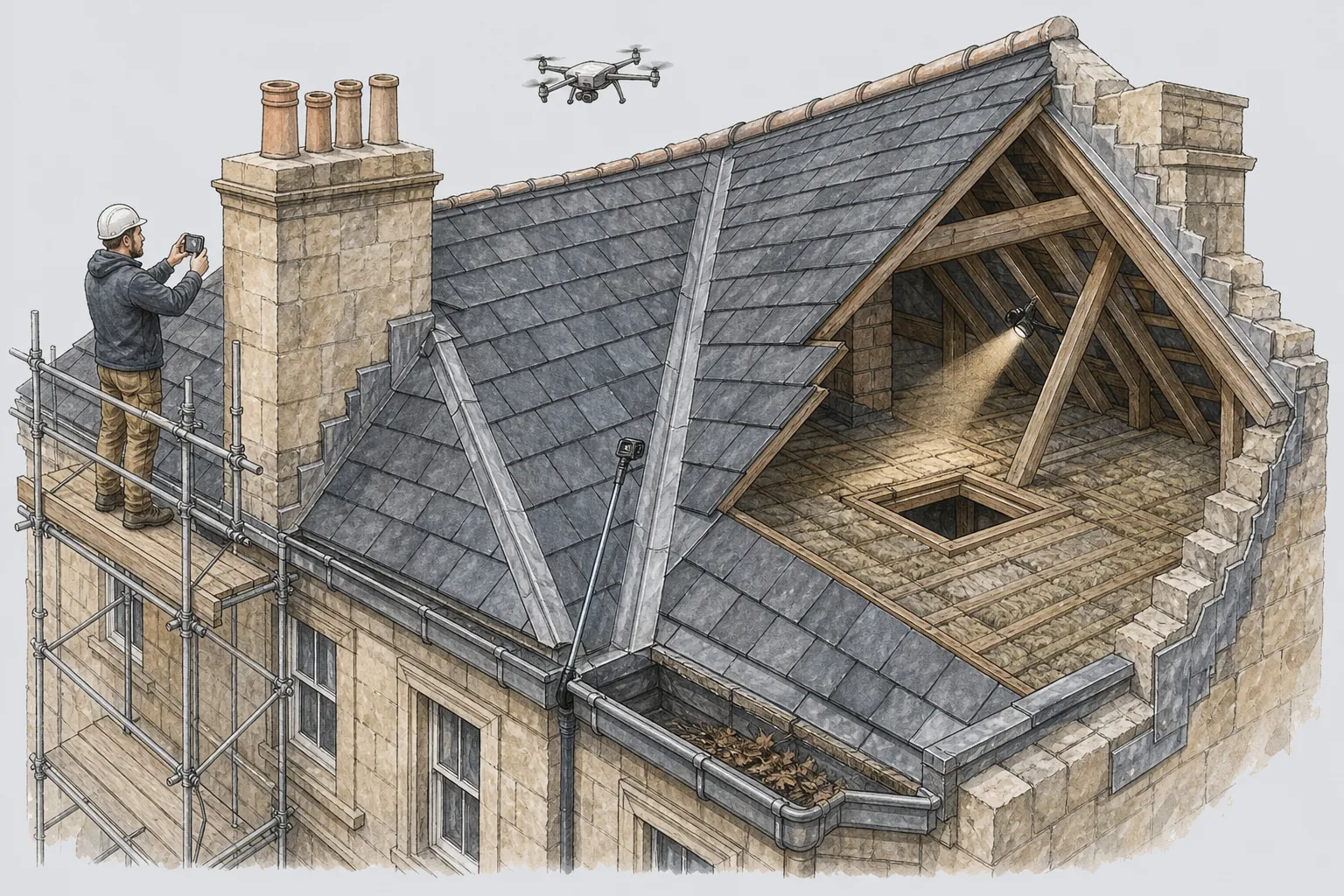
Lead and flashings near the old coreHouses and outbuildings around the church have junctions patched time after time. Our eye goes to the lead flashing, the soakers and the valley linings, which are the places where an old roof gives way first.
Drainage on a hill and the valley belowWater runs quickly off a hillside roof and into gutters that may not have been sized for it. Fall, joints and downpipes come under review, along with the place the water is sent once it leaves the gutter.

A roof on top of a hill

Height and open sky change how a roof ages, and how quickly small faults turn into larger ones.

Winterbourne is built on a hill, and a roof on a hill has fewer neighbours to shelter it. Wind finds the edges of such a roof first: the ridge, the hips, the verge and the lowest course at the eaves. No measured gust figure is available to us for the village, so we describe instead what wind damage looks like on site. Tiles that are loose at the verge, ridge tiles that rock, and gutters that have been pulled from their brackets are all signs of wind getting at the roof.

The code that applies is BS 5534:2014, and under it ridge, hip and verge need mechanical fixings, not mortar by itself. One way to meet that is dry-fix: proprietary caps, seals and clamps that secure the ridge or verge with no bedding, tested under BS 8612:2018. On an exposed roof, we often prefer it to re-bedding on mortar, because it is less likely to crack and lift.

Fixings also fail at a smaller scale. A slate on a rusted nail slides out, and a tile with a snapped nib drops. These are not always spotted from the ground. On the roof we sight along the courses for gaps, and we sort out whether the failures are scattered or are spreading across a slope, since that decides whether to repair or re-cover.

The loft tells the other half of the story. After a windy spell, look at the underside of the roof with a torch. Light coming through where it should not, or damp patches on the sarking (boards or felt laid under the covering), show where the covering has moved. Insulation that is damp or stained indicates water has been coming in for some time.

The first call on a hilltop roof is often a repair, priced sensibly, with the mechanical fixings brought up to standard. For a longer picture of roof repair, see our roof repairs page. A full re-roof is considered only where the survey shows the fixings are failing across the roof.

St Michael's, the tithe barn and the old core

Roofs beside a twelfth-century church and a fourteenth-century barn deserve a slower approach.

Around St Michael's Church, with its prominent spire, the buildings carry a long history. Beside the church, Winterbourne Court Farm Barn is listed Grade II* and dates from the 14th century. A roof in this part of the village may be on a listed building, in a setting that the council cares about, or simply on an older house whose fabric deserves care.

Consent for a listed building runs on a separate track from planning permission, and the decision rests with South Gloucestershire Council. Councils generally advise a word with planning officers before anyone touches a listed building, and unauthorised work can be a criminal offence. Whether consent is needed in law is for the council to say, but a detailed account of the job is what a conservation officer wants, and we write one. The council's own website, southglos.gov.uk, is a good starting point.

On a historic roof, the first principle is to keep what is sound. Old covering that is serviceable stays where it is, and repairs are made to match: same material, same size, same laying pattern. Where new material is needed, we source it to suit, using reclaimed pieces where they exist. A roof with a patchwork of unmatched repairs looks wrong and often leaks at the joins.

Large roofs such as a barn's carry loads that a house roof does not. Long rafters, heavy timber and a big area of covering mean that a small failure in the weatherproofing can allow water into the structure behind it. We look at the timber ends, the wall plates and the places where the roof joins a gable, and record what we find with photographs for the owner and, if needed, the council.

The same sensitivity applies to chimney stacks, which on older buildings should be repaired in lime mortar, not cement. Our lead roofing page describes how lead flashings, gutters and valleys are made and fixed on historic roofs, and it is a good guide to what a careful repair looks like.

Historic roof repairs: what to ask first

QuestionWhy it matters
Is the building listed?Consent from the council is needed for work beyond like-for-like repair.
Is the covering original?Sound original covering is kept and matched, not replaced for convenience.
Is lime used for the stone and stacks?Hard cement can trap moisture and damage soft stone.
Is lead specified for gutters and flashings?Correct detailing keeps water out at the junctions that fail first.

Gutters and water on a hillside

Water running off a hilltop roof has to be taken somewhere sensible.

A roof on a hill sheds water quickly, and that water has to go somewhere. On the valley side of Winterbourne, the River Frome lies below, and the ground between falls away. Gutters, downpipes and the ground they discharge to need to work together, or the wall below the roof pays for it.

The first thing we check is capacity. A gutter has to carry what the roof delivers in a heavy shower, and a short gutter on a long slope can overflow when rain is heavy. If the downpipes are few, or are too small for the roof, water spills across the lip of the gutter and runs down the wall. Adding an outlet or changing the size is a small job against the cost of damp brickwork.

Fall is the second. A gutter should fall gently towards its outlet, and over time brackets sag, joints open and the fall reverses. A gutter that holds water along part of its length is a sign of this. The water then freezes in winter and overloads the brackets, so the fault feeds itself. We re-set the fall and replace brackets where needed.

The third is the boards behind. Fascias and soffits (the board at the roof edge and the underside of the overhang) can rot where a gutter has leaked for years. A painted board may look sound and be soft behind the paint. We probe it and report on how much has to be replaced. Soffit ventilation matters too, since it lets the roof space breathe.

Finally, there is the discharge. A downpipe that empties onto a path beside the wall will saturate the foundation. If the property has soakaways or connects to a surface water drain, those need to be clear. That is beyond the roofer's remit, but we flag it when we see it. For the work on the roof edge, our gutters, soffits and fascias page gives the detail and the national cost ranges.

Gutter or roof

If rain spills over the lip of the gutter in a downpour, fix the outlets and the fall before blaming the roof covering.

Valley-side shade, moss and cleaning

A village between hill and valley collects damp, and a roof that stays damp grows moss.

Winterbourne lies between a hilltop and the river valley, and roofs in a place like that can stay damp longer than those on an open plain. Moss and lichen grow on a covering that stays wet, and they grow most where trees overhang or the roof faces away from the sun. A little is harmless, but it holds water against the covering, and it is a sign that the slope is not drying out.

Moss is not just ugly. On tiles it lifts the edges as it grows, and when it dies or is scraped off, the pieces fall into the gutters and block them. On slate it holds moisture against the surface and can encourage the surface to flake. The wrong kind of cleaning does harm too. The MyBuilder cost guide warns that pressure washing can harm delicate tiles, which is why we reach for gentler methods first.

The usual method is soft washing, which applies a biocide to kill the growth and rinses it with low-pressure water, so the surface is not blasted. National ranges from MyBuilder are about £15 to £20 per square metre for soft wash and £10 to £15 for pressure wash, and the guide's typical totals begin at about £300. These are typical UK figures, not our price. The cost on your roof follows the survey.

Cleaning is not always the right thing. If the tiles are already crumbling, taking the moss off may reveal how far the covering has gone, and the better answer may be a repair or a new covering. We look at the condition first, and say whether a clean is worth it. Often the right order is to repair the faults, then clean, and then leave the roof to dry out.

Overhanging branches are the cause that we can sometimes remove at source. A branch that drips onto a slope or drops leaves into a valley keeps the area wet. Cutting it back may be a job for a tree surgeon and may need permission if the tree is protected, so ask the council before you do. Methods and costs are covered under roof cleaning.

Myth

Pressure washing is the quickest and safest way to clear moss from any roof.

Fact

A strong jet can damage older tiles and strip their surface, so a soft wash with a biocide is the safer first choice.

Map showing the location of Winterbourne.

Nearby

Roofers near Winterbourne

Roofing services in Winterbourne

Local questions

Winterbourne asks, from the spire down to the Frome

My Winterbourne house stands on the hill and its ridge tiles keep loosening. Is dry-fix the answer?

Often it is, because dry-fix holds the ridge with mechanical parts instead of a mortar bed that cracks. It suits many tile profiles, but not every one, and some older roofs look better with a traditional bedded ridge that has proper fixings added. We look at your tile and the roof before recommending either.

Do I need consent to repair the roof of an outbuilding near St Michael's Church?

If the building is listed, or is within the curtilage of a listed building, ask South Gloucestershire Council before starting. A like-for-like repair may raise few questions, but a change of covering often does. We can write down exactly what we would do so the council can answer your question.

Why does my gutter overflow only on one side of the house in heavy rain?

The usual causes are a fall that has slipped, so water pools away from the outlet, or a downpipe that is too far away for the length of the roof. Leaves in the outlet make it worse. We check the fall with a level, clear the outlet and tell you whether a new outlet would help.

Is soft washing safe for old roof tiles near the valley side of the village?

Soft washing is gentler than a pressure jet, and it is the method we choose first for older coverings. We test the surface before starting and stop if the tile or slate is flaking. If the covering is too far gone, we explain why a repair is a better use of money than cleaning.

Get your free survey

Get your free roof survey

Tell us what's happening and we'll call you back to arrange a visit. Prefer to talk? Call 01225 285181.

  • Photos of your own roof
  • A fixed price in writing
  • 10-year workmanship guarantee
Call Free survey