
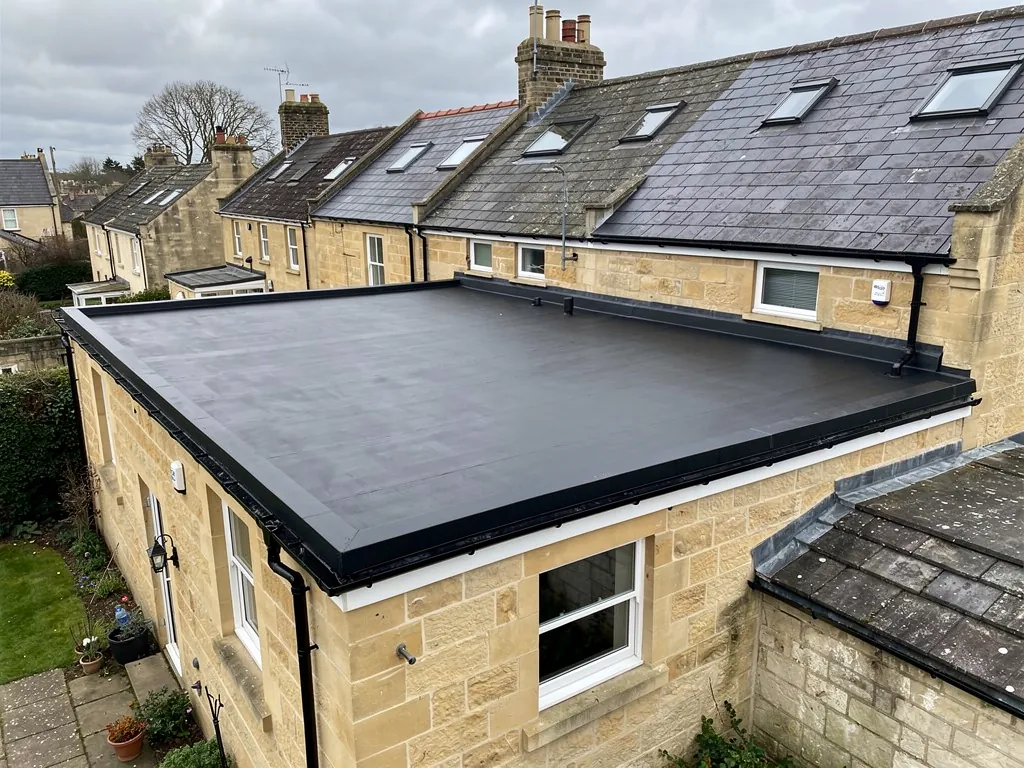
Flat roof prices are usually quoted by the square metre, but the figure on a quote is built from more than the membrane. Beneath the covering sit the boards, the insulation, the slope that sends rain to the outlet and the edge details, and those hidden layers often move a price further than the choice of material does. Below are the typical UK ranges that third-party cost guides publish for new and replacement domestic flat roofs, followed by what pushes a figure up or down on a real house. The ranges are national, so use them to read a quote rather than to predict one. Your own figure comes from a survey of your own roof. We go up, look at the boards and the edges, take photographs, and put a fixed price in writing afterwards with each item named, so two quotes can be laid side by side and compared fairly.
What a flat roof replacement typically costs
Start with the whole-job figure, because it frames everything else. MyBuilder's 2026 flat roof pricing page, revised in August 2026, reports £2,800 up to £7,500 for replacing a domestic flat roof, with an average near £75 per square metre. These are national ranges across many house types. Your fixed quote follows the survey.
| Item | Typical UK range |
|---|---|
| Whole replacement | £2,800 to £7,500 |
| Average across all coverings | About £75 per m² |
| Garage, one car, flat | £700 to £1,000 |
| Garage, two cars, flat | £900 to £1,400 |
The garage rows come from a separate MyBuilder garage roof page (2026). They are a useful check on the low end, because a garage roof has no ceiling below it to protect, usually no insulation and simple edges.
The spread between £2,800 and £7,500 is wide for a reason. A small porch roof and a long rear extension are both called a flat roof, yet the extension has more area, more edge to trim, often a rooflight or two, and an outlet that has to cope with a bigger catchment. Cost does not rise in a straight line with area either. A small roof still needs a skip, a day or more of setting up and a minimum of material, so the rate per square metre looks higher on a small roof and settles as the roof gets larger.
Treat the table as a way of asking better questions. If a quote sits well below the range, find out what has been left out. If it sits well above, ask which layers are being renewed that another roofer would keep.
Cost per square metre by material
The covering is the part of the roof you can see, and it is where the published guides give the clearest numbers. These installed rates come from the same MyBuilder source (2026) and are typical across the UK. The quote you sign is a fixed price written after we have surveyed your roof.
| Covering | Installed, per m² |
|---|---|
| Felt (bitumen) | £70 to £100 |
| EPDM rubber | £90 to £130 |
| GRP fibreglass | £95 to £150 |
| Sheet lead | £150 to £200 plus |
EPDM comes as a rubber membrane in one big piece. GRP, or glass-reinforced plastic, is resin brushed over fibreglass matting that cures hard. Felt is bitumen-coated fabric, laid in layers and sealed by heat or adhesive. Lead is sheet metal worked in bays and rolls.
Felt sits at the lower end because the material is cheap and the method is well known, but a cheap covering on a poor deck is false economy. EPDM costs a little more per square metre and gives a single unbroken sheet across the field of the roof, which suits simple shapes with few penetrations. GRP is priced higher because it is skilled hand work, yet it copes well with awkward shapes, curves and small roofs where cutting a sheet would waste material. Lead is the dearest by some margin and is mostly chosen where appearance or heritage matters more than budget, such as a flat roof seen from a listed building or a parapet gutter.
None of these rates includes the extras that sit beside the covering: scaffold, strip-out, disposal, insulation and repairs to the deck. A low rate for the membrane tells you very little about the total until you know what else is in the price. Our guide to flat roof materials compares how each one behaves in use.
What drives the price up or down
Four things account for most of the difference between one flat roof quote and another.
Area and shape
More area means more material and labour, and a roof with several levels, steps, a dormer cheek or a curved edge takes longer than a clean rectangle. Every change of direction needs an upstand (the short vertical return of the membrane up a wall or kerb), a trim or a flashing, and each is hand work.
The boards and insulation underneath
The biggest unknown on a replacement sits below the old covering. Sound, dry boards can often stay. Soft boards or wet insulation come out and are renewed, and no one can price that honestly without lifting the roof. The same MyBuilder source names the warm-deck upgrade, where insulation is laid above the boards, as one of the main variables. We explain the difference in our guide to warm deck and cold deck roofs.
Edges and details
A flashing seals the junction of roof and wall, made of metal or membrane. Edge trims, outlets, rooflights and pipes all add detail. A roof with a simple drip edge and one outlet costs less to finish than one with a tall abutment, two rooflights and a hidden gutter.
Access and waste
MyBuilder's new roof page (2026) gives scaffold as roughly £1,125 and waste disposal as £100 to £1,000, both typical UK figures. A ground-floor extension may be reached from a ladder platform, while a flat roof above a first-floor room needs full scaffold. A narrow side return, or a roof that has to be reached across a neighbour's land, adds time, because every material is carried by hand.
Why one quote is much lower than another
When two flat roof quotes for the same house differ by a large margin, the roof is rarely the reason. The scope is. A low quote may lay a new membrane straight over the old one, keep the existing boards and insulation, skip the edge trims and leave out disposal. A higher one may strip everything to the joists, fit new boards, lay insulation above them and finish with new trims and outlets. Both can be fair descriptions of different jobs.
Laying new over old is the commonest way a price is trimmed. It can be reasonable when the existing covering is dry underneath and still stuck down, but it traps whatever moisture is already in the build-up, and it adds weight and height at the edges. If the roof has leaked for some time, the layers below are more likely to be wet than dry, and covering them over only hides the problem for a while.
Ask each roofer to put the following in writing so the quotes can be compared on the same footing.
- Which layers are being removed and which are kept.
- What the new boards are, if any are being fitted, and how the slope is set.
- The thickness and type of insulation, and whether it sits above or below the boards.
- The membrane, with its trims, outlets and edge details named.
- Scaffold, skips and clearing the site.
A quote that cannot answer those five points is a price for a covering, not for a roof. Our page on flat roof design shows how the layers fit together, which makes a quote easier to read.
Repair, patch or replace: what each costs
Not every leak needs a new roof. MyBuilder's roof repair page (2026) gives typical UK figures of £100 to £300 for a minor job and £500 to £1,000 for a moderate one, with major repairs starting at about £2,500. These are national ranges across all roof types, so they are a general guide only.
A flat roof repair is worth doing when the damage is local and the build-up beneath is dry. A split at a seam, a lifted upstand, a puncture from a fallen branch or a failed sealant bead around a pipe can all be dealt with without touching the rest. Where the same roof has been patched several times, or water has entered through the covering and soaked the insulation, repeated patching spends money without ending the leak.
Standing water is one of the clearest signs that repair is no longer enough. A shallow dip that holds water after rain means the slope has gone, perhaps because the boards have sagged or were laid dead level, and water that sits on the surface speeds up the ageing of the membrane and any seam. BS 6229:2018 best practice, as Rockwool summarises it, is to design every flat roof surface to a fall of 1:40 so that the finished fall reaches 1:80. We cover the causes on our page about flat roof ponding.
The survey is where the repair-or-replace question is settled. We press the boards by hand, check the edges and outlets, and look at the ceiling below. Where a repair will serve, that is the option we recommend and price. Where the covering has run its course, we tell you so and show the photographs behind that view.
Bath roofs, consent and how a survey sets the price
Planning in Bath sits outside any price table. Listed status is the first question: a listed house, or an extension attached to one, needs listed building consent from B&NES Council before the roof covering is changed, and work done without it breaks the law. Location is the second. The city is a World Heritage Site and roughly half of it lies inside the conservation area, so a new material, or a flat roof you can see from the road, merits an early call to the council's planning team. A like-for-like replacement out of sight is the easy end of the range.
Building Regulations can also affect the bill. On the Planning Portal's figures, re-covering that affects less than 25 per cent of the total building envelope and less than 50 per cent of the roof does not normally need approval. Beyond that, approval applies and an insulation upgrade may follow. Ask about that cost early. Our guide to flat roofs and Building Regulations sets out the rules.
On older terraces and villas, flat roofs often sit behind a parapet or drain into a hidden lead gutter. Those details take longer and need more skill than an open drip edge, so they cost more, and any lead involved is priced at the higher end of the table above.
All of this is why we price from a visit, not a rate card. We inspect the boards, check the slope, photograph the roof and the ceiling below, and write a fixed price with every item named. If the roof needs a full rebuild, the quote says so and shows why. Our written 10-year guarantee covers the workmanship, and our flat roofing service page covers our other flat roof work.