The short answer
The answer turns on which building and which street you mean. Listed buildings in Bath need listed building consent, issued by the planning team at the council, before any rooflight is added or altered. Ordinary houses in the conservation area have more freedom, though some streets carry Article 4 directions that withdraw it. Put the question to B&NES planning first, because unconsented works on a listed home are a criminal matter.
Three different layers in Bath
Bath has several overlapping designations, and people often blur them together. Bath as a whole is a UNESCO World Heritage Site, inscribed in 1987, with a boundary that follows the city limits. That standing colours how planners view the skyline, but it is not itself a permission system.
The city-wide conservation area is smaller. It covers about half of the World Heritage Site, so some parts of Bath sit outside it, and the whole city is not a conservation area. Then there are the listed buildings, around 5000 of them according to Bath Record Office, each protected individually whether or not it is inside the conservation area.
The three layers work differently. The World Heritage Site informs decisions. The conservation area affects the permissions a house may rely on. A listing controls what you can do to that specific building, inside and out. Knowing which layers apply to your address is the first step, and B&NES can tell you.
Listed buildings: always ask first
If your home is listed, a new rooflight is a change to the building's character, and listed building consent is the route. The council's planning team decides it, and it sits apart from ordinary planning permission. Its guidance says to contact the planning team ahead of any works to a listed property, and that unauthorised works are an offence. Its listed buildings page explains the process and gives the conservation team's contact details.
The same applies when you are replacing an existing rooflight with a different type. Changing a cast conservation rooflight for a larger modern unit, or the other way round, alters the roof and the consent history. Expect the council to look at the size, the position on the slope, how far the unit sits proud of the slates and the way the frame is finished.
Do not rely on the fact that a neighbour has a window. Their roof may have been altered before listing, under a different consent, or without consent at all.
Unlisted houses in the conservation area
For an ordinary house that is not listed, a conservation area does not ban rooflights. It does mean rights that apply elsewhere may be restricted, and the details depend on the house and its slope. We do not restate the permitted development rules here, because they are set in detail and change. Our guide to roof window planning covers them, and B&NES planning can confirm what applies to your property.
Some streets in Bath have an Article 4 direction. That is a council order taking away some permitted development rights where an area's character needs protecting, and the World Heritage Site is one such place. The examples B&NES gives are porches, windows, doors, outside decoration and sheds. Roofs do not appear in that list, so you cannot assume an answer either way. A policy map held by the council shows which streets are covered, and consulting it is quick.
Flats and maisonettes follow different rules from houses, and a flat does not share the rights of a single dwelling. If your home is a converted part of a larger building, ask before assuming anything.
What planners tend to look at
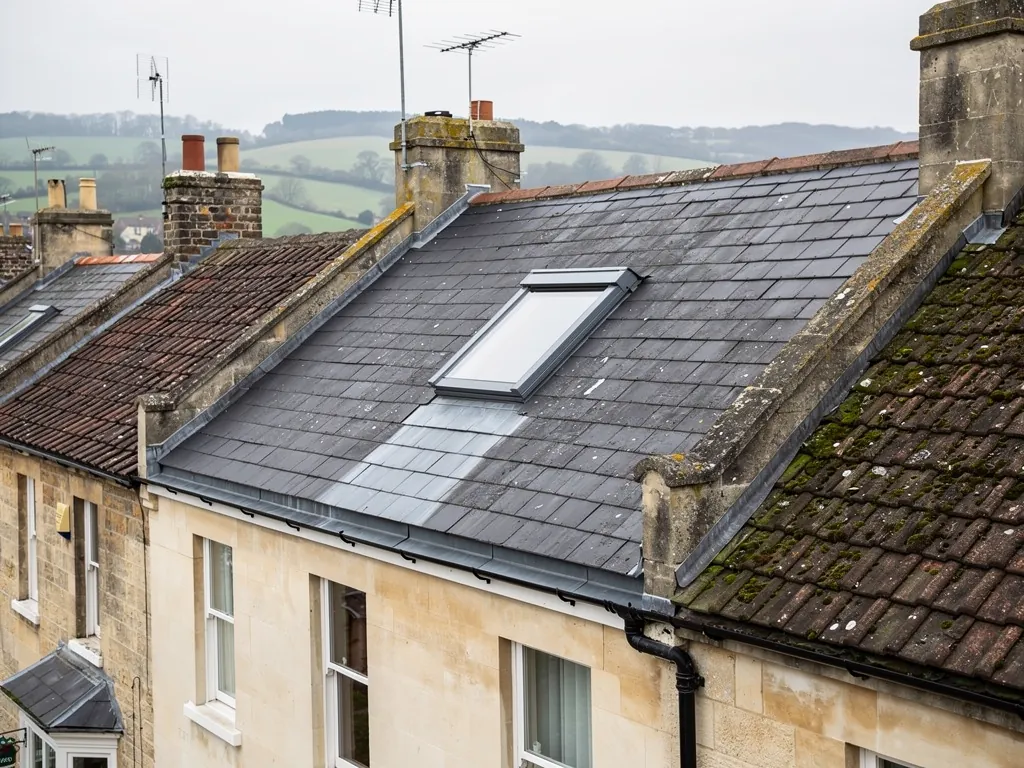
Whatever route applies, the question behind it is the same: does the roof still look like itself when seen from the road and from the surrounding hillsides? Bath's roofs are viewed from long distances, and a rooflight that catches the light can stand out. Planners and heritage bodies pay attention to rooflights on the front slope, rooflights that are large, and rooflights that stand proud of the covering.
The Bath Preservation Trust's published comments on individual buildings give a sense of the thinking. In one case it preferred natural Welsh slate to artificial slate, and in another noted that a terrace's mansard roof and integrated dormers draw the eye more than a pitched roof hidden behind a parapet. Those are casework statements, not policy, but they show that the form and materials of a roof are examined closely.
A flush-fitting conservation rooflight, with a slim frame bedded into the slates, is the type most often discussed in this setting. Our guide to conservation rooflights describes how they are built.
How to find out and what to prepare
Start with three questions. Is the building listed? Is it inside the city-wide conservation area? Does the street have an Article 4 direction? B&NES can answer all three. Describe the proposal without trade jargon, with the position on the roof slope, the size and the type of window, and ask whether consent or permission is needed.
Have your plan clear before the council replies. Photographs of the roof, a sketch of the intended position and the make and model of the window give planners something to react to. If the answer is that an application is required, allow time, because decisions are not instant and you should not order the window before consent arrives.
We survey the roof, photograph what is there and explain which permissions look relevant. We fit the window once the permission question is settled, and where the work is notifiable under the Building Regulations we deal with that application. For the full set of topics, see the roof windows and skylights hub, and for the building rules on escape, thermal limits and glazing, roof window regulations.