

Part 1 of 6
Single-ply membranes: one sheet, many seams
A single-ply roof is only as sound as its joins, its edges and the deck beneath it.
A single-ply roof is a flexible sheet unrolled over insulation on a flat or gently sloping deck and joined to itself at the edges. The sheet is usually PVC, TPO or EPDM. EPDM is a synthetic rubber supplied in wide sheets and normally stuck down or held by ballast. PVC and TPO are plastics whose overlaps are welded with hot air, so the seam becomes part of the sheet rather than a glued strip on top of it. Because the membrane itself is thin, the roof depends far more on what lies beneath it and on how it is finished at every edge than on the sheet alone. Our guide to single-ply roofing covers the systems in more detail.
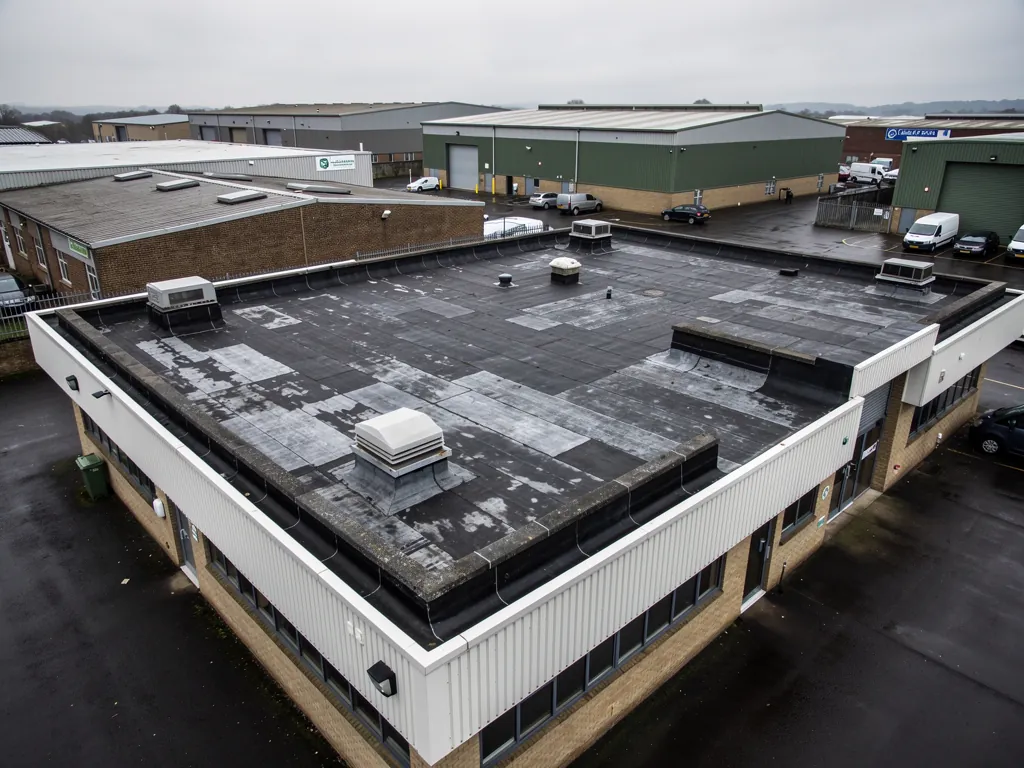
On industrial units and warehouses the first job is reading the deck. A single-ply sheet can be laid over an existing roof only if the old covering is sound, dry and flat enough to carry it. Wet insulation under an old membrane is the usual reason an overlay is ruled out. We find it by looking at where water has been getting in, lifting a small area at a time, and feeling for soft or sodden board. If the insulation is damp, it comes out. Laying a new sheet over wet board only seals the problem in, and the new roof inherits the old one's leak.
Where single-ply fails
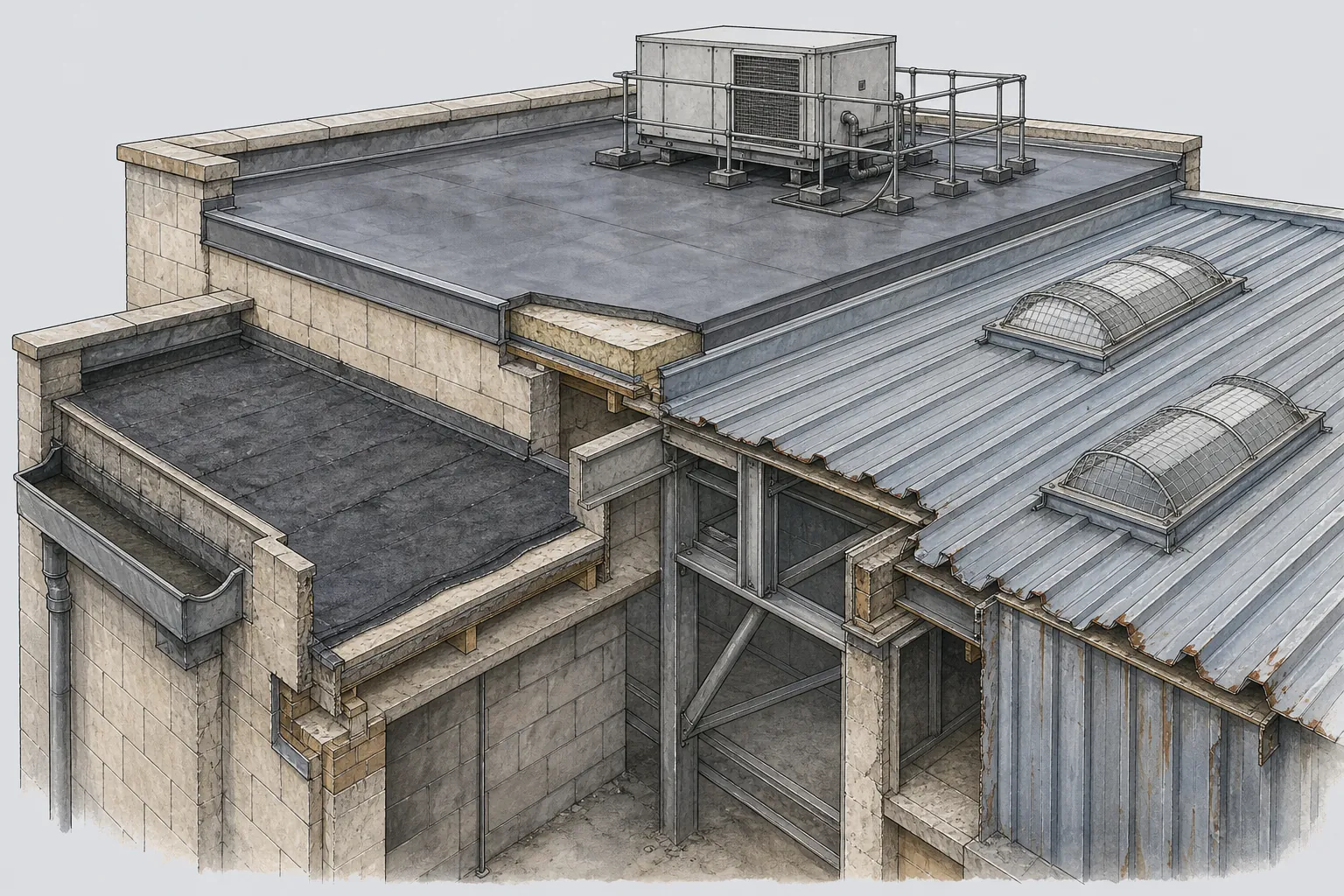
Wear in the middle of a large membrane is rare. Trouble shows up at the details. Upstands at walls and plant bases need the sheet turned up and sealed, with a termination bar or a flashing to stop water getting behind the top edge. Flashing means the metal or membrane that seals the junction at a wall. Pipe penetrations need purpose-made collars, since a sheet cut around a pipe and daubed with sealant will open again as the pipe expands and contracts. Seams that were not properly cleaned before welding or adhesive may show as a thin dark line, and a run of failed seams usually points to a contaminated surface or a rushed day on the original job rather than a sheet at the end of its life.
Foot traffic is the other cause. Roofs that are walked by engineers servicing air handling units or cleaning rooflights pick up scuffs, dropped tools and cut corners at the edge of a path. Where the traffic is regular, a walkway of heavier membrane or paving pads is laid so that boots never touch the thin sheet. It is a small addition that saves a repair later.
Repair, patch or recover
A single failed seam or a punctured area can usually be cut out and patched with matching membrane, welded or adhered to a cleaned surface. Chemical compatibility matters, because a patch of the wrong material will not bond to the sheet around it. Where the membrane is crazed, shrunk away from the upstands or leaking in several places, patching becomes a poor use of money and we tell you directly. The usual choice is then a recover over sound insulation, or a strip back to the deck and a new build-up. Commercial roofs are priced on survey, because the system, the insulation, access and edge details all change the figure.
Many single-ply roofs on older units sit on a flat deck with very little fall. Standing water that remains for days after rain is a sign the deck has dished or the outlets are set too high. Neither is cured by the membrane. The build-up questions are the same ones we deal with on domestic flat roofs, only on a larger scale and with heavier equipment on top.
If you manage several units with the same membrane, tell us. The seams and details on one building often predict what we will find on the next, and a survey of one roof can inform a sensible order of work across the estate. We can also compare the condition of each roof on a single page, so spending is aimed where the need is greatest.