
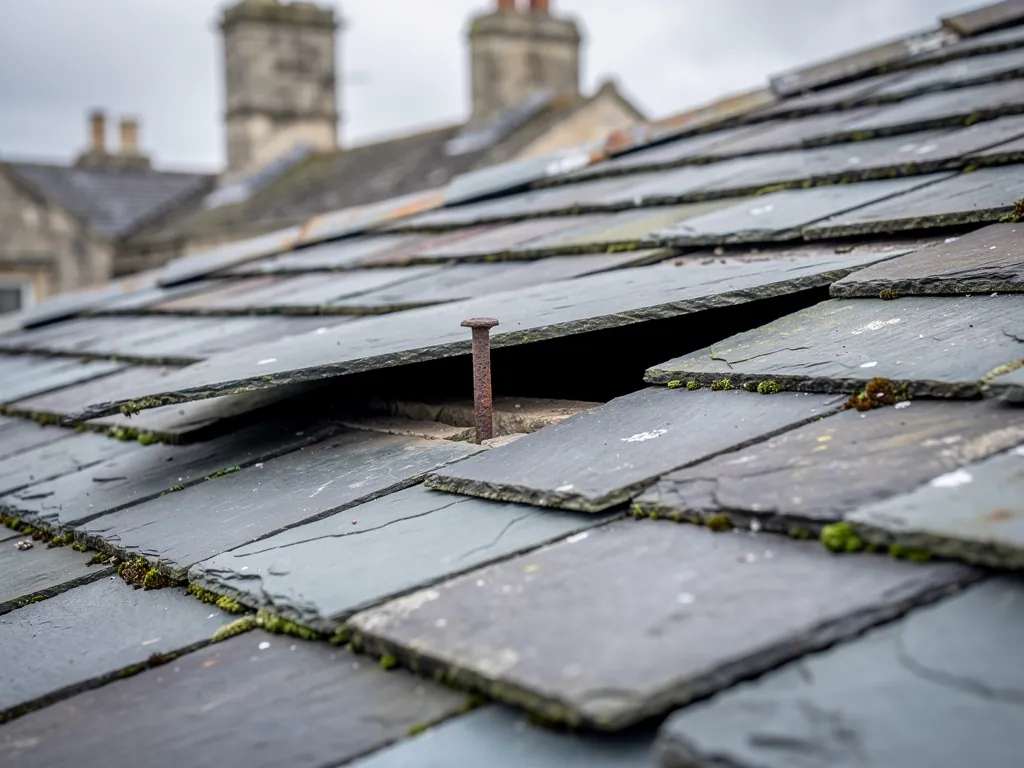
Georgian terrace of honey Bath stone with natural slate roofs and chimney stacks

Roofers in Locksbrook

Locksbrook lies 1.9 road miles west of Bath, on the flat ground beside the Avon. Its roofs are pitched and tiled, its walls are brick or stone, and a modern listed building stands on the riverbank. Along that stretch of riverbank, any repair or re-covering keeps to the same family of tiles, brick and stone.

Local roofs

Flat ground, a lock and a footbridge

Locksbrook sits on the valley floor. The B&NES character appraisal describes the whole stretch on either side of the River Avon as a flat flood plain lying on river alluvium, and the district has the look of low ground: level streets, long views up to the hillsides, and the water never far away. Lock number 6, the highest on the Avon River Navigation, is here, and Twerton footbridge (also known as Fielding's Bridge) crosses from Locksbrook to Twerton, where it replaced an old rope ferry in 1894.

The housing dates from the late 19th and early 20th centuries, with tiny areas of modern infill. The appraisal records that the 19th-century housing in this character area is a mix of brick, Bath stone, or less commonly Lias limestone, under clay or concrete tile roofs that are always pitched. That last point is useful to a roofer. It means the work here is rarely about membranes and more often about tiles, ridges, verges, valleys and the masonry that carries them.

There is one very different building. The former Herman Miller furniture factory, designed by Nicholas Grimshaw and Farrell and Grimshaw and built in 1976, is listed, and Bath Spa University bought it in 2016 for the Bath School of Art and Design.

Whatever your own building is, the approach is the same: a survey with photographs of your roof, a written explanation, and a fixed price in writing.

Council
Bath and North East Somerset Council
From central Bath
1.9 road miles, west
Ground
Flat flood plain on river alluvium
Walls
Brick, Bath stone or, less commonly, Lias limestone
Roofs
Clay or concrete tile, always pitched

What we find

Loose tiles, brick stacks and wet ground at Locksbrook

Tiles that have lost their gripOn a clay or concrete tile roof, the nibs and the nails hold the tiles to the battens. We look for tiles that have slid, chipped edges where frost has worked into the clay, and gaps in the rows that suggest the battens beneath have rotted.
Brick stacks and their jointsRain strikes a brick stack from every side. We inspect the joints, the cap and the lead at the base, since the base is where water so often gets in.
Drainage on flat, wet groundOn a valley floor the water from the roof has nowhere to run. We check gutters, hoppers and downpipes, and where each one discharges, so the roof and the ground are not working against each other.

Clay and concrete tile on the late Victorian rows

The roofs here are pitched and tiled, and a good repair keeps the same kind of tile on the same kind of roof.

Tiles are the covering that defines Locksbrook. Clay plain tiles are small and gently cambered, laid in overlapping courses so each row hides the joints beneath it. Concrete tiles are larger, flatter and heavier. Both types are held on timber battens, hooked by a nib at the top of each tile and fixed by nails at intervals. A roof can last a long time on that arrangement, but it needs the nibs and battens to stay sound.

Slippage is the first fault to look for. Over time, a few tiles drop out of line, the felt or underlay beneath wears, and rain reaches the timber. Clay has its own enemy in frost: moisture that has soaked into a porous tile expands as it freezes and flakes the face away, a process called spalling. Concrete tiles lose the coloured coating that was applied at the factory, and the surface roughens and holds moss.

Matching matters. Clay is not concrete, and a repair that drops a few concrete tiles into a clay roof is visible from the pavement. Where we can, we source clay tiles of the same size, colour and profile, and where a roof has already been patched in mixed materials, we can tidy it so that the replaced section reads as one. If the whole covering needs replacing, we price the options and explain what each involves. Details of how we approach the larger job are on our roof replacement page, and the repair work comes under pitched roofing.

Each survey photographs the roof in sections and records which tiles are failing and why. That tells you whether you are looking at a repair or the start of a re-cover.

Brick, Bath stone and Lias at the roof edge

Where a tiled roof meets a masonry wall, three different materials may be at work at once.

A Locksbrook house can have brick walls, Bath stone dressings or, less commonly, Lias limestone, and each of these behaves differently where it meets the roof. Brick is hard and dense, and it takes mortar well. Bath stone is soft, and it needs lime. Lias is a darker, harder limestone, and its irregular blocks can leave awkward gaps at the eaves and verge.

The chimney stack is where these differences show most. It stands clear of the roof, so every face is exposed to rain, and its top, the cap and flaunching, takes the worst of it. We look at the joints for erosion, at the brickwork for loose or spalled units, and at the flashing round the base. If the stack has been repointed in the past in a hard cement mortar, we look for signs that the bricks or stone are decaying around the joint, which is the pattern of a mortar harder than the masonry it holds.

The verge, the roof's edge against a gable, is the second place to look. Older houses bedded the tiles in mortar, and when that crumbles the end tiles loosen. We re-form the edge and add a mechanical fixing, since the current standard no longer accepts mortar as the sole hold on edge tiles. Our chimney repairs page shows the full range, from a repointed joint to a rebuilt stack.

When the wall is stone, we match the repair to the stone. That means lime mortar and, if stone has to be replaced, a block that suits the wall in colour and hardness.

Myth

Any strong mortar will do for a chimney stack, since the stronger the better.

Fact

A mortar harder than the brick or stone around it pushes the decay into the masonry, which is why joints are filled with a mix matched to the wall.

A listed riverside factory and what listing means

Listing is not only for old buildings, and a modern listed building still needs its owner to talk to the council first.

The former Herman Miller factory shows that heritage in Locksbrook is not only Georgian. Built in 1976 by Nicholas Grimshaw and Farrell and Grimshaw, it is a listed building on the riverbank, and in 2016 Bath Spa University bought it for the Bath School of Art and Design. A building of that date and type is far from a stone villa, yet the principle that applies to it is the one that applies to any listed property: changes that affect its character need consent.

Bath and North East Somerset Council grants consent for a listed building, separately from any planning permission. The council treats works done without it as an offence, and it wants owners to make contact before a start. On a large roof that has a plain consequence: a new covering, a reshaped edge or added rooflights each need describing fully before anything is booked. You can read the council's own guidance on listed buildings.

For an ordinary Locksbrook home the question is smaller. The entire city is a World Heritage Site, yet the conservation area stops short of covering all of it, and certain streets carry Article 4 directions that withdraw particular rights. Like-for-like repair rarely collides with any of that, but a quick look at the council's map is sensible before you alter something visible from the road.

For larger buildings and shared premises, our commercial roofing work is priced after the survey, because access, edges and drainage differ on each roof. We will describe what a job involves in the detail the council expects.

1894

Year the footbridge replaced the rope ferry

1976

Year the Herman Miller factory was built

2016

Year Bath Spa University bought the building

Figures: Locksbrook entry, Wikipedia, checked October 2026

Soft ground, drainage and getting access beside the river

On a flood plain the water from your roof and the ground it lands on are connected.

The appraisal describes the area as the flat flood plain either side of the Avon, lying on alluvium, the soft sediment a river leaves behind. Alluvium holds water and does not carry heavy loads well, so ground conditions affect roofing work in two ways.

Access comes first. A scaffold or a tower is only as steady as the ground under its feet. On soft or wet ground we use spreader boards to share the load, and we check that the base is level before anything goes up. We plan the delivery of materials with the same care, because a pallet of tiles is heavy and a muddy verge is not a road.

Drainage is the other. Rain that runs off a roof has to go into the ground or a drain, and on low, flat land it can sit for some time. A downpipe that discharges next to a wall, or a gully that no longer clears, can leave the foundations in damp soil and push water back up the wall. We check where each pipe ends and whether the gully beneath it takes the flow. Sagging gutters, leaking joints and blocked hoppers are quick to fix, and they relieve the ground as well as the roof. The materials and repairs are set out under guttering, soffits and fascias.

None of this makes Locksbrook a difficult place to roof. It just means the survey looks down as well as up, and the written scope records how the work will be reached.

Words you will hear

Alluvium
Soft sediment laid down by a river, found across the valley floor.
Spalling
The flaking of a tile or brick face after water inside it has frozen.
Nib
The small projection at a tile's head that catches on the batten.
Hopper
The open box at the top of a downpipe that catches water from a gutter.

Map showing the location of Locksbrook.

Nearby

Roofers near Locksbrook

Roofing services in Locksbrook

Local questions

Asked on the flat riverside streets of Locksbrook

My Locksbrook terrace has clay tiles. Can concrete ones be used to repair a few gaps?

They can, but they will show. Concrete tiles are a different size, thickness and colour, and the mismatch is obvious from the pavement. We source clay tiles of a similar size and shade, and if the roof has already been patched in mixed materials, we can tidy it so that the repaired area reads as one.

Does soft river-plain ground make scaffolding harder?

It needs more planning rather than more difficulty. On soft or wet ground we spread the load with boards under the standards and check the base is level. We note any extra measures in the written scope so the price already includes them.

There is a listed building nearby. Does that make my house listed too?

No. Listing applies to individual buildings, and your neighbour's status does not carry over. To check your own address, look on the Historic England list or ask B&NES. If you are in doubt, the council's conservation team can confirm before any roof work is planned.

The brick chimney stack on my house has white powder on it and open joints. What does that mean?

White powder is usually salt that has been drawn out of the brick by moisture, which tells us water is getting into the stack. Open joints let rain in and the cap or flashing may also be at fault. We look at all three, repoint in a mortar matched to the brick and repair the flashing if the lead has lifted.

Get your free survey

Get your free roof survey

Tell us what's happening and we'll call you back to arrange a visit. Prefer to talk? Call 01225 285181.

  • Photos of your own roof
  • A fixed price in writing
  • 10-year workmanship guarantee
Call Free survey