



Pantile and slate on the High Street and village
The old buildings of Twerton were roofed in clay and slate by people who used what was near to hand.
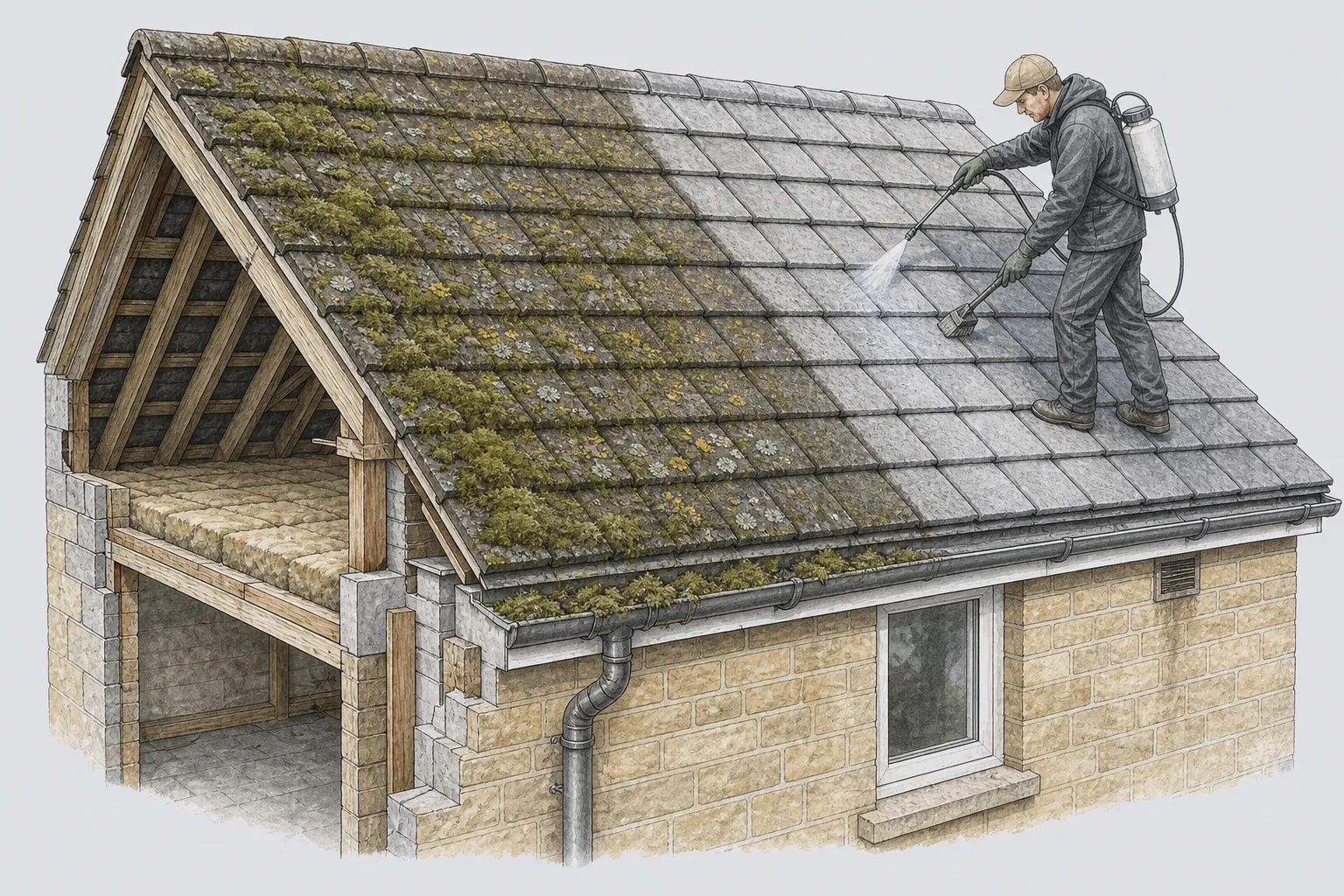
The village buildings are walled in rubble stone, the irregular blocks that come straight from the quarry, and in ashlar, which is the smoother, squared stone used where a wall is meant to be seen. Over them go clay pantiles and slates. A pantile is a single-lap tile with a wave in its profile, shaped like a shallow S, so that each tile locks into its neighbour along one edge and overlaps the course below. It is lighter than a plain tile, and it sheds water quickly.
Pantiles fail in particular ways. They are held to the batten by a lug and, on many roofs, by a nail every few courses, so a roof can lose a tile or two without warning in a gale. The mortar that seals the verge and the ridge ages. And the clay itself can crack at the edges where water has frozen in it. A cracked pantile can often be replaced singly, provided a matching clay tile is found, and the surrounding courses lifted gently to slide it in.
The slate on the older buildings is a separate case. As on the rest of the city's stone houses, the problem is generally the fixing and the timbers, not the stone. Our work on slate roofing explains how we approach a re-lay, and the broader repair is covered under pitched roofing.
Rubble walls need a mention of their own. Water takes the path of least resistance, and in rubble that path runs through the joints and the voids. A failed gutter or flashing can soak a wall for months before the damp shows indoors. Fixing the roof is only the first step: the wall needs time to dry, and any repointing should be in lime so the stone can release its moisture.