
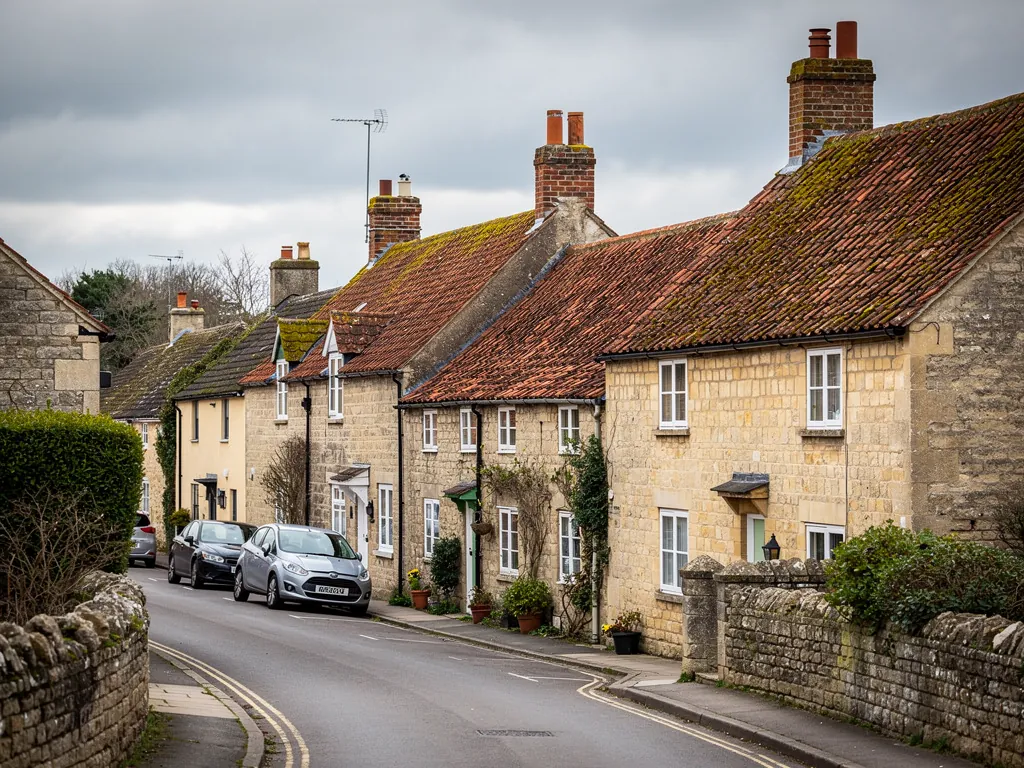
A Somerset village street of stone cottages with clay pantile roofs

Roofers in Bathampton

Bathampton lies 2.5 road miles north-east of central Bath, on the south bank of the Avon with the Kennet and Avon Canal running through it. Stone houses, canal-side cottages and village buildings line the canal side of the village, and when one of them needs mending, re-covering or a regular check, the new work is matched to the covering already on it.

Local roofs

A canal village under a quarried hill

Bathampton sits on the south bank of the River Avon, and the Kennet and Avon Canal passes through the village, so water is part of the setting whichever way you look. Above the houses the ground climbs steeply to a ridge that was heavily quarried for stone, in the area now called Bathampton Rocks. A toll bridge links the village across the river to Batheaston.

The buildings under that hillside belong to several periods. The parish church of St Nicholas has 13th-century origins, a 15th-century tower, a north aisle built in 1858 and a chancel restored in 1882, so a single building here carries roofs of different ages. Higher up stands Sham Castle, the folly Richard James built in 1762 for Ralph Allen, a screen wall with a pointed arch and round turrets. Between them are the houses and cottages that fill the lanes.

Plasticine was made in Bathampton from 1900 to 1983, by a company William Harbutt founded. A village with a working past is likely to have some larger and flatter roofs than a postcard suggests, and we work on those as readily as on a pitched roof of slate or tile.

Whichever kind of roof you have, the first visit follows one pattern. We go up, look at the covering and the parts beneath it, and send you photographs of your own roof with a fixed price in writing.

Council
Bath and North East Somerset Council
From central Bath
2.5 road miles, north-east
Waterways
River Avon and the Kennet and Avon Canal
Folly
Sham Castle, built in 1762
Parish church
St Nicholas, 13th-century origins

What we find

Canal damp and hillside runoff in Bathampton

Moss and damp near the waterA roof close to the river or canal, or under overhanging trees, stays damp longer. We look for moss in the laps of the tiles or slates, for gutters packed with leaf litter, and for the dark staining under the eaves that says water has been spilling over for a while.
Water running off the slopeHouses set into the hillside meet a lot of run-off at the back. We check the gutters and downpipes on that side, the verge (the edge of the roof over a gable wall) and any lead where a roof abuts a rising wall.
Flat sections on older buildingsRear extensions, outbuildings and former works buildings often have flat roofs. We look at the membrane for blistering, ponding and open seams, and at the upstand where the felt or single-ply meets the wall.

Roofs on a hillside that was quarried

Steep ground changes how a roof is reached, scaffolded and drained.

The slope above Bathampton was heavily quarried towards its top, and the ground below it is steep enough to matter before a roofer has lifted a single slate. A house set into that slope can have a rear roof that sits close to the hillside, a front that drops away, and a garden with no flat patch for the base of a scaffold. We look at access first, because it decides how the work is done and what it costs. Scaffold is a named cost driver in the national roofing price guides, and on sloping ground it deserves careful pricing.

The second effect of a hillside is water. Whatever falls on the slope behind a house has to go somewhere, and the roof and its gutters are the first things it meets. A gutter that is slightly out of fall, a downpipe that discharges too close to the wall, or a bed of leaves along the back run can send water into the eaves rather than away from them. We clear and check these before we recommend anything larger, because a cleared gutter costs far less than a rotted fascia board and a stained ceiling.

Underneath the covering, the part that tires first on an older roof is usually the timber at the eaves. The wall plate (the beam bedded on the wall head, which the rafters sit on) and the lowest few rafters take every drip that gets past a failed gutter. When we lift the first courses of tiles or slates at the eaves, we are looking at that timber with a screwdriver and a torch. Sound timber can stay. Soft timber is cut out and spliced, and the covering goes back over it.

The rest follows from what we find. A few slipped tiles on a sound roof call for a repair, and we will tell you that. A roof that has failed across every slope is a replacement, and we will tell you that as well. The choice between the two is set out in our roof repairs guidance, and the full re-covering process, from stripping to waste removal, is on the roof replacement page.

Canal and river damp, moss and gutters

A village built around water gives moss, algae and blocked gutters more to feed on.

Bathampton is a village of canal bank and river bank, with the Kennet and Avon Canal passing through it and the Avon on its edge. We are not going to claim that the water makes every roof worse, because we have no measurements to offer. What any roofer knows is that a roof which dries slowly grows moss and algae, and a roof under trees collects leaves in its valleys and gutters. Both are easy to spot from the ground, and both are cheaper to deal with early.

Moss holds water against the covering. It lifts the edges of tiles, blocks the gap between slates and passes damp into the battens (the thin timbers that carry the covering) below. Cleaning it off is a reasonable first step, but the method matters. A national cost guide notes that pressure washing can damage delicate tiles, and old clay or soft natural slate is exactly that. We use gentler methods on older coverings, and we look at the roof under the moss before deciding whether to clean it, repair it or leave it alone. Our roof cleaning page sets out the options.

Valleys are the other water trap. A valley is the channel where two roof slopes meet, lined with lead or another sheet, and everything the slopes shed runs down it. Leaves sit in the valley, hold moisture and sometimes force water sideways under the covering at its edge. We rake them out and check the lining for splits.

Gutters complete the picture. Cast iron, aluminium and uPVC all suffer when they are left full, and joints open under the weight. A run of gutter with a sagging bracket can overflow at one point every time it rains, and that single point can soak a wall for years. The range of fixes, from re-aligning a run to replacing fascias, is covered on our gutters, soffits and fascias page.

Myth

A pressure wash is the quickest way to get a mossy roof back to new.

Fact

High pressure can strip the face of old tiles and soft slate, so the covering needs inspecting before any cleaning method is chosen.

St Nicholas, Sham Castle and stonework that sheds water

Two very different stone structures show how much of roofing is about the edges and the joints.

Look at Bathampton's best-known buildings and you see the same problem in two forms. The parish church of St Nicholas has a tower from the 15th century, a north aisle from 1858 and a chancel restored in 1882. Each addition meets the older fabric at a junction, and every junction between roofs of different ages is a place where water can find a way in. On a building like that the work is in the valleys, the abutments and the lead flashings (strips of sheet lead dressed into the wall and over the covering to keep water out), not in the broad slopes.

Sham Castle, built in 1762 as a screen wall with a pointed arch and circular turrets, has no roof at all. It is a useful reminder all the same. A freestanding stone wall survives or fails at its top, where the coping stones shed rain away from the joints below. Ordinary houses depend on the same idea. The parapet, the chimney cap and the garden wall coping all do the job that a roof does for the rest of the building, and when the coping lifts or the pointing falls out, the damage goes down the wall rather than through the ceiling.

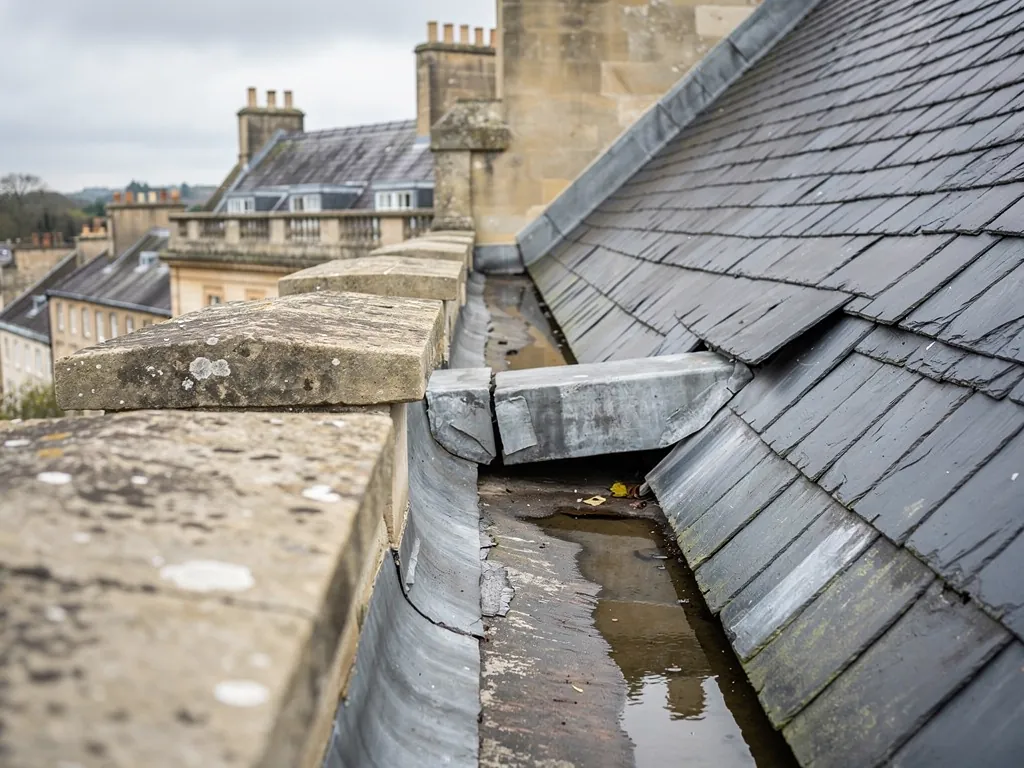
For a house with a parapet, the gutter often sits behind the wall in a lead-lined channel called a parapet gutter. It cannot be seen from the street, which is why it is neglected. A split in the lead, found by lifting the edge of the slates and looking along the channel, can feed water into the wall for years. Our lead roofing page explains the repairs.

If your Bathampton house is listed, or stands within a conservation area, speak to the planning team at Bath and North East Somerset Council before you plan work that changes how the roof looks. The council can tell you whether a street has an Article 4 direction, which removes some permitted development rights, on its policy map. Like-for-like repairs raise fewer questions than a change of material, and we describe the work in detail so that you have something specific to put to the council.

Words you will hear

Coping
The capping stones on top of a wall that shed rain away from its joints.
Parapet gutter
A lined channel behind a parapet wall that carries roof water to a downpipe.
Abutment
The point where a roof slope meets a rising wall, sealed with flashing.
Flashing
Lead or other sheet dressed into a wall and over the covering to keep water out of a junction.

Flat roofs and larger buildings in a working village

Bathampton's industrial past means some roofs here are not pitched.

For most of the twentieth century Bathampton made Plasticine, which the company founded by William Harbutt produced in the village until 1983. We do not know what survives of that works, and we do not need to. The point is that a village with industrial buildings, workshops and later extensions has flat and low-pitched roofs among its pitched ones, and they age differently.

A flat roof is a membrane over a deck, sloped very slightly so that water runs to an outlet. The membrane can be bitumen felt, EPDM (a synthetic rubber sheet), GRP (glass-reinforced plastic, laid as a liquid and cured in place) or lead on the right building. All of them fail at the details first: the upstand where the roof meets a wall, the outlet, the edge trim. A flat roof that ponds water after rain is telling you the deck has deflected, and no coating will cure a bad fall.

The national price guides give typical ranges for each material per square metre, and the spread is wide because the deck and insulation condition decide so much. A warm-deck upgrade, which puts the insulation above the structure rather than below it, is often the right answer when a flat roof is stripped, and it can bring the roof within the thermal rules for a larger job. Where only a small patch is being re-covered, Building Regulations approval is not normally needed below 25% of the building envelope and 50% of the roof, though your building control body has the final say. Your fixed quote follows the survey.

Commercial buildings follow the same logic on a bigger scale, with access, edge protection and drainage added to the list. Our flat roofing page covers the membrane choices in detail, and the commercial roofing page covers larger buildings. For a Bathampton workshop, a garage roof or a rear extension, the survey is the same: we go up, photograph what is there and write down what we would do.

Patch or re-cover

A flat roof with one failed seam and a sound deck can be patched, but a roof that ponds water or has wet insulation needs a new deck detail.

Map showing the location of Bathampton.

Nearby

Roofers near Bathampton

Roofing services in Bathampton

Local questions

Asked beside the canal and river at Bathampton

My Bathampton house backs onto the hill. Does that change how the roof should be repaired?

It changes the access and the drainage more than the repair itself. A steep back garden can limit where scaffold stands, and run-off from the slope puts extra work on the gutters and downpipes at the rear. We look at both before we price anything. If the roof needs more than a repair, the survey tells you why and shows you the photographs.

Is it safe to clean moss off an older tiled roof beside the canal?

It can be, with the right method. High-pressure washing can damage old tiles and soft slate, so we inspect the covering first and usually choose a gentler approach. If the tiles are already failing under the moss, cleaning will not help and the better answer is repair. We tell you which case you are in.

Do you work on the flat roofs of workshops and extensions in the village?

Yes. Flat roofs are part of our work, from a small rear extension to a larger commercial roof. We check the deck, the falls, the edges and the way the membrane meets the walls, and then recommend a material that suits the building. Commercial roofs are priced on survey, so we need to see the roof first.

Can you advise on repairs to a roof beside a listed building in Bathampton?

We can describe exactly what the work involves and how it affects the covering, lead and stone, which helps when you speak to the council. Whether consent is needed for a particular property is a question for the planning team, because the two permissions differ. Work done without the right consent can be a criminal offence, so ask before the work starts.

Get your free survey

Get your free roof survey

Tell us what's happening and we'll call you back to arrange a visit. Prefer to talk? Call 01225 285181.

  • Photos of your own roof
  • A fixed price in writing
  • 10-year workmanship guarantee
Call Free survey