

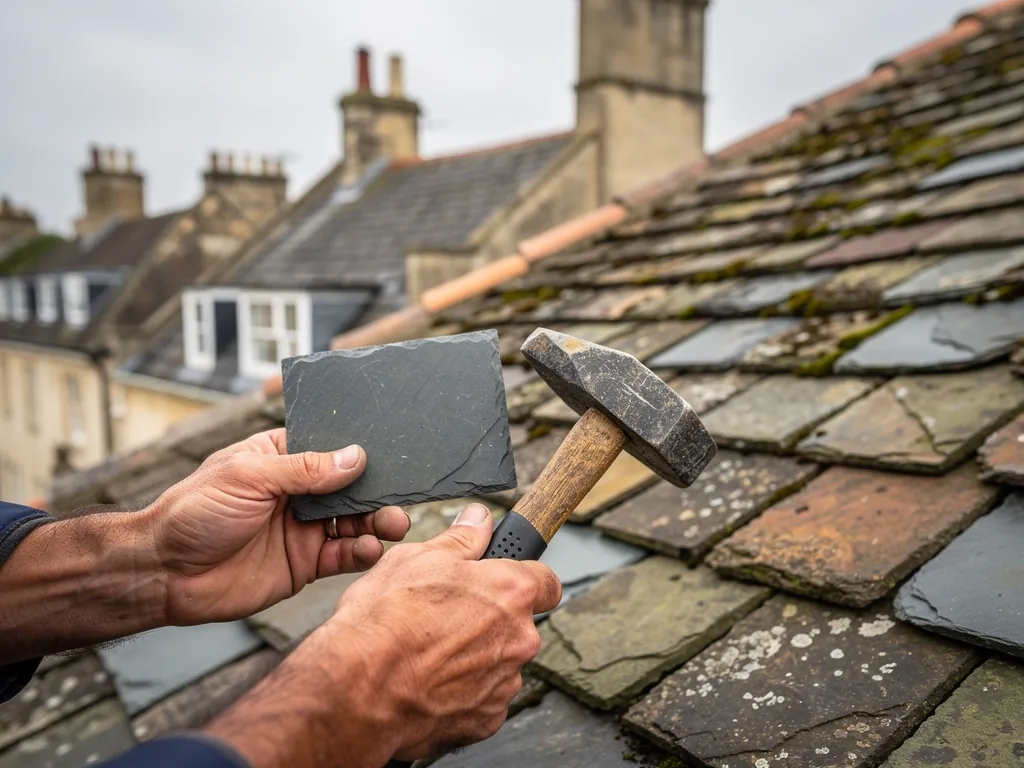
A Mendip village of grey limestone cottages with clay tile roofs

Roofers in Nunney

Nunney sits 18 road miles south of Bath and holds a moated castle from 1373, a Grade I church and more than 30 other listed buildings. We work on its roofs by describing every repair so closely that the planning authority, Somerset Council, can answer it quickly.

Local roofs

A castle, a stream and a village that worked water

Nunney Castle is a small French-style castle surrounded by a deep moat, built for Sir John Delamare in 1373. It gives the village its outline, but the roofs that matter to most owners are the ones around it. The Church of All Saints is Grade I listed and dates from the 12th century. Beyond the church there are more than 30 other listed buildings in the village.

Among them is Rockfield House, built in 1805 by John Pinch, and the George at Nunney Inn, an inn of the mid 18th century with Grade II protection. Inside the inn, the stone walls, exposed beams and large open fireplaces remain. The Grade II* listed market cross was moved from the churchyard in 1869 and rebuilt on its present site in 1959.

Water shaped the village's working life as well. From the medieval period until the 19th century Nunney had water-powered mills, owned first by the Hoddinotts and then by James Fussell. Nunney Brook still runs through the village and feeds the castle moat.

Somerset Council is the planning authority here. With a Grade I church, a Grade II* cross and a village full of listed neighbours, the first thing we ask about a roof job is whether any part of it needs the council's agreement.

Council
Somerset Council
From central Bath
18 road miles, south
Nunney Castle
Built 1373 for Sir John Delamare, with a deep moat
Listed buildings
Church of All Saints (Grade I) and over 30 others
Rockfield House
Built 1805 by John Pinch

What we find

Working stacks, wet ground and converted roofs

Stacks serving open firesHouses with large open fireplaces have wide stacks, and wide stacks collect water. We check the pots, the capping, the pointing and the lead flashing, and from the inside we look for staining around the chimney breast.
Damp from drainage, not just the roofBeside a stream and a moat, wet ground can mimic a leaking roof. Before we blame the covering, we check that gutters empty into proper drains and that nothing is splashing back onto the wall.
Mixed-age roofs on converted buildingsMill and farm buildings that have been converted for housing often have several roof ages under one ridge. We survey each part separately and list which ones are sound.

A Georgian house of 1805 and its roof

Rockfield House, built by John Pinch, is the kind of house that rewards a careful look at the junctions.

Rockfield House was built in 1805 by John Pinch. A Georgian house of that date was designed to look settled and proportionate, and its roof was made to match: a clean outline with discreet drainage. The elegance depends on details that the eye does not catch from the road, such as a hidden gutter behind a parapet or a valley tucked between two ranges.

When we survey a Georgian-period house, we start with the places where water has to turn a corner. A parapet gutter lies behind the front wall and carries the water of a whole slope to an outlet. A valley takes two slopes. A flashing seals each stack. If any one of these fails, the first signs are damp in a ceiling or a stain high on an internal wall, long before a slate slips.

The covering is a separate question. Houses of this age may carry slate, stone tile or clay, and later owners may have swapped one for another. We read the roof as it is, and we recommend repairs in the same material. A different covering changes the look of the house and the weight on the frame, and anything much heavier than the original raises a structural question before it raises a price.

Underneath, the timbers are usually generous. The timbers in a Georgian roof are often generous, and a sound frame can carry a new covering for generations. The usual enemy is slow damp: a failed gutter joint, a missed flashing or a slipped slate that let water reach a wall plate. How we examine each part, the inside face included, is set out on our roof inspections hub, along with what a report covers.

Where the house is listed, its roof is protected too. A repair in matching materials may be straightforward; a new covering, an altered profile or a rebuilt stack is for Somerset Council to agree beforehand. Our job description is written to keep that exchange brief.

Mill buildings, water and large roofs

Water-powered mills worked here from the medieval period to the 19th century, and their buildings carry big roofs.

For centuries, Nunney Brook was a source of power. Water-powered mills stood here from the medieval period until the 19th century, owned first by the Hoddinotts and then by James Fussell. A mill building is made to hold machinery and stock, so its roof tends to be wide and its timbers heavy. When a mill is converted to flats or workspace, that roof stays, though the use below it changes.

Converted buildings bring a particular set of questions. Ownership of the roof comes first. In a block of flats it often sits with a management company or freeholder, and any repair needs a decision all parties can accept. A clear scope helps. We survey the whole roof, list the faults in order of urgency and give a written price that a managing agent can circulate.

The technical issues are those of any large roof. Rainwater from a wide area has to reach the drains, so gutters and outlets are sized generously and kept clear. Where a roof has been altered, the old and the new meet at flashings, and each is a place to look for movement. Insulation added during conversion can hide problems: if the roof space is filled or sealed, moisture may be trapped against the timbers. We check this on any building that has been converted.

Rooflights set into a converted roof need the same scrutiny, since the seals and flashings round them wear faster than the covering. Fitting details, and the standards for replacement units, are on our roof windows hub.

Where a mill building is listed, consent is a separate matter from the repair itself. We do not give legal rulings, but we can say what the job involves, and we suggest you talk to Somerset Council before the first scaffold pole goes up.

Shared roofs

On a converted mill, agree the scope with every owner first, because a roof fixed in sections will fail at the joins.

More than thirty listed neighbours

Where a Grade I church has over 30 listed neighbours, roof repairs go by agreement.

The Church of All Saints dates from the 12th century and is Grade I listed. There are over 30 other listed buildings in the village, including the Grade II* market cross, the inn and Rockfield House. Owning one means the roof is listed with the rest. Living beside one means your house stands in its setting.

In Nunney, Somerset Council grants listed building consent, which you apply for separately from planning permission. The rule of thumb is to contact the council ahead of the work, since works to a listed house that lack consent are an offence. A like-for-like swap, matched for size and fixing, is often minor. A different covering, a fresh opening in the slope or a stack taken down is another matter.

We help in a practical way. The kind of description that works best names the covering, the thickness or size, the number of courses affected, the lead detail and the mortar. It includes photographs of the area. With that, a conservation officer can say yes or no quickly, and you avoid paying for work you then have to alter.

The mortar question matters especially on stone buildings. Lime suits pointing and bedding, since it is gentler and breathes better than the stone around it. Cement holds moisture in and pushes decay into the masonry. A Bath casework example from the Preservation Trust, a listed stack where lime was urged and cement blamed for damage, shows the principle; it holds in any stone village.

Building control runs on a separate track. Whether a particular re-roof is notifiable is for the building control office or a private approver to answer, and where it is notifiable, we arrange that side of the job.

30+

Other listed buildings in Nunney besides the church

1805

Year Rockfield House was built

1959

Year the market cross was rebuilt on its present site

Figures: Nunney entry, Wikipedia, checked October 2026

Open fires, old chimneys and wet ground

The George at Nunney Inn still has large open fireplaces, and a house with big flues has big stacks to look after.

The George at Nunney Inn carries Grade II protection and was built in the mid 18th century. It keeps its stone walls, exposed beams and large open fireplaces. That combination says something about how a building of its age was meant to work: a big hearth, a wide flue and a stack that carried smoke through the roof for generations.

For a roofer, a big old stack is both a feature and a risk. It stands tall above the roof, is exposed on every side and relies on a handful of joints to stay watertight. We look at the cap, the pots, the flaunching and the pointing. We check where lead meets stone, and how the soakers lie beneath it. If the flue is still used, we also recommend a chimney sweep and a flue inspection. If it is not, the pots should be capped to ventilate the flue without letting rain in. Our chimney repairs hub sets out the steps from repointing to rebuilding.

Exposed beams inside a house mean the roof timbers can be seen from the room below. That is helpful, because you can watch for staining, movement or new gaps. If a beam shows a damp patch, tell us where and when it first appeared. Water often travels along a timber before it drips, so the stain may be some distance from the fault.

The ground matters too. Nunney has a stream and the castle moat, and wet ground can raise damp in walls that seems to come from above. A gutter that spills onto the base of a wall, a downpipe that discharges to the ground, or a gully that has silted up can all mimic a roof leak. Before we recommend a repair, we rule these out. Telling roof faults from drainage ones is covered on our roof repairs hub.

Birds nest in old stacks, and bats use old roofs. Both are protected. If we see signs, work waits until we have taken advice.

Words you will hear

Flaunching
The mortar cap, sloped to shed rain, in which the pots are bedded.
Soaker
A thin lead strip woven between courses beside a stack.
Flue
The channel through the stack that takes smoke away from the hearth.
Pot
The clay or metal pipe at the top of the stack that finishes the flue.

Map showing the location of Nunney.

Nearby

Roofers near Nunney

Roofing services in Nunney

Local questions

Open fires, old chimneys and Nunney queries

My Nunney house has a large open fireplace. How do I check the stack above it?

Start from inside: look for staining on the chimney breast, damp patches in the loft around the flue, or crumbling mortar at the base. Outside, we check the cap, the pots, the flaunching and the lead. A stack with a wide flue takes a lot of rain, so a small crack can matter. We explain what is wrong and whether it needs repointing or a partial rebuild.

Rockfield House dates from 1805. Are roofs of that Georgian period difficult to repair?

Not hard, but it needs care. Georgian roofs have discreet drainage, so we check parapet gutters, valleys and flashings first. We repair in the existing material, because a change affects the look and the weight on the frame. If the house is listed, we describe the work for Somerset Council before starting.

I live in a converted older building in Nunney. Who decides when the roof is done?

Usually the freeholder or a managing agent, with owners consulted. We can survey the whole roof, itemise the faults and supply a single written price to circulate. A roof fixed section by section tends to fail at the joins, so we recommend agreeing the scope first.

The wall of my house near the Nunney stream is damp. Is the roof the cause?

Perhaps not. We check gutters, downpipes and gullies first, because a blocked outlet or a splash-back can wet a wall that seems to be under a leak. Then we look at flashings, valleys and the covering. Where the roof is sound, you will hear that, along with a pointer to the drainage.

Get your free survey

Get your free roof survey

Tell us what's happening and we'll call you back to arrange a visit. Prefer to talk? Call 01225 285181.

  • Photos of your own roof
  • A fixed price in writing
  • 10-year workmanship guarantee
Call Free survey